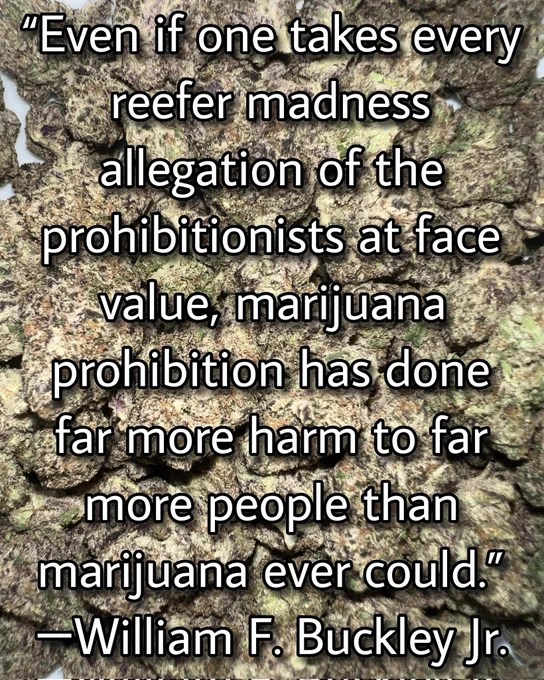
William F. Buckley, jr. on the war on (some) drugs…

A BILL TO legalize psychedelics is on a trip to California Gov. Gavin Newsom’s office.
On Thursday, the California Senate gave final approval to a bill legalizing certain psychedelics for people who are 21 or older. If Newsom signs the bill, it will go into effect in 2025 and make it legal to possess or grow plant-based psychedelics, including psychedelic mushrooms.
Newsom has not said where he stands on the bill, but he has mostly been a critic against the war on drugs, having been a leading voice to legalize cannabis in California and reduce nonviolent offenses like drug crimes to misdemeanors rather than felonies. Last year, however, he vetoed a bill that would have allowed three California cities to operate supervised drug-consumption sites in efforts to combat fatal overdoses.
“We respect the legislative process and don’t typically comment on pending legislation,” a Newsom spokesperson told Marijuana Moment on Thursday. “The governor will evaluate the bill on its merits when it reaches his desk.”
Music fans heading to Mundelein, Illinois, this weekend will make history as part of the state’s first-ever concert to allow open marijuana consumption. Headliners, fittingly, include the cannabis-friendly artists Cypress Hill, Stephen Marley and Action Bronson.
Kicking off Saturday afternoon, the two-day Miracle in Mundelein festival will feature complimentary rolling papers, lighters and grinders, as well as dab bars and rolling stations for use by attendees. Marijuana products themselves will be available for sale through a retailer located next door.
Consuming cannabis will be allowed anywhere inside the 21+ event, while using marijuana outside the perimeter fence is strictly forbidden. Organizers say it’s an opportunity for the cannabis crowd to lead by example.
“Let’s show everyone what a responsible and respectful community we are by adhering to these rules and regulations,” the website for the event says.

An anti-marijuana advocacy group is taking aim at a banking arrangement between Wells Fargo and the state of Maryland that allows officials to receive and process tax revenue generated by state-legal cannabis businesses, calling the scheme “an active effort to protect the banks who are breaking federal law” and making an attempt to alert federal officials about it.
The state, for its part, has said it “complies with applicable laws and regulations.”
Smart Approaches to Marijuana (SAM), which opposes marijuana legalization, made the allegations in a press release late last month following media reports of the banking arrangement, including in Marijuana Moment.
The also group sent an open letter to Maryland officials and Wells Fargo, while CCing several federal officials, requesting that “Wells Fargo cease working with Maryland state officials to circumvent federal laws and regulations.”
“The workaround by the Maryland government reported on in the media is a clear attempt to protect banks from thoughtfully crafted federal regulations,” the prohibitionist group’s letter says.
Among those copied on the letter are Erek L. Barron, the U.S. attorney for Maryland, whose office would oversee any potential federal prosecutions in the state, as well as Attorney General Merrick Garland and Treasury Secretary Janet Yellen.
For half a century, reformers have been urging the Drug Enforcement Administration (DEA) to reclassify marijuana, which since 1970 has been assigned to Schedule I of the Controlled Substances Act, the law’s most restrictive category. Although the DEA has always rejected that proposal, it could change course in light of a recent recommendation from the Department of Health and Human Services (HHS).
Last week, HHS recommended that the DEA move marijuana from Schedule I, which includes illegal drugs such as heroin, LSD, psilocybin, and MDMA, to Schedule III, which includes prescription medications such as anabolic steroids and Tylenol with codeine. Although that reclassification would facilitate medical research and indirectly benefit state-licensed marijuana businesses, it would leave federal prohibition essentially untouched.
Schedule I supposedly is reserved for drugs with “a high potential for abuse” that have no recognized medical applications and are so dangerous that they cannot be used safely even under a doctor’s supervision. Marijuana’s Schedule I status never made much sense, and the justification for that designation has become steadily weaker over the years.
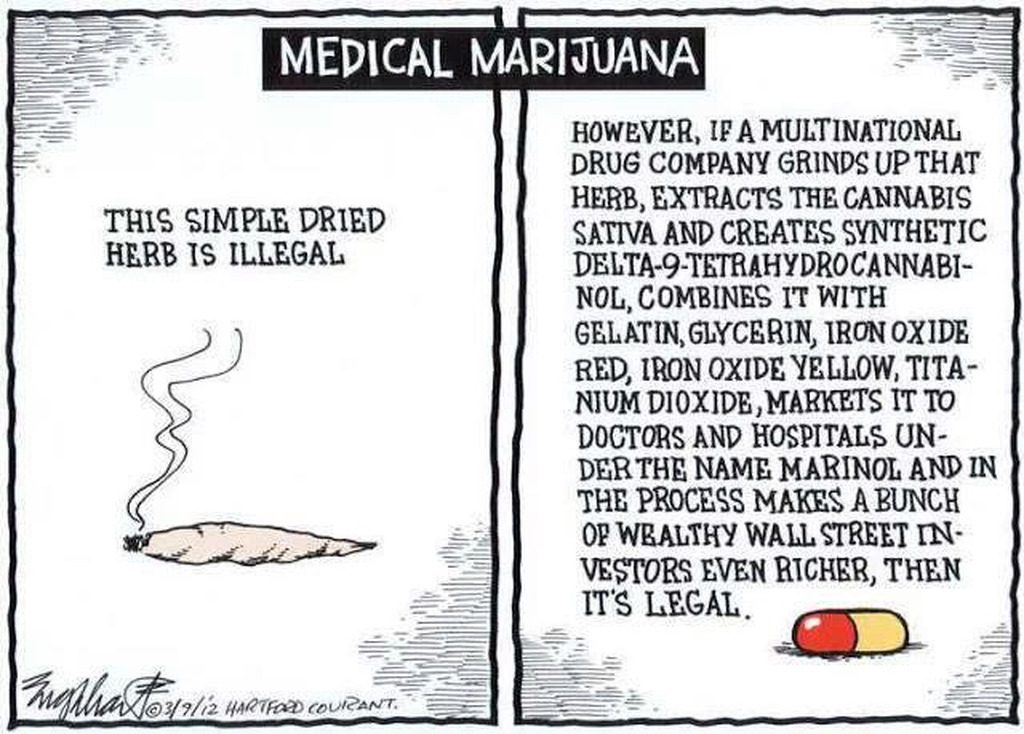
Back in 1985, the Food and Drug Administration (FDA) approved Marinol—a synthetic version of THC, marijuana’s main active ingredient—as a treatment for nausea and vomiting caused by cancer chemotherapy. The FDA later extended that approval to AIDS wasting syndrome, and five years ago it approved Epidiolex, which contains cannabis-derived CBD, as a treatment for two forms of severe, drug-resistant epilepsy.
Research indicates that marijuana is effective at relieving various symptoms, including neuropathic pain and muscle spasms as well as nausea and epileptic seizures. Based on such findings, 38 states allow medical use of cannabis.
A former prison officer has been jailed for three years for having an inappropriate relationship with an inmate.
Joanne Hunter, 28, conducted the relationship with Connor Willis while working at HMP Forest Bank in Salford.
Hunter – described as ‘naive’ and ‘vulnerable’ in court – believed Willis was ‘in love’ with her and agreed to smuggle packages, including cannabis, into the prison for him. She also sent him explicit photographs, which were later found on her phone.
Manchester Crown Court heard how Hunter, who has a master’s degree in Childhood and Youth studies, began working at the prison in December 2018.
In December 2020, prison authorities received information that she was taking items inside and when she was interviewed by security managers she admitted having a relationship with Willis.
Rachel Widdicombe, prosecuting, told the court how Hunter had agreed smuggle packages into the prison for Willis, one containing a juice carton and another coating a Red Bull can.
Hunter received the packages from an unnamed woman after meeting her at a Tesco supermarket, the court heard. She then smuggled them inside the prison before passing them on to another prisoner – whom she knew as a ‘big player’ and member of crime gang – for Willis. Willis offered to pay her £200-300 for each package, but she refused to take the money.
A Republican congressman says he’s concerned that if the federal government doesn’t “go further” than simply moving marijuana to a lower drug schedule—as the top health agency has recommended—large pharmaceutical companies might be able to overtake the cannabis industry.
On Monday, Rep. Matt Gaetz (R-FL) filled in for a Newsmax host and led a segment that featured attorney John Morgan, who spent millions to put a successful medical cannabis initiative on the ballot in Florida. The two discussed recent reporting that the U.S. Health and Human Services (HHS) is advising the Drug Enforcement Administration (DEA) to move marijuana from Schedule I to Schedule III of the Controlled Substances Act (CSA).
Morgan criticized the status quo that currently lists marijuana in the same schedule as drugs like heroin, and he accused the alcohol and pharmaceutical industries of wanting to block research into cannabis because such studies could support the idea of substituting marijuana for the more dangerous drugs that they market.
“Well, I totally concur with the assessment that marijuana reform is often blocked by Big Pharma because they want the opportunity to control it,” Gaetz, who also pressed the DEA administrator on the status of the scheduling review last month, said. “My concern is that if we don’t go any further than moving marijuana from Schedule I to Schedule III, that could potentially allow Big Pharma to control it.”
The congressman also suggested that the Biden administration may have been moved to recommend rescheduling after seeing research showing that legalization is associated with reduced opioid-related hospitalizations and lower rates of child foster case cases due to substance misuse. And he then asked Morgan if he felt the HHS Schedule III recommendation is “sufficient.”
Despite certain concerns about a potential power grab by the pharmaceutical industry if marijuana is rescheduled, Morgan said that it represents “a step in the right direction,” echoing recent remarks made my numerous congressional lawmakers who back marijuana reform. “It has to happen,” he said.
The Department of Health and Human Services (HHS) this week recommended that the Drug Enforcement Administration (DEA) move marijuana from Schedule I of the Controlled Substances Act, the most restrictive category, to Schedule III, where it would join medications such as Tylenol with codeine, buprenorphine, and anabolic steroids. The DEA has the final say on rescheduling decisions, and it is not clear whether it will agree with HHS, especially given its longstanding opposition to reclassifying marijuana, or how long it might take to decide. But if cannabis is eventually moved to Schedule III, that change would signal a new understanding of the drug’s risks and benefits. It also would facilitate cannabis research, and it would have important tax implications for state-licensed marijuana businesses. At the same time, it would leave federal marijuana prohibition essentially untouched.
The HHS recommendation is a product of the regulatory review that President Joe Biden ordered last October, when he also announced a mass pardon for people convicted of simple marijuana possession under federal law. At the time, Biden said “it makes no sense” to “classify marijuana at the same level as heroin,” and HHS evidently agrees. That category, which also includes psychoactive substances such as LSD, psilocybin, peyote, MDMA, and methaqualone, supposedly is reserved for drugs with a “high potential for abuse” that have no recognized medical use and cannot be used safely even under a doctor’s supervision.
Abuse potential is in the eye of the beholder. As the DEA tautologically sees it, any use of a prohibited drug is “abuse” by definition. But the notion that marijuana is so dangerous that it cannot be safely used “under medical supervision” is pretty perplexing, given that its side effects compare favorably to those of many prescription drugs. The idea that marijuana has “no currently accepted medical use in the United States” likewise is hard to reconcile with reality.


You must be logged in to post a comment.