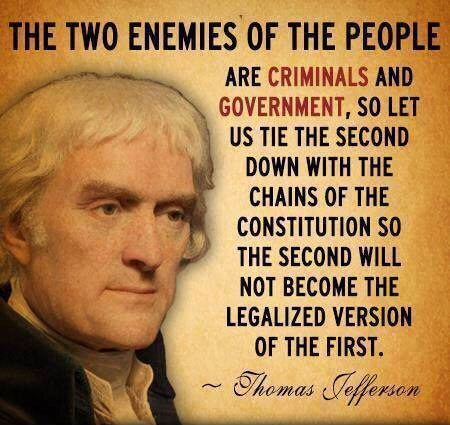
Thomas Jefferson on our enemies…


I hear a lot of bad constitutional arguments justifying this or that federal action. One common justification for expanding federal power is: “This thing is necessary! It needs to be done.”
But it doesn’t follow that the federal government has to do the thing. In fact, the founding generation expected that the states and the people would do most of the “necessary things” – not the federal government.
Tench Coxe was a prominent and influential advocate for ratification of the Constitution and a delegate for Pennsylvania to the Continental Congress in 1788-1789. He later served as Secretary of the Treasury. He wrote three essays published in the Pennsylvania Gazette in early 1788 under the pen-name “A Freeman.”
In these essays, Coxe offered some of the most forceful arguments asserting the limited nature of the federal government under the proposed Constitution. He insisted that many, if not most, of the “necessary” things for society would be taken on by state and local governments, not the federal government.
Last Friday the Michigan Supreme Court ruled that a law Gov. Gretchen Whitmer (D) used to shutter businesses and confine people to their homes except for Whitmer-approved purposes improperly delegated legislative functions to the executive branch. And last month a federal judge in Pennsylvania said that state’s lockdown violated the right of assembly guaranteed by the First Amendment, along with the 14th Amendment’s guarantees of due process and equal protection.
Both decisions uphold a principle that politicians across the country seemed to forget while they rushed to curtail the epidemic last spring. As U.S. District Judge William Stickman put it in the Pennsylvania case, “the Constitution sets certain lines that may not be crossed, even in an emergency.”

The statement is wrong on a number of levels. There is no question the Constitution did not end our deeply shameful history of slavery. However, even with the Declaration of Independence figures like John Adams and Thomas Jefferson sought to address slavery. The decision was made to accommodate slave states to secure the Declaration. The same political calculus was behind the infamous the Three-Fifths Compromise found in Article 1, Section 2, Clause 3 of the United States Constitution.
Thus, the Constitution did indeed perpetuate and protect the institution of slavery with its inherent white supremacy values. However, that was not the “design” of the Constitution. The Three-Fifths Compromise was a fight over representation and taxation. The decision to leave slavery unaddressed was based on the same political expediency. It was wrong. It is no excuse to secure the independence of most citizens at the cost of leaving enslaved others. It was and remains the original sin of our nation. The design of our Constitution should have guaranteed freedom from all men and women.
Yet, the actual design of the Constitution was the Madisonian vision of shared and limited government. It was founded on the philosophical work of figures ranging from John Locke to Montesquieu. The assertion that the design was to perpetuate slavery is revisionist and wrong.

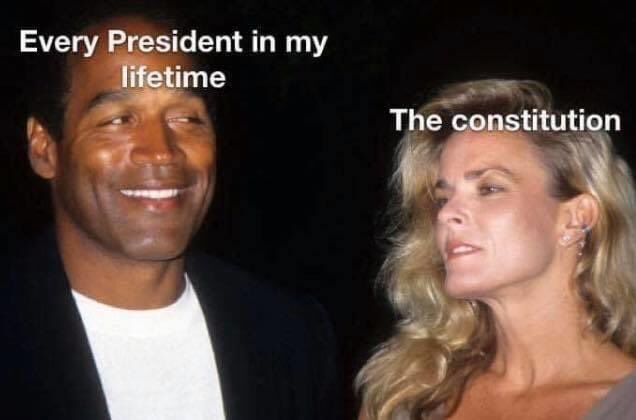
In a move that legal experts say is “patently unconstitutional,” federal authorities in Portland are arresting people for minor offenses and then barring them from attending any future protests as a condition of their release, ProPublica reported Tuesday. According to the report, at least 12 people arrested in connection with the demonstrations were expressly prohibited from being present at any future public demonstrations as they await their days in court.
In one instance, the conditions of release issued by the U.S. District Court in Oregon for a defendant whose offense was “fail[ing] to comply with the lawful direction of federal police officers” stated that “Defendant may not attend any other protests, rallies, assemblies or public gatherings in the state of Oregon.”


You must be logged in to post a comment.