
78-Year-Old Grandmother Awarded $3.8 Million After Illegal SWAT Raid

A 78-year-old woman whose home was mistakenly raided by a Denver SWAT team will now receive a nearly $3.8 million payout. The large sum comes as a result of a 2020 Colorado law that banned qualified immunity protections for police officers in the state, making civil rights lawsuits against police significantly more likely to succeed. 

On January 4th, 2022, Ruby Johnson, a retired postal worker, was sitting in her Denver home when she heard a police airhorn loudly commanding that she leave her home with her hands up. Johnson, who had recently showered and was only wearing a bathrobe, left her house to find a Denver SWAT team gathered outside her door.

The SWAT team had been sent to Johnson’s home as part of an effort to recover a vehicle that had been stolen the previous day. According to Johnson’s lawsuit, the stolen car had an iPhone inside, and the Find My app feature indicated that the phone was near Johnson’s house. 

While the police officers had obtained a warrant to search Johnson’s home, they did so using an affidavit that allegedly provided “false characterization” of how reliable the Find My app is, overstating how sure the police could be that the iPhone—and the truck—would be at Johnson’s house.

According to Johnson’s lawsuit, after receiving this warrant, the SWAT team aggressively searched her home, causing considerable damage to her belongings. Making matters worse, even though Johnson gave police her garage door opener and told them how to enter the garage’s front door, police used a battering ram to enter the garage, destroying the door and door frame. Ultimately, the SWAT team found no sign of the truck or any other criminal activity. The officers left and later told Johnson’s children that the department wouldn’t pay Johnson for the considerable damage caused to her home.

Johnson filed a lawsuit with the American Civil Liberties Union (ACLU) of Colorado in December 2022, alleging that the search was unlawful under the Colorado Constitution.
Keep reading

Congress Wastes Billions With Bogus Emergency Declaration

What constitutes an emergency? According to Congress’ new spending package, research equipment and facilities for the National Science Foundation is an emergency. So are the 2024 Democratic National Committee convention and the Republican National Committee convention. So is NASA space exploration. 

By classifying all these line items as emergencies, Congress can get hundreds of millions of taxpayer funding for them with reduced oversight.

Congress’ latest spending package, released this week, is hardly the first time obviously nonemergency projects have been given this special funding designation. According to a January report from the Cato Institute, Congress has approved over $12 trillion in spending for emergencies over the past three decades, making up around 1 in 10 federal budget dollars spent—more than both Medicaid and veterans programs combined.

How is this possible? Much of it comes down to lax rules that let lawmakers classify regular spending projects as “emergencies.” 

“Congress has complete discretion in designating spending for emergencies because what qualifies as an emergency is subject to interpretation,” Romina Boccia and Dominik Lett wrote in Cato’s report. While the Office of Management and Budget (OMB) has laid out several criteria that emergency spending is supposed to meet, Boccia and Lett note that “the current process lacks a mechanism to evaluate whether an emergency provision meets the OMB’s test, which means that anything can count as emergency spending.”

Once spending gets earmarked as an emergency, it isn’t subjected to typical caps on discretionary spending, allowing Congress to rack up costs with little accountability. “Unfortunately, over the course of the last 30-some years, Congress took what was designed to be a ‘break glass in case of emergency’ escape valve, and they’ve turned it into a major source of funding for federal activity,” David Ditch, a senior policy analyst at The Heritage Foundation, tells Reason.”It’s just a way for [Congress] to avoid fiscal consequences. And that’s part of how we got where we are.”

“Emergencies are, by definition, unexpected and urgent situations requiring immediate action—except in Congress, where the term is increasingly used to justify spending decisions that should be part of the normal budget process,” Eric Boehm pointed out in the April 2024 issue of Reason magazine, “Because emergency spending bypasses some of the scrutiny applied to the normal budgetary process, it has become a convenient way for lawmakers and presidents to hike spending—and add to the national debt.”

Cato’s report highlights some particularly egregious examples of this exact phenomenon, including $600 million earmarked for replacing aircraft used in weather forecasting, $347 million for prison construction and detention costs, and $278 million to speed up the building process for a single research center.

Keep reading

Federal program sends $100 million plus to deceased Americans

Two House lawmakers blasted a federal program this week for sending over $100 million to deceased Americans.

The lawmakers sent the letter to the Pension Benefit Guaranty Corporation Director Gordon Hartogensis after money given to his federal group under the American Rescue Plan Act was misspent.

Education and the Workforce Committee Chairwoman Virginia Foxx, R-N.C., and Health, Employment, Labor, and Pensions Subcommittee Chairman Bob Good, R-VA., led the letter.

According to the lawmakers, $127 million went to the Central States Pension Fund, taxpayer dollars that were paid out for people who are no longer alive.

Now the issue is under investigation, but the lawmakers said that the agency has not explained how the overpayments happened or done enough to recover them.

Keep reading

How the Government Used ‘Track F’ to Fund Censorship Tools

Officials from the National Science Foundation tried to conceal the spending of millions of taxpayer dollars on research and development for artificial intelligence tools used to censor political speech and influence the outcome of elections, according to a new congressional report.

The report looking into the National Science Foundation (NSF) is the latest addition to a growing body of evidence that critics claim shows federal officials—especially at the FBI and the CIA—are creating a “censorship-industrial complex” to monitor American public expression and suppress speech disfavored by the government.

“In the name of combatting alleged misinformation regarding COVID-19 and the 2020 election, NSF has been issuing multimillion-dollar grants to university and nonprofit research teams,” states the report by the House Judiciary Committee and its Select Subcommittee on the Weaponization of the Federal Government.

“The purpose of these taxpayer-funded projects is to develop AI-powered censorship and propaganda tools that can be used by governments and Big Tech to shape public opinion by restricting certain viewpoints or promoting others.”

The report also described, based on previously unknown documents, elaborate efforts by NSF officials to cover up the true purposes of the research.

The efforts included tracking public criticism of the foundation’s work by conservative journalists and legal scholars.

The NSF also developed a media strategy “that considered blacklisting certain American media outlets because they were scrutinizing NSF’s funding of censorship and propaganda tools,” the report said.

Keep reading

Federal Judge Rules That Congress Violated Constitution Passing $1.7 Trillion Spending Bill

In a landmark decision, a federal judge in Texas has ruled that a $1.7 trillion government funding bill was passed unconstitutionally in 2022 because lawmakers voted by proxy rather than in person because of a pandemic-era rule.

U.S. District Judge James Wesley Hendrix, an appointee of former President Donald Trump, issued a memorandum opinion and order on Feb. 27 finding that lawmakers violated the Constitution’s Quorum Clause when, in December 2022, they passed the Consolidated Appropriations Act of 2023, the largest ever spending package in U.S. history.

The Biden administration, which was sued over the matter by Texas Attorney General Ken Paxton, argued that the court didn’t have the power to address the issue “because it cannot look to extrinsic evidence to question whether a bill became law,” per the order.

Judge Hendrix disagreed because, as he said in the order, the court was interpreting and enforcing the U.S. Constitution rather than second-guessing the vote count.

“The Court concludes that, by including members who were indisputably absent in the quorum count, the Act at issue passed in violation of the Constitution’s Quorum Clause,” the judge wrote.

The judge gave the Department of Justice (DOJ), which was representing the Biden administration in the case, a week to file an appeal.

Keep reading

Pennsylvania Police Settle Lawsuit With Woman Forced to Undergo ‘Humiliating’ Strip-Search

Pennsylvania police officers have reached a settlement with a woman who says she underwent an unnecessary and humiliating strip-search after she was pulled over for a minor traffic violation. 

According to a lawsuit filed in 2021, Holly Elish was traveling through Bentlyville, Pennsylvania, on her way home from work when she was pulled over by local police officer Brian Rousseau.

When Rousseau pulled Elish over, he quickly asked for consent to search her vehicle, which Elish denied. According to the lawsuit, Rousseau responded that “he had the right to search her vehicle.” Soon after, a second police officer arrived on the scene. The two men again asked to search Elish’s vehicle, telling her that even more officers would soon arrive.

“Fearing for her safety and knowing that the police did not have justification to search her vehicle yet were insistent and intimidating in attempting to do so, Ms. Elish allowed the vehicle search to occur under duress and coercion,” the complaint states.

The officers searched Elish’s car but found no sign of drugs, illegal weapons, or other contraband. However, that wasn’t enough for the officers to let Elish go. A female police officer—unnamed in the suit—had arrived on the scene, and after having a brief conversation with the other officers began to strip-search Elish.

The officer “began the strip search by physically and visually inspecting Ms. Elish’s breasts,” according to the complaint. Elish then had “to remove her pants and underwear to her ankles and ‘squat’ to the ground, during which she bent down to the ground with one knee and performed a visual cavity inspection.”

Keep reading

Biden To Give $850 Million to a Chinese-Owned Battery Company

Last summer, the Biden administration announced an $850 million conditional loan to a company called KORE Power to build a battery production plant in Arizona. The purpose was to decrease the United States’ reliance on China’s batteries, but KORE Power has enlisted its co-owner, a Chinese battery maker, to help build the taxpayer-funded facility, according to court filings.

The Biden administration touted the project as a way to “strengthen the domestic battery supply chain” and combat China’s grip on the global market. KORE, with its Idaho headquarters and small staff of around 150 employees, seemed to have the perfect all-American background for the job.

But that backstory conflicts with court documents and corporate disclosure filings, obtained by the Washington Free Beacon, which outline the company’s extensive roots in China.

The records reveal that KORE is 14 percent co-owned by Do-Fluoride New Materials (DFD), a Chinese battery manufacturer led by Chinese Communist Party official Li Shijiang. One of KORE’s directors is Li Shijiang’s daughter, Li Lingyun, who also serves as vice chair of DFD and as vice president of China’s state-supervised Patent Protection Association.

The KORE loan is the latest example of how the Biden administration’s green energy funding is benefiting China due to the country’s dominance in the global market. Last year, the Department of Energy was forced to cancel a $200 million grant to the battery maker Microvast, after the Free Beacon reported that the company operated primarily from China.

In a court filing in November, KORE disclosed that DFD New Energy, a China-based subsidiary of Do-Fluoride New Materials, will help it build the Arizona battery plant.

“The facility is under construction at present and DFD New Energy will assist in the buildout,” said KORE’s CEO Lindsay Gorrill.

The Department of Energy confirmed to the Free Beacon that DFD will help KORE build the Arizona facility by providing intellectual property, research and development, and engineering capabilities. The department said it conducted “extensive due diligence” of the arrangement, adding that KORE has been working to reduce its Chinese ownership, with the goal of eventually becoming completely independent of Chinese technology.

“The partnership with DFD provides KORE with access to proven IP and an experienced team—experience that does not currently exist at [that] scale [in] the United States, but through this partnership will be transferred to American workers and to an American company,” said the Department of Energy.

Some links between KORE and DFD have previously been reported. In June, the Department of Energy’s loan director, Jigar Shah, said the Idaho company would rely on “technology from a Chinese company, DFD, to manufacture battery cells in Arizona.” Shah’s comments were reported by the Daily Caller, which also noted DFD’s connections to the Chinese Communist Party.

In October, the inspector general for the Department of Energy told Congress that KORE’s use of technology from DFD “clearly does not support the legislation’s goals of U.S. technology development since this project deploys Chinese intellectual property.”

But the extent of the relationship between the two companies—including DFD’s ownership stake in KORE and its involvement in building the Arizona plant—has not previously been reported.

Keep reading

City of Denver Cut Employee Hours to Zero in Order to Keep Paying for Services for Illegal Border Crossers

The city of Denver has been struggling for weeks now to pay for services for illegal border crossers. Early in February it was announced that the city would start cutting some services for taxpayers, and unsuccessfully tried to blame Republicans.

Now the city is going to start cutting the hours of city employees, in some cases down to zero, in order to keep paying for services for illegals.

This is simply not sustainable and anyone with an ounce of common sense knows it.

Keep reading

Biden wants to put the US on permanent war footing

The White House is steering the United States into a budgetary ditch it may not be able to get out of.

The Biden administration is supersizing the defense industry to meet foreign arms obligations instead of making tradeoffs essential to any effective budget. Its new National Defense Industrial Strategy lays out a plan to “catalyze generational change” of the defense industrial base and to “meet the strategic moment” — one rhetorically dominated by competition with China, but punctuated by U.S. support for Ukraine’s fight against Russia and Israel’s military campaign in Gaza.

Instead of reevaluating its maximalist national security strategy, the Biden administration is doubling down. It is proposing a generation of investment to expand an arms industry that, overall, fails to meet cost, schedule, and performance standards. And if its strategy is any indication, the administration has no vision for how to eventually reduce U.S. military industrial capacity.

When the Cold War ended, the national security budget shrank. Then-Secretary of Defense Les Aspin and deputy William Perry convened industry leaders to encourage their consolidation in a meeting that later became known as the “Last Supper.” Arms makers were to join forces or go out of business. So they ended up downsizing from over 50 prime contractors to just five. And while contractors needed to pare down their industrial capacity, unchecked consolidation created the monopolistic defense sector we have now — one that depends heavily on government contracts and enjoys significant freedom to set prices.

In the decades since, contractors have leveraged their growing economic power to pave inroads on Capitol Hill. They have solidified their economic influence to stave off the political potential for future national security cuts, regardless of their performance or the geopolitical environment.

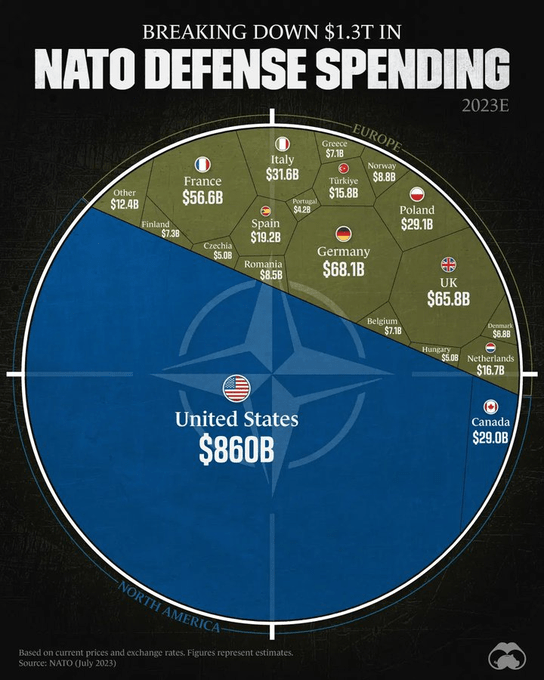
Growing the military industrial base over the course of a generation would only further empower arms makers in our economy, deepening the ditch the United States has dug itself into for decades by continually increasing national security spending — and by doling about half of it out to contractors. The U.S. spends more on national security than the next 10 countries combined, outpacing China alone by over 30%.

Ironically, the administration acknowledges in the strategy that “America’s economic security and national security are mutually reinforcing,” stating that “the nation’s military strength depends in part on our overall economic strength.” The strategy further states that optimizing the nation’s defense needs typically requires tradeoffs between “cost, speed, and scale.” It doesn’t mention quality of industrial output — arguably the biggest tradeoff the U.S. government has made in military procurement.

Keep reading