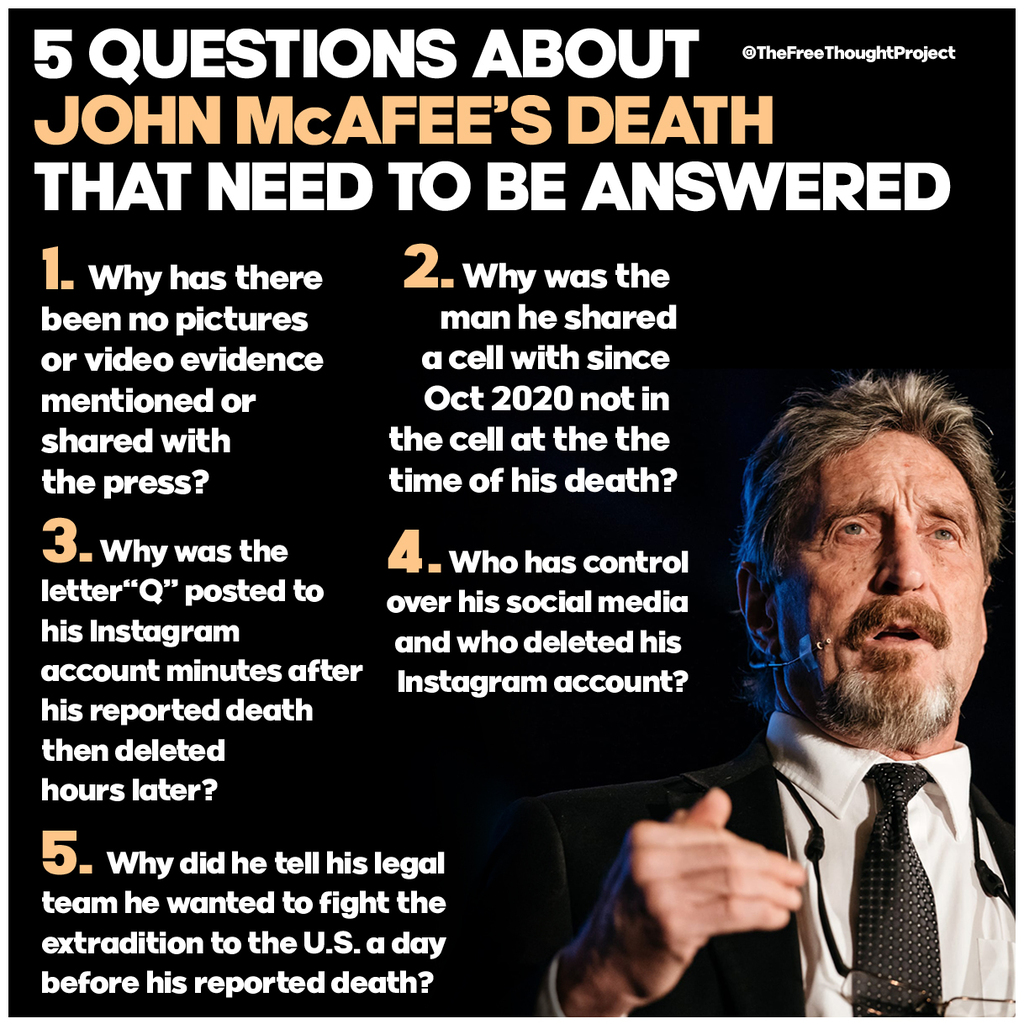
5 unanswered questions…


Former NSA consultant and data privacy advocate Edward Snowden tweeted on Wednesday that Julian Assange “could be next,” after antivirus mogul John McAfee died by apparent suicide in a Barcelona prison cell following news that he was being extradited to the US on criminal tax evasion charges.
Spanish outlets broke the news of McAfee’s death by suicide on Wednesday.
“Europe should not extradite those accused of non-violent crimes to a court system so unfair — and prison system so cruel — that native-born defendants would rather die than become subject to it. Julian Assange could be next,” Snowden tweeted.
“Until the system is reformed, a moratorium should remain,” he added.

After news broke Wednesday that tech entrepreneur John McAfee, the founder of the McAfee antivirus software company, was found dead following a suspected suicide in a Spanish jail cell while awaiting extradition to the United States, Twitter users were quick to dig through the tech mogul’s social media feed.
Several posts stood out, leading many to suggest that the cause of McAfee’s death remains far from certain.
Soon after his arrest, McAfee tweeted from a Barcelona jail cell, and directly referenced the conspiracy theories surrounding Jeffrey Epstein’s death.
“I am content in here. I have friends,” McAfee tweeted on October 15, 2020. “The food is good. All is well. Know that if I hang myself, a la Epstein, it will be no fault of mine.”
In a well-known criminal case in which an American woman from Idaho attempted to smuggle 33 Haitian children across the Haitian border into the Dominican Republic soon after the 2010 earthquake, then-Secretary of State Hillary Clinton took extraordinary measures, including the deployment of former president Bill Clinton as a negotiator, to get the woman released and sent back to the states to freedom. Also released were 9 co-participants in the enterprise, who denied any in-depth knowledge of the plan.
In 2013 an NBC News report claimed that the Clinton State Department had squashed an internal investigation into allegations of pedophilia and prostitution involving State Department personnel.
The Dominican Republic is recognized by the US State Department as a hotspot for the child sex tourism industry. Last year Clinton allies, including Hillary Clinton’s 2016 campaign manager, John Podesta, got caught up in a furor known as Pizzagate, which claimed that actionable evidence for launching an investigation had been uncovered by lewd pedophiliac images by a Wikileaks release of emails belonging to Podesta, who has acknowledged they are his. Podesta charged “they stole my emails” after a G-20 conference last year. While focused on assigning blame to “the Russians,” Podesta inadvertently acknowledged the emails’ authenticity. Wikileaks boasts a record of never having published an inauthentic document.
It is highly unusual for a secretary of state to get personally involved in a case of arrested Americans abroad. Department policy is to not interfere with a host nation’s legal proceedings. In 2010, that same year, there were more than 3,500 U.S. citizen arrests overseas, according to the Bureau of Consular Affairs.
Laura Sislby, now age 46, was convicted in a Haitian court in 2010 of lesser charges than human trafficking, although the Haitian public was demanding such charges. Described by CBS News as an “Idaho businesswoman,” Silsby took the Haitian children from their homes with promises to their parents of a “better life” for them in a school in the Dominican Republic, although she had stated to members of an Idaho church, and the Haitian authorities, that the children were orphans. Silsby had falsely stated at one point that she had found the children in front of a collapsed orphanage.

John McAfee, an eccentric software creator, was found dead in his prison cell in Spain in an apparent suicide after Spanish courts reportedly agreed to extradite him to the United States.
McAfee was arrested in October of 2020 at El Prat airport in Barcelona at the request of the US Justice Department.
McAfee was accused of evading millions of dollars in taxes from money made crypto trading.
In 2019, John McAfee hinted that the US government was gunning for him and threatening to kill him.
“Getting subtle messages from U.S. officials saying, in effect: “We’re coming for you McAfee! We’re going to kill yourself”. I got a tattoo today just in case. If I suicide myself, I didn’t. I was whackd. Check my right arm,” McAfee said in a November 2019 tweet with a photo of his “$WHACKD” tattoo.


 Hellbound and Down
You must be logged in to post a comment.