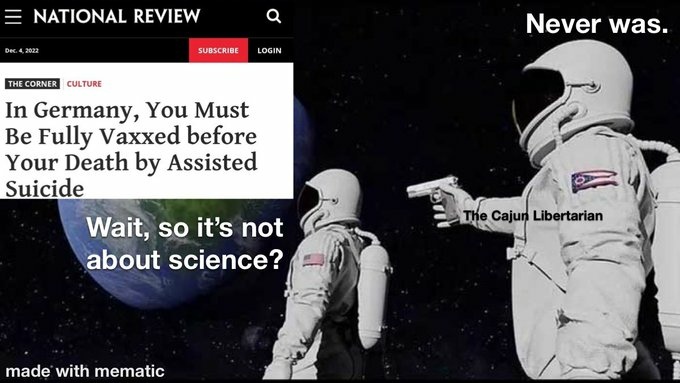
Makes perfect sense…


It was a Tuesday in early November when federal agents from the Drug Enforcement Administration paid a visit to the office of Dr. David Bockoff, a chronic pain specialist in Beverly Hills. It wasn’t a Hollywood-style raid—there were no shots fired or flash-bang grenades deployed—but the agents left behind a slip of paper that, according to those close to the doctor’s patients, had consequences just as deadly as any shootout.
On Nov. 1, the DEA suspended Bockoff’s ability to prescribe controlled substances, including powerful opioids such as fentanyl. While illicit fentanyl smuggled across the border by Mexican cartels has fueled a record surge in overdoses in recent years, doctors still use the pharmaceutical version during surgeries and for soothing the most severe types of pain. But amid efforts to shut down so-called “pill mills” and other illegal operations, advocates for pain patients say the DEA has gone too far, overcorrecting to the point that people with legitimate needs are blocked from obtaining the medication they need to live without suffering.
One of Bockoff’s patients who relied on fentanyl was Danny Elliott, a 61-year-old native of Warner Robins, Georgia. In March 1991, Elliott was nearly electrocuted to death when a water pump he was using to drain a flooded basement malfunctioned, sending high-voltage shocks through his body for nearly 15 minutes until his father intervened to save his life. Elliott was never the same after the accident, which left him with debilitating, migraine-like headaches. Once a class president and basketball star in high school, he found himself spending days on end in a darkened bedroom, unable to bear sunlight or the sound of the outdoors.
“I have these sensations like my brain is loose inside my skull,” Elliott told me in 2019, when I first interviewed him for the VICE News podcast series Painkiller. “If I turn my head too quickly, left or right, it feels like my brain sloshes around. Literally my eyes burn deep into my skull. My eyes hurt so bad that it hurts to blink.”
A man in Ontario claims that he is being pushed by hospital staff to end his life rather than continue receiving treatment.
Roger Foley suffers from cerebellar ataxia, a disease that attacks the brain and muscles, and has been bedridden for six years. The 47-year-old requires continual help in order to eat, wash and sit up.
“They asked if I want an assisted death. I don’t. I was told that I would be charged $1,800 per day [for hospital care]. I have $2 million worth of bills.” he told the New York Post. “Nurses here told me that I should end my life. That shocked me.”
Foley has filed a lawsuit against the Victoria Hospital London Health Sciences Centre, the health care network in London, Ontario responsible for his wellbeing.
He claims in the lawsuit that not only has there been verbal pressuring to end his life, but that hospital staff have been neglectful and manipulative in a way that is trying to push him into assisted suicide.
“Mr. Foley was told by hospital staff that he had stayed at the hospital for too long and if he did not receive self-directed funding, he should apply for assisted death as an option,” the lawsuit claims.
Foley claims that, for a period of time, the hospital did not provide a Hoyer Lift or personnel to operate it. This machine is absolutely necessary to hoist him into a seated position so that he can eat, drink, and take medicine. For days at a time, he asserts that he was unable to eat and drink for days at a time, and almost died as a result.
Assisted suicide became legal in Canada in 2016, and now lead the world in medically-assisted deaths.
The Canadian healthcare system is experiencing an acute shortage of basic painkillers, particularly acetaminophen and ibuprofen, which are commonly used to relieve pain and fever in children during flu season.
Canada’s Association of Medical Assistance in Dying Assessors and Providers (CAMAP) chose this perhaps awkward moment to roll out a webinar for healthcare professionals that advised them to offer assisted suicide to their suffering patients.
As Canada’s National Post noted, doctors around the world are normally “explicitly prohibited or strongly discouraged” from bringing up the subject of euthanasia, even in jurisdictions where assisted suicide is legal.
Beginning with a “guidance document” published in 2019, CAMAP asserted that, on the contrary, Canadian doctors have a duty to begin the conversation about Medical Assistance in Dying (MAID) with their patients rather than waiting for patients to ask about their options. MAID is a process by which healthcare professionals kill the patient.
A new MAID curriculum developed by the group and introduced via a webinar this week maintained that position, which critics find increasingly disturbing as MAID eligibility expands under Canadian law, far beyond the original concept of offering killing only to “those whose natural death was reasonably foreseeable.”
As the laws stand, there is “no legal restriction on who can raise the subject of MAID with someone with a grievous and irremediable illness, disease or disability, provided the intent is not to induce, persuade or convince the person to request an assisted death.”
Critics point out that given the “power dynamics of the doctor-patient relationship,” it is difficult for doctors to initiate such a discussion without the patient interpreting it as an encouragement to commit suicide.
The rate of suicide among veterans may be more than double what federal officials report annually because of undercounting related to drug overdose deaths and service record errors, according to a new analysis released Saturday.
Officials from America’s Warrior Partnership, in a joint study with University of Alabama and Duke University, reviewed census death data from 2014 to 2018 for eight states and found thousands of cases of suspected or confirmed suicides not included in federal calculations.
If those figures were to be repeated across the other states, it would push the veterans suicide rate from about 17 individuals a day (the official estimate released by the Department of Veterans Affairs last year) to 44 veterans a day.
A North Dakota farmer and three farm hands, all three from the same family, were found dead on Monday in what law enforcement officials have described as a likely murder-suicide.
In the small town of barely 1,000, in the midst of harvest season, loved ones are living what they’ve called a “complete nightmare.”
Douglas Dulmage, 56, a farmer, husband and father of two, was found shot dead in his combine in his family’s field south of Cando, North Dakota.
Outside of the combine, Justin Bracken, 34, Richard Bracken, 64, and Robert Bracken, 59, also of Cando, lay dead in the field they’d been helping him harvest. A .357 revolver was found near the bodies, according to The Associated Press.
In a statement released via Facebook on Tuesday, Towner County Sheriff Andrew Hillier described what his deputies found.
A Colorado man has died 24 hours after lighting himself on fire in front of the United States Supreme Court on Earth Day as part of what appears to be a religious protest against the use of fossil fuels and in order to bring attention to climate change.
On Friday evening, Washington, D.C., first responders airlifted Wynn Bruce, a 50-year-old climate activist, to a local hospital after he engulfed himself in flames. He later died Saturday evening despite medical efforts to save his life.
Those reportedly close to Bruce are emphasizing that he did not consider this to be an act of suicide, rather that he was simply practicing Shambhala Buddhism and viewed the intentional act as one of self-immolation in order to draw attention to the supposedly damaging effects of climate change.
On Twitter, Zen Buddhist priest and environmental scientist Dr. K Kritee tweeted, “This guy was my friend. He meditated with our sangha. This act is not suicide. This is a deeply fearless act of compassion to bring attention to climate crisis.”
According to an article by Brain Peckford, a recent post-Covid vaccine death in France was ruled to be “a suicide” by a judge, due to the experimental nature of the “vaccine.” The insurance company refused to pay. No death benefit. The article reads:
A wealthy elderly man with a high value Life Insurance policy to the amount of millions of euros… dies from the covid jab. His death as a consequence of being jabbed is not disputed by the doctors, nor his life insurers. The Insurance company refused to pay the policy, citing that the taking of experimental drugs, treatments, etc., is excluded from the policy. The family takes the insurance company to court and they have just lost the case.
The judge stated, “the experimental vaccine side effects are publicised and the deceased could not claim not to have known about them when he voluntarily took the jab. There is no law or mandate in France which forced him to be jabbed. Therefore, his death is essentially suicide”.
Suicide is explicitly excluded from this particular policy and in fact from all life insurance policies in general.
This has been the finding of a major western world court system and there is zero doubt that insurance companies world wide will cite this case as legal fact.
Therefore, if anyone ever challenges you on whether these jabs are experimental or not, and that neither the pharma companies, nor govts, nor anyone else but YOU are responsible for accepting them and if you die, legally you have committed suicide.
No insurance, no payouts, no refunds. You are on your own!
Link to original French article.
Listen to Dr. Pierre describe the same story and explain the view of the American Council of Life Insurers; that insurance companies may deny payment of death benefit if death results from the experimental COVID injection.
When law-enforcement officials believe that someone has committed a crime, they often go to great lengths—and can be quite creative—in coming up with charges to file. Criminal codes are voluminous, and it’s common for prosecutors to pile up one charge after another as a way to keep someone potentially dangerous off the streets.
When the accused is a police officer, however, agencies typically find their hands tied. “Nothing to see here,” they say, “so let’s move along.” Their eagerness to protect their own colleagues from accountability can have deadly consequences. A recent lawsuit by the victim of a California Highway Patrol officer’s off-duty shooting brings the problem into view.
The case centers on Brad Wheat, a CHP lieutenant who operated out of the agency’s office in Amador County. On Aug. 3, 2018, Wheat took his CHP-issued service weapon and hollow-point ammunition to confront Philip “Trae” Debeaubien, the boyfriend of Wheat’s estranged wife, Mary. As he later confessed to a fellow officer, Wheat planned more than a verbal confrontation.
“I just learned this evening that Brad confided in an officer…tonight that he drove to a location where he thought his wife and her lover were last night to murder the lover and then commit suicide,” an officer explained in an email, as The Sacramento Bee reported. Fortunately, Debeaubien had left the house by the time that Wheat arrived.
Initially, Wheat’s colleagues convinced him to surrender his CHP firearm and other weapons and they reported it to superiors. Instead of treating this matter with the seriousness it deserved, or showing concern for the dangers that Debeaubien and Mary Wheat faced, CHP officials acted as if it were a case of an officer who had a rough day.
They essentially did nothing. “Faced with a confessed homicidal employee, the CHP conducted no criminal investigation of its own, notified no allied law enforcement agency or prosecutor’s office, and initiated no administrative process,” according to a pleading filed by Debeaubien in federal district court. “Nor did the CHP notify [the] plaintiff that he was the target of a murder-suicide plan that failed only because of a timely escape.”
You read that right—the agency seemed so uninterested in the safety of two potential murder victims that it didn’t even inform them about the planned attack. It sent Wheat to a therapist, who reportedly said he needed a good night’s sleep. It sent him on vacation for two weeks, let him return to work, and returned his firearm and ammunition—something CHP said he needed for his job.
You can probably guess what happened next. Two weeks later, Wheat took the same weapon and ammo and this time found his ex-wife and her boyfriend. He shot Debeaubien in the shoulder, the two struggled and Wheat—a trained CHP officer, after all—retrieved his dislodged weapon, shot to death his ex-wife, and then killed himself.
Now CHP says it has no responsibility for this tragic event and that its decisions did not endanger the plaintiff’s life. This much seems clear from court filings and depositions: CHP’s response centered on what it thought best for its own officer. Any concern about the dangers faced by those outside the agency seemed incidental, at best.
The Mayor of Hyattsville, Maryland, Kevin Ward died Tuesday in an apparent suicide, officials said. He was 44-years-old.
Ward’s body was reportedly found in a park in McLean, Virginia.
“It is with great sadness that we report that our beloved Hyattsville Mayor Kevin Ward passed away yesterday, January 25, from an apparent self-inflicted gunshot wound,” the city announced in a statement. “Mayor Ward was a valued and trusted leader and a fierce advocate for all the people of Hyattsville. We are heartbroken at this loss and extend our deepest sympathy to his family.”
You must be logged in to post a comment.