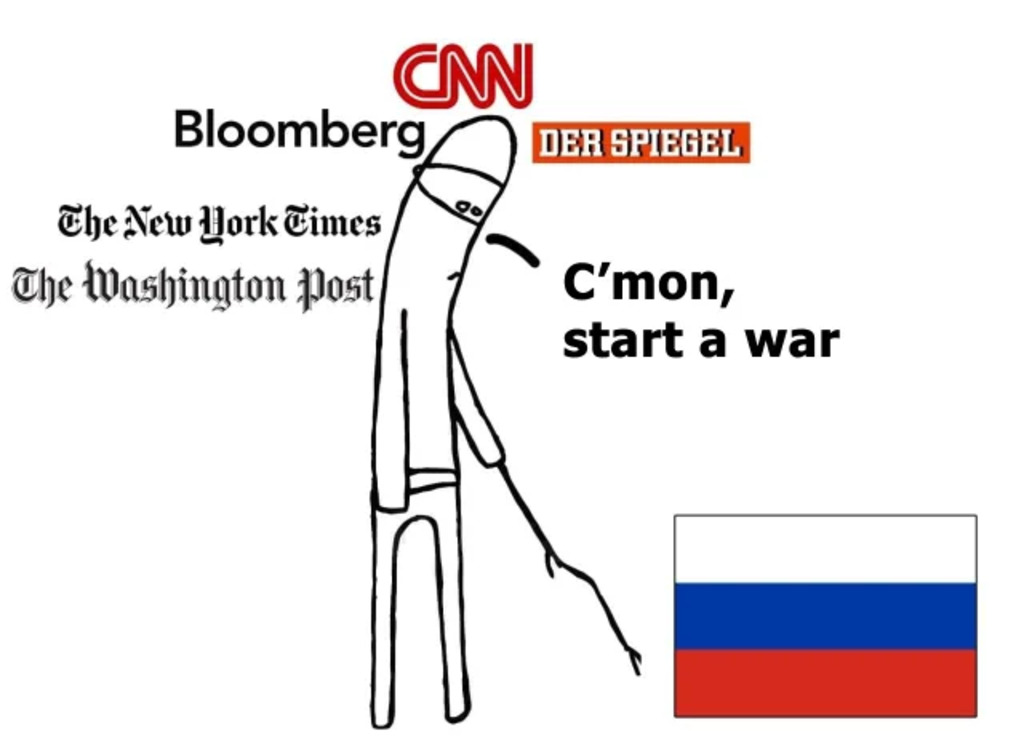
Russiagate Smears Against WikiLeaks

Julian Assange and WikiLeaks have been the subject of numerous false, unfounded smears of connection to the Russian government, particularly in relation to WikiLeaks’ 2016 publication of DNC emails. In this brief we recount some of the most pervasive claims and correct the record.

False Claim: Julian Assange’s source is the Russian government

Julian Assange has a long-standing policy never to reveal his sources. However, in this case, he has stated that his source of the 2016 releases was not a state party. Regardless of the source, WikiLeaks will publish what it receives provided the material is verifiable and newsworthy.

Keep reading

Russians are receiving text messages about the U.S. State Department’s $10 million reward for information on election interference

Residents of cities across Russia are receiving SMS messages about the U.S. State Department’s newly announced $10 million “Rewards for Justice” (RFJ) offer for information that helps identify or locate hackers attempting to interfere in the 2020 presidential elections, reports the Russian outlet TJournal

Russian social media users began sharing screenshots of these messages online on August 6, the day after the U.S. State Department announced the reward offer. Reports about the messages also started to appear in local news outlets, such as the Yekaterinburg-based outlet It’s My Cityand the Vladivostok-based outlet Vl.ruamong others. According to the website Pikabu.ruresidents of the Russian cities of Saratov, Krasnodar, Ulyanovsk, Chelyabinsk, Perm, and Tyumen also reported receiving similar messages. 

Keep reading

VIPS MEMO: To Nancy Pelosi — Did Russia Hack the DNC Emails?

MEMORANDUM FOR: Speaker Nancy Pelosi

FROM: Veteran Intelligence Professionals for Sanity

SUBJECT: Did Russia Hack the DNC Emails?

Dear Madam Speaker:

After your intelligence briefing Friday, Politico reported that you were sharply frustrated by the lack of detail presented on “Russia’s continued interference in the 2020 election campaign.” You were quoted as saying you thought the administration was “withholding” evidence of foreign election meddling and added, “What I am concerned about is that the American people should be better informed.” We share your concern and, having followed this issue closely from the perspective of non-partisan, veteran intelligence officials, we are able to throw considerable light on it.

The narrative that Russia hacked Democratic National Committee emails in 2016 and gave them to WikiLeaks to hurt Hillary Clinton’s candidacy has become an article of faith for about half of Americans — somewhat fewer than the number misled into believing 18 years ago that there were weapons of mass destruction in Iraq — but it is still considerable.

Because of a bizarre, but highly instructive media lapse these past three months, most Americans remain unaware that the accusation that Russia “hacked” the DNC has evaporated.It turns out the accusation was fabricated — just like the presence of weapons of mass destruction in Iraq. In fact, some of the same U.S. officials were involved in both deceptions. For example, James Clapper, Obama’s director of national intelligence, played a key role 18 years ago in covering up the fact that no WMD had been identified in satellite imagery of Iraq; more recently he helped conjure up evidence of Russian hacking.

We quote below the horse’s-mouth testimony of Shawn Henry, head of CrowdStrike, the cyber security outfit paid by the DNC, and certified as a “high-class entity” by FBI Director James Comey, to look into the “hacking” of the DNC. Mr. Henry admitted in sworn testimony on December 5, 2017 that his firm has no concrete evidence that the DNC emails were hacked — by Russia or anyone else. This testimony was finally declassified and released on May 7, 2020, but you will not find a word about it in The New York Times, Washington Post or other “mainstream” outlets. (We wonder if you yourself were made aware of Henry’s testimony.)

The original accusation achieved its purpose in fostering the belief that President Trump owed his election to President Putin, and thus is beholden to him. It also provided a degree of verisimilitude — as well as faux-righteous indignation — to support a host of punitive measures. “Russian hacking” was immediately used to justify President Obama’s expulsion of 35 Russian diplomats/intelligence officers at the end of 2016. Those with a sharp anti-Russia axe to grind no doubt deemed this unnecessary diplomatic step felicitous, welcome collateral damage to ties between Washington and Moscow.

Keep reading

THE SAME COMPANY 3D PRINTING KFC’S MEAT NUGGETS IS PRINTING HUMAN TISSUE IN SPACE AS WELL

It’s been a wild weekend for Russian startup 3D Bioprinting Solutions.

First, the company announced a partnership with fast food chain KFC as part of an effort to create the “world’s first laboratory-produced chicken nuggets.”

Now, the same company is ready to announce that it’s been hard at work bringing similar tech into orbit as well.

In an experiment on board the International Space Station that took place in 2018 but has only now been published, Russian cosmonaut Oleg Kononoenko was tasked to 3D print human cartilage cells in near-zero gravity using a machine called “Bioprinter Organ.Aut,” as Space.com reports — a machine assembled by, you guessed it, 3D Bioprinting Solutions.

The goal was to investigate ways to reverse some of the negative effects of spending prolonged periods of time in space, in particular evidence that parts of the human body can atrophy over time — something we’ve known about for quite some time.

The eventual hope is to give astronauts the ability to print entire body parts in space, according to the researchers — just in case something goes catastrophically wrong during a mission.

paper about the research was published in the journal Science Advances last week.

Prosecutors say avalanche killed Dyatlov group in Urals in 1959

The Russian Prosecutor General’s Office has come to a conclusion that an avalanche killed the Dyatlov group in the Ural Mountains in 1959, Andrei Kuryakov, a deputy chief of the directorate of the Russian Prosecutor General’s Office for the Ural Federal District, told reporters on Saturday.

“[The dead tourists’] injuries are characteristic for the injuries of rock climbers caught in an avalanche,” Kuryakov said.

In February 2019, the Prosecutor General’s Office announced an inquiry into the Dyatlov group case, 60 years after their mysterious death.

Keep reading

The ‘Primary Subsource’s’ Guide To Russiagate, As Told To The FBI

The Primary Subsource said at first that maybe he had asked some of his friends in Russia – he didn’t have a network of sources, according to his lawyer, but instead just a “social circle.” And a boozy one at that: When the Primary Subsource would get together with his old friend Source 4, the two would drink heavily. But his social circle was no help with the Manafort question, and so the Primary Subsource scrounged up a few old news clippings about Manafort and fed them back to Steele.

Also in his “social circle” was Primary Subsource’s friend “Source 2,” a character who was always on the make. “He often tries to monetize his relationship with [the Primary Subsource], suggesting that the two of them should try and do projects together for money,” the Primary Subsource told the FBI (a caution that the Primary Subsource would repeat again and again.) It was Source 2 who “told [the Primary Subsource] that there was compromising material on Trump.”

And then there was Source 3, a very special friend. She would borrow money from the Primary Subsource that he didn’t expect to be paid back. She stayed with him when visiting the United States. The Primary Subsource told the FBI that in the midst of their conversations about Trump, they would also talk about “a private subject.” (The FBI agents, for all their hardnosed reputation, were too delicate to intrude by asking what that “private subject” was).

Keep reading