
On government schools…

San Diego’s public schools want to be anti-racist, so they’re…abolishing the traditional grading system?
“This is part of our honest reckoning as a school district,” San Diego Unified School District Vice President Richard Barrera told a local NBC affiliate. “If we’re actually going to be an anti-racist school district, we have to confront practices like this that have gone on for years and years.”
District officials evidently believe that the practice of grading students based on their average score is racist, and that an active effort to dismantle racism necessitates a learning environment free of the pressure to turn in assignments on time. As evidence for the urgency of these changes, the district released data showing that minority students received more Ds and Fs than white students: Just 7 percent of whites received failing grades, as opposed to 23 percent of Native Americans, 23 percent of Hispanics, and 20 percent of black students.
The officials in charge of San Francisco’s public schools are hard at work—not coming up with a plan to quickly reopen the schools, but to rename as many as 44 of them.
As parents, teachers, and principals deal with the frustrations of distance learning, the San Francisco Unified School District recently asked them to brainstorm replacements for schools that are “inappropriately” named after problematic historical figures, such as Abraham Lincoln, George Washington, Thomas Jefferson, and even Sen. Dianne Feinstein (D–Calif.).
“I don’t think there is ever going to be a time when people are ready for this,” Mark Sanchez, president of the school board and a member of the committee that proposed the changes, told the San Francisco Chronicle. “Predictably people are going to be upset no matter when we do this.”
Maybe. But people are more upset right now, because San Francisco’s public schools aren’t even open and have no plans to reopen until probably January.


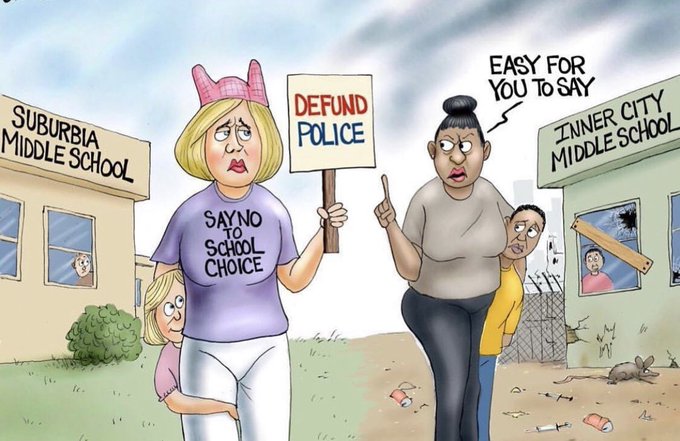
The public schools have been turned into experimental laboratories for utopian social engineering by arrogant upper-middle-class technocrats—who, of course, usually send their children to private schools.
Camille Paglia
In early august, the first kids in America went back to school during the pandemic. Many of these openings happened in areas where cases were high or growing: in Georgia, Indiana, Florida. Parents, teachers, and scientists feared what might happen next. The New York Times reported that, in parts of Georgia, a school of 1,000 kids could expect to see 20 or 30 people arrive with COVID-19 during week one. Many assumed that school infections would balloon and spread outward to the broader community, triggering new waves. On social media, people shared pictures of high schools with crowded hallways and no masking as if to say I told you so.
Fear and bad press slowed down or canceled school reopenings elsewhere. Many large urban school districts chose not to open for in-person instruction, even in places with relatively low positivity rates. Chicago, L.A., Houston—all remote, at least so far.
It’s now October. We are starting to get an evidence-based picture of how school reopenings and remote learning are going (those photos of hallways don’t count), and the evidence is pointing in one direction. Schools do not, in fact, appear to be a major spreader of COVID-19.



You must be logged in to post a comment.