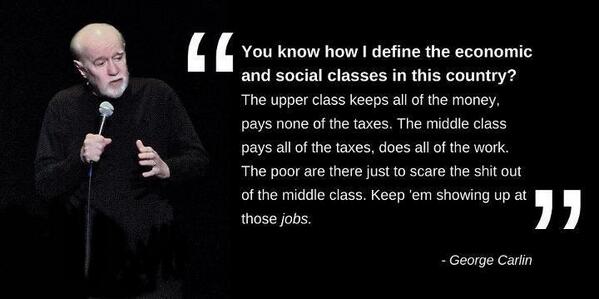
George Carlin on class…

In 1906, Alfred Henry Lewis stated, “There are only nine meals between mankind and anarchy.” The sentiment was expressed right on the heals of a banking crisis which led to the Panic of 1907. The event was widely blamed on a liquidity crunch, and this same crisis was used as a rationale for the creation of the Federal Reserve Bank in 1913-1916. Of course, it is the central bank and its ability to generate fiat money from thin air (unbacked liquidity) that has led the US to the stagflationary disaster we face today. The “solutions” offered by establishment elites are often worse than the problems they are supposed to solve.
The total inflationary damage done to Americans consumers since 2020 varies according to who you ask. Stats from the Federal Reserve and government are muddled in a series of creative mathematics in order to make the situation look much better than it is. CPI is not a valid indicator of true inflation given it is watered down with over 80,000 items and services, and many of them are not necessities for the common US household. If we look only at necessities like housing, food and energy, the economic picture looks increasingly bleak.
Food, as Alfred Lewis noted, is particularly vital to civil cohesion. The human body can in fact survive up to three weeks without a meal, but the vast majority of people in the first world are not acclimated to such conditions and might just panic after one or two days without sustenance.
The potential for this scenario might sound exaggerated to those in a higher income bracket, but it’s important for these people to understand that a 25%-50% increase in food costs for them is not the same as a similar increase for people on a low or fixed income. For example, food price increases for the average middle-class to upper-middle-class households amount to around 11% of their annual income in 2023. However, for people in the low income bracket, food costs now amount to 31% of their annual income. That’s a pile driver to the wallet.
Los Angeles is reportedly spending $44,000 for each individual tent in a temporary tent village for homeless people in East Hollywood, The Messenger reports.
All told, it cost about $4 million to put up fencing, bathrooms, and staffing facilities for the village. Catering services and 24-7 staffing cost an additional $3 million per year, the Los Angeles Times reported.
Despite the high costs, the site is only temporary. It’s located on a parking lot that will eventually be turned into public housing. But because it will take years for construction to commence on that project, the city decided to fill the space with tents in the meantime.
San Francisco-based nonprofit Urban Alchemy maintains the encampment. Launched in 2018 with a small grant, the group hires mostly former prisoners because they have the “ability to read people in unpredictable situations.”
According to several lawsuits, however, some of those employees have engaged in abusive behavior.
After expanding to Portland and Austin, the group brought in $51 million in 2021.
Washington State has been trying to deal with their homeless problem, but they haven’t had much success.
A program designed to close down tent communities and get homeless people into housing has already spent $143 million dollars to house less than a thousand people. That’s a horrible ratio.
And now they want more cash, because they think this program has been so effective.
FOX News reports:
Blue state’s $143 million homeless program got less than a thousand people housed. Now governor wants more
An initiative to remove homeless camps from roadways needs more money to continue next year, according to Washington Gov. Jay Inslee, after burning through $143 million in a little over a year.
“You can’t do this with zero dollars,” Inslee, a Democrat, told KOMO News. “We’ll need the legislature in January to step up to increase funding so we can continue the progress we’re making.”
Inslee’s statewide Rights-of-Way Safety Initiative began in June 2022 with the goal of removing homeless camps from state property near roads and offering housing to the people living in the camps.
On Friday, Inslee toured a tiny home village in Olympia funded by the initiative that will soon provide shelter to 50 people who previously lived in an encampment along I-5, KOMO reported. The governor said during the tour that the safety initiative is out of money and, come January, camps will remain on state lands if the legislature does not allocate more funds.
“We’re very proud of the work state agencies have done in our right of way initiative working alongside local officials and service providers,” a spokesperson for the governor told Fox News in an email. “We will take as much funding as we can get to continue this work.”
If you take an honest look at the numbers, the obvious conclusion is that the U.S. economy is rapidly going in the wrong direction. Delinquency rates are soaring, sales of previously owned homes have declined by more than 32 percent over the past two years, inflation is starting to rise at a frightening pace again, large companies all over America are laying off workers, and we just witnessed the largest decline in real median household income in more than a decade. Sadly, it is often the most vulnerable members of our society that get hit the hardest when economic times get rough. According to the Census Bureau, the child poverty rate in the United States more than doubled from 2021 to 2022…
The U.S. poverty rate according to the Supplemental Poverty Measure (SPM) was 12.4% in 2022, a rise of 4.6 percentage points from 2021. The poverty rate for children more than doubled year over year, from 5.2% to 12.4% — a record increase.
There is no way to spin that number to make it look good.
So why did this happen?
With Sen. Raphael Warnock (D., Ga.) safe and secure in the Senate for the next six years, the church where he collects a salary as a part-time pastor is back to evicting residents of the low-income apartment building it owns—a subject that became a flashpoint in Warnock’s 2022 reelection campaign.
Since the Democrat won reelection in December, Fulton County court records show, the apartment building owned by Ebenezer Baptist Church has moved to evict six residents. The building, Columbia MLK Tower, has received over $15 million in federal and state funding to shelter the “chronically homeless,” but has nonetheless taken four residents to court this year for falling behind on rent by less than two months. Law enforcement officials forcibly ejected another resident from the pest-infected building in July.
Warnock denied during the 2022 campaign that the church was evicting residents, telling Georgia voters that the Free Beacon reports were “vicious and venomous” attempts to “sully Ebenezer Baptist Church” and the “church of Jesus Christ.”
Ebenezer pays Warnock a six-figure salary for his part-time pastoral services at levels that exceed the outside income allowance for senators. Warnock has leveraged several accounting loopholes to rake in sums far beyond that $30,000 limit. The church paid the senator $120,000 in 2021, for example, $89,000 of which was a tax-free “parsonage allowance” that he used to pay for his $1 million Atlanta home. And though Warnock made $155,000 from his church in 2022, the senator claimed $125,000 of that salary as “deferred compensation” for services he rendered before he was sworn into office in January 2021, the Washington Free Beacon reported.
Despite the Biden administration’s cheerleading that “Bidenomics” is the economic savior of the middle class — most Americans will disagree there has been an economic revival amid the worst inflation storm in a generation that has sent negative real-wage growth negative for more than two years, forcing consumers to deplete personal savings and rack up record amounts of credit-card debt in a high-interest rate environment.
We have shown many households are in rough financial shape. Dollar Tree executives confirmed weeks ago that mid/low-tier consumers are trading down from other more expensive retailers to their stores for groceries. This means Walmart has become too expensive for some consumers.
Even before we noted “Consumers Trade Down From Walmart, Dollar Tree Becomes Supermarket For The Working Poor,” we found a trend on TikTok that showed an increasing number of Americans in March were resorting to dollar stores for groceries to save money. We tilted that note “Dollar Tree Dinners”: TikToker Goes Viral After Showing People How To Cook For $35 A Week.
Last week, we were the first to point out that Google searches for “pawn shop near me” just erupted to record highs, indicating that consumers are in rough shape.
During our investigation of Sustainable Development Goals (SDGs), the disingenuous use of language to sell SDGs to an unsuspecting public has emerged as a common theme.
The United Nations (UN) claims the purpose of SDG16 is to:
Promote peaceful and inclusive societies for sustainable development, provide access to justice for all and build effective, accountable and inclusive institutions at all levels.
If we accept the supposition that “sustainable development” is global development that meets the needs of the world’s poor, then a reasonable person is unlikely to disagree with this stated objective.
But helping the poor is not the purpose of SDG16.
The real purpose of SDG16 is threefold: (1) empower a global governance regime, (2) exploit threats, both real and imagined, to advance regime objectives; and (3) force an unwarranted, unwelcome, centrally controlled global system of digital identity (digital ID) upon humanity.
We find the UN’s digital ID objective tucked away in its SDG Target 16.9:
By 2030, provide legal identity for all, including birth registration.
While SDG16 doesn’t allude specifically to “digital” ID, that is what it means.
As we shall see, the SDG16 target indicators don’t reveal the truth, either. For example, the only “indicator” to measure SDG16.9 progress (16.9.1) is:
[The] proportion of children under 5 years of age whose births have been registered with a civil authority, by age.
You might therefore think the task of “providing legal identity” would primarily fall to said “civil authorities.” That is not the case.
Within the UN system, all governments (whether local, county, provincial, state, federal) are “stakeholder partners” in a global network comprised of a wide-ranging gamut of public and private organisations. Many of these are explicitly backed by or housed at the UN, and all of them are pushing digital ID as the key mechanism to achieve SDG16.
This aspect of SDG16 will be more fully explored in Part 2.
There is a term that this worldwide amalgam of organisations often uses to describe itself: it is a global public-private partnership—G3P, for short.
The G3P is toiling tirelessly to create the conditions necessary to justify the imposition of both global governance “with teeth” and its prerequisite digital ID system. In doing so, the G3P is inverting the nature of our rights. It manufactures and exploits crises in order to claim legitimacy for its offered “solutions.”
The G3P comprises virtually all of the world’s intergovernmental organisations, governments, global corporations, major philanthropic foundations, non-governmental organisations (NGOs) and civil society groups. Collectively, these form the “stakeholders” implementing sustainable development, including SDG16.
One of the biggest frustrations about getting old is hearing younger people propose ideas that were debunked decades ago—and then getting “eyes glazed over” looks from them after explaining that we’ve already been there and done that. Proposers of such ideas rarely change their minds after I say, “Dude, I was there and remember—and it was a disaster.”
The latest “old is new again” proposal is for the government to just build housing—as in public officials buying the land, choosing the design, finding a developer, and then serving as landlord. The impetus is the nation’s affordable-housing crisis. Advocates have changed the terminology. They are proposing that “we” build “social housing” rather than “public housing projects,” but it’s the same blighted idea.
“Public housing is ready to make a comeback,” wrote Daniel Denvir and Yonah Freemark in left-leaning Slate. They say current efforts to up-zone property (allowing developers to build higher-density projects with fewer regulations) yield only modest results. They rehash the debate on the Left—between YIMBYs (Yes In My Back Yarders) and those who claim that new building promotes gentrification.
“But this debate is often impoverished,” they add. “As policymakers continue to confront this crisis, it is time for them to reconsider an obvious but long-taboo solution: building new public housing.” Of course, this time the government will do it better than the last time by—get this—avoiding income restrictions and opening the units to all comers.


You must be logged in to post a comment.