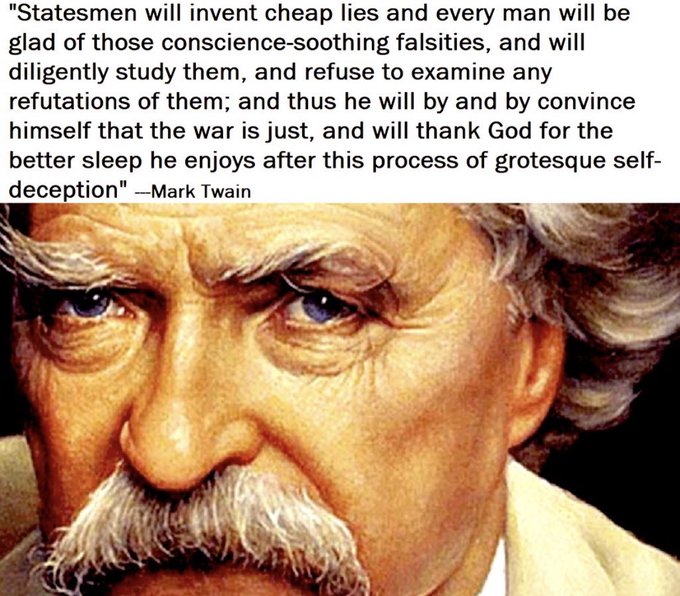
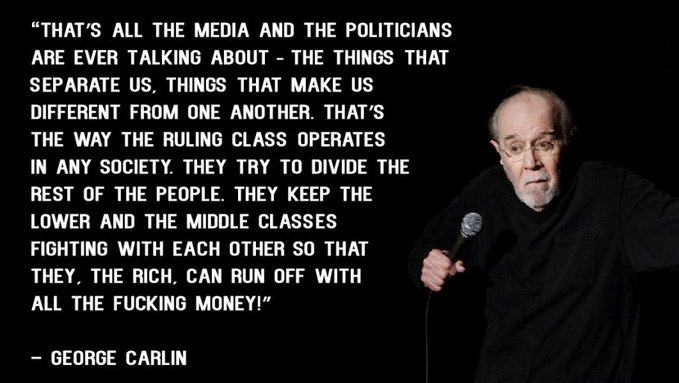
George Carlin on divide and conquer…


AS THE NATIONAL security workforce ages, dementia impacting U.S. officials poses a threat to national security, according to a first-of-its-kind study by a Pentagon-funded think tank. The report, released this spring, came as several prominent U.S. officials trusted with some of the nation’s most highly classified intelligence experienced public lapses, stoking calls for resignations and debate about Washington’s aging leadership.
Sen. Mitch McConnell, R-Ky., who had a second freezing episode last month, enjoys the most privileged access to classified information of anyone in Congress as a member of the so-called Gang of Eight congressional leadership. Ninety-year-old Sen. Dianne Feinstein, D-Calif., whose decline has seen her confused about how to vote and experiencing memory lapses — forgetting conversations and not recalling a monthslong absence — was for years a member of the Gang of Eight and remains a member of the Senate Intelligence Committee, on which she has served since 2001.
The study, published by the RAND Corporation’s National Security Research Division in April, identifies individuals with both current and former access to classified material who develop dementia as threats to national security, citing the possibility that they may unwittingly disclose government secrets.
“Individuals who hold or held a security clearance and handled classified material could become a security threat if they develop dementia and unwittingly share government secrets,” the study says.
California Sen. Dianne Feinstein has relinquished power of attorney to her daughter — even as she continues to serve in Congress at the age of 90, according to a report.
The Democratic senator — who is the oldest member of Congress — has faced calls to resign after health complications kept her away from the Capitol for months earlier this year.
Since returning to Washington DC, she has appeared frail and has had a number of public mental lapses.
Feinstein handed over power of attorney to her daughter, 66-year-old Katherine Feinstein, in part to help handle legal battles over her late husband Richard Blum’s estate, the New York Times reported on Thursday.
In one dispute, Katherine, Feinstein’s only child, is at odds with Blum’s three daughters over the ownership of a luxury beach house owned by Feinstein, according to the paper.
In a separate lawsuit, the two families are feuding over Blum’s life insurance, which Feinstein claims she needs to cover her increasing medical costs, The Times reported.
The intimate connection between secret societies and the nation’s political elite is as strong as ever.
House Speaker Kevin McCarthy (R-Calif.) was among those present at this year’s infamous meeting of the secretive Bohemian Club at the Bohemian Grove campground in Monte Rio, California.
Known as much for its eyebrow-raising occult-tinged rituals as for its luminary member roster, the male-only Bohemian Club has hosted business titans (William Randolph Hearst, the Rockefellers) and presidents (Ronald Reagan, Richard Nixon). It was reportedly the place where J. Robert Oppenheimer first discussed the Manhattan project.
Donald Trump is notably one major power player who is not known to be involved with the Bohemian Club. But he was a major topic of conversation at the group’s July meeting last week.
As Politico reports:
At The Bohemian Grove, the secretive conclave of men who gather in Northern California, the attendance was a Who’s Who of pre-Trump Republicans, a murderer’s row of bundlers and Wall Street Journal editorial page favorites including former House Speaker Paul Ryan and ex-Florida Gov. Jeb Bush, as my colleague Ryan Lizza reported. With fear setting in about Trump’s re-nomination, the gathering became something of a fantasy camp on how to avert that prospect or at least confront it. One name that came up as a potential apolitical independent nominee was retired Admiral William McRaven, the former special operations commander who became chancellor of the University of Texas.
Politico further reported that, per sources in attendance at Bohemian Grove, McCarthy spoke favorably of Trump, expressing confidence that he will claim the GOP nomination for the presidency.
At Bohemian Grove, the world’s rich and powerful dress in ceremonial garb, chant around a bonfire, and burn a child in effigy in the presence of a large owl-shaped idol.
The group was started after the Civil War by Henry Harry Edwards, originally as a club for artists, writers, journalists, and other “Bohemians” to get together and relax. Since then, though, the outfit has grown to include more than 2,500 of the world’s elites.
The Bohemian Club, like other major secret societies, has an agenda of furthering globalism. At the United Nations’ founding conference in 1945, UN delegates and key dignitaries were invited to Bohemian Grove for a special program.
During their time at Bohemian Grove, members are known to walk around the forest in the nude inebriated and urinating at will throughout the camp.

As elections approach, sweeping generalizations have a certain allure that often energizes the frustrated and captivates the hopeful. However, it’s essential that we as voters remember that things that seem too good to be true typically are. Here are a few warnings.
First, as far as our finances go, beware of politicians promising that they won’t touch Social Security and Medicare. In reality, they’ll have no choice. For one thing, if they keep this hollow promise, Social Security benefits will be cut across the board in 2033 by over 20 percent. According to the Committee for a Responsible Budget, that’s a cut of between $12,000 and $17,000 annually for a traditional retired couple. Medicare faces the same predicament for a variety of reasons.
The only workaround from this reality, which has been known for decades, is for Democrats and Republicans to finally come together for serious reform. That will likely result in a reduction of benefits and an increase in taxes. As unpleasant as it will be, we’d better hope that politicians don’t take the cowardly path and resort to shoving the problem onto Uncle Sam’s proverbial credit card (by paying all benefits that exceed payroll-tax receipts out of general revenues).
As the Manhattan Institute’s Brian Riedl noted recently, “Social Security and Medicare are projected by the CBO to spend $156 trillion in benefits but collect only $87 trillion in payroll taxes and premiums. This $69 trillion cash shortfall will have to be financed by budget deficits, which will in turn be responsible for $47 trillion of interest costs on the national debt.” Who will lend the U.S. government $114 trillion, even at unprecedentedly high interest rates?
That’s a question voters should ask politicians who promise never to touch entitlement programs. Those who claim it’s an easy fix by taxing the rich should be immediately dismissed as unserious. The numbers don’t add up. Any other one-sided ideological answers to an accounting question won’t cut it, either.


Money keeps pouring into the U.S. Marshals Service from federal political campaigns and committees who received funds from FTX, the now-defunct cryptocurrency company, according to a Raw Story analysis of federal campaign records.
Another five political campaigns sent $15,500 in campaign cash to the government agency best known for hunting down suspected criminals, adding to at least $160,000 collected from 30 federal political candidates and party committees, as Raw Story first reported.
The five new campaigns that gave up the money are fundraising entities for Rep. Marc Molinaro (R-NY), Rep. Elise Stefanik (R-NY), Rep. Lori Chavez-DeRemer (R-OR), Rep. Bob Latta (R-OH) and Rep. Brian Fitzpatrick (R-PA).
Stefanik is chairwoman of the House Republican Conference, the GOP’s fourth most powerful position in the U.S. House of Representatives.

You must be logged in to post a comment.