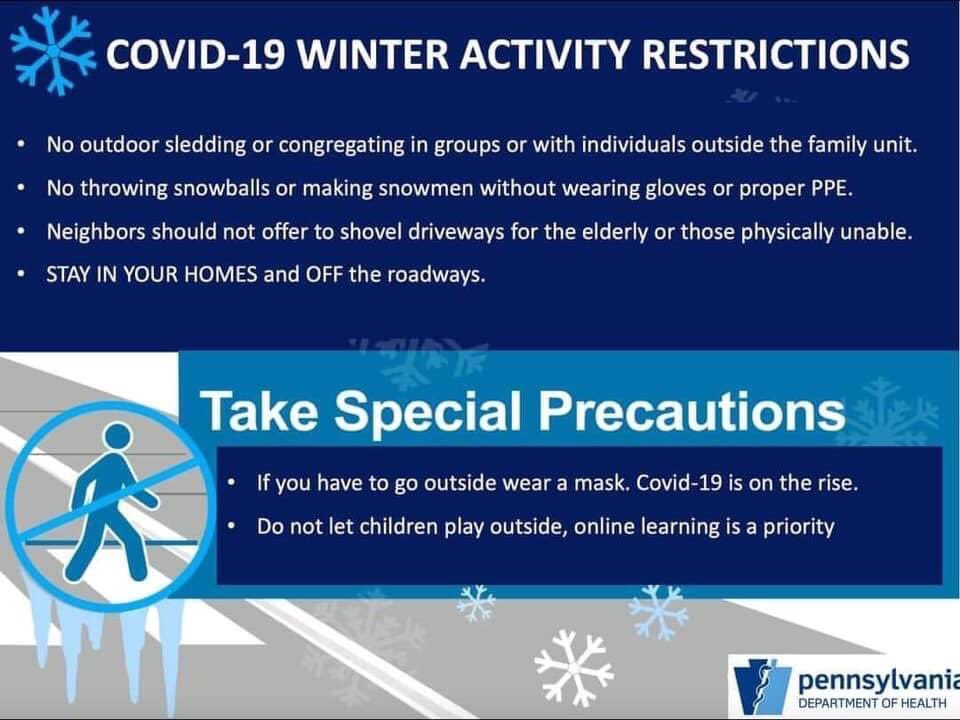
Meanwhile in Pennsylvania…


In the relatively short span of the last ten months, societies throughout the world have been transformed beyond recognition. Constitutional rights have been suspended. Protest has been banned. Dissent is being censored. Government officials are issuing edicts restricting the most basic aspects of our lives … where we can go, when we can go there, how long we are allowed to spend there, how many friends we are allowed to meet there, whether and when we can spend time with our families, what we are allowed to say to each other, who we can have sex with, where we have to stand, how we are allowed to eat and drink, etc. The list goes on and on.
The authorities have assumed control of the most intimate aspects of our daily lives. We are being managed like inmates in a prison, told when to eat, sleep, exercise, granted privileges for good behavior, punished for the slightest infractions of an ever-changing set of arbitrary rules, forced to wear identical, demeaning uniforms (albeit only on our faces), and otherwise relentlessly bullied, abused, and humiliated to keep us compliant.
Main Core is the code name of a database maintained since the 1980s by the federal government of the United States. Main Core contains personal and financial data of millions of U.S. citizens believed to be threats to national security. The data, which comes from the NSA, FBI, CIA, and other sources, is collected and stored without warrants or court orders.
Among those first in line for the COVID-19 vaccine in Massachusetts are correction workers and the nearly 13,000 people incarcerated in jails and prisons in the state. The news comes as COVID cases continue to spike behind bars.
Gov. Charlie Baker included both groups in the first phase of his COVID vaccination plan, which he announced last week. The first phase also includes health care workers, police, fire and emergency responders and residents of long term care facilities and those living and working in homeless shelters. Massachusetts is one of six states to specifically include prisoners in the first phase of vaccinations, according to the Prison Policy Initiative.
The Department of Correction referred questions about the vaccine process to the state’s COVID-19 Response Command Center. It says those working and living in congregate care settings, like homeless shelters and correctional facilities, are prioritized for phase one because of the high-risk, high-exposure setting. The state estimates that 22,000 vaccines will be needed for those living and working in correctional facilities, and officials expect the vaccines to be distributed between December and February. Details about how the vaccines will be given behind bars will be clearer once the state receives vaccine shipments.
In a year of extraordinary and often terrible actions taken in response to COVID-19, yet another international civil society group warns that governments are leveraging the pandemic to tighten controls over their subjects. Ominously, it’s not the first such warning and comes as even traditionally liberal democratic countries step up surveillance of dissidents and crack down on public opposition.
“The COVID-19 pandemic has had a dire impact on civic freedoms globally,” Civicus, a South Africa-based group that promotes civil society and freedom of association, reported last week. “Our research shows that governments … are using the pandemic as an opportunity to introduce or implement additional restrictions on civic freedoms.”
The United States drops in status from “narrowed” to “obstructed” for “restrictive laws, the excessive use of force against protesters, and an increasingly hostile environment for the press.” The Civicus rating emphasizes militarized tactics and mass arrests in response to the Black Lives Matter protests that erupted this year. While those protests aren’t explicitly linked to the pandemic, they were likely exacerbated by the disruptions and economic pain caused by lockdowns that brought simmering preexisting tensions to a boil.
Unfortunately, Civicus’s ratings criteria seem anecdote-driven and rather arbitrary. While the U.S. is (rightfully) dinged for sometimes heavy-handed treatment of protesters (while police in other locations seemingly surrendered the streets to favored political factions), other countries get a relative pass for cracking down on public expression that was specifically targeted at pandemic responses.
Australia, for example, is classified as “narrowed”—a better ranking than the U.S.—even as authorities arrest people for merely planning to protest against pandemic-related lockdowns. The country is also moving to centralize surveillance of travelers in the name of public health and to ease domestic monitoring of electronic communications.
“Journalists in France have been obstructed in doing their jobs through intimidation and detention while covering protests,” observes Civicus, which ranks the country as “narrowed.”
Last Friday, 142 people were arrested in Paris during demonstrations against a law that would restrict photographing police officers during such events as protests against lockdowns.
Germany‘s arrests of anti-lockdown protesters are acknowledged even as the country gets an “open” rating.
Unmentioned is Germany’s surveillance of opponents to restrictive anti-pandemic measures on the grounds that they have been “infiltrated by extremists.” The “move is effectively a public warning to sympathizers and leaders of the group—which officials described as the ‘epicenter’ of Germany’s coronavirus protests—but it falls short of banning the movement,” notes The Washington Post.
The listing for Israel—ranked as “obstructed”—focuses on the treatment of Palestinians. That’s certainly an important issue. Still, as Civicus emphasizes governments’ exploitation of health concerns to justify expanded authority, it’s worth mentioning that the Shin Bet, the country’s internal security force, presented bogus information to gain authorization to monitor citizens for coronavirus. “In other words, the committee voted and reaffirmed surveillance on Israeli citizens by the Shin Bet based on partial or even misleading data,” according to Haaretz.
That said, the Civicus warning is timely, and the organization’s concerns are shared by others.
Casey Christopher Goodson Jr., 23, had no criminal record, was not wanted by police, and was bringing his grandmother lunch, when he was gunned down by Franklin County Sheriff’s deputy, Jason Meade who was working with a U.S. Marshals Service fugitive task force. His grandmother and Goodson’s 5-year-old brother watched Goodson die in front of them — their Subway sandwiches lying in a pool of blood. Few details about why Meade decided to kill this man have been released, other than the standard “feared for his life” and “I saw a gun” claims. However, we are now learning about this killer cop’s past which may have contributed to his trigger happy nature.
Meade has a background as a pastor. But unlike most pastors who teach Jesus Christ’s philosophy of turning the other cheek, Meade preached to strike first and ask questions later.
In a YouTube video series for the Franklin County Sheriff’s Office called “Connecting with the Community,” Meade gave a sermon at the the Ohio State Association of Free Will Baptists in 2018. During that sermon, this killer cop said, “I learned long ago why I’m justified in throwing the first punch. Don’t look up here like ‘Oh police brutality’.”
Meade reiterated his stance on preemptively striking those he “hunted” several times.
While telling the church goers that he was a cop, Meade said, “I work for the Sheriff’s office… I hunt people – it’s a great job, I love it. I got a bunch of my SWAT members here and even my bosses are here, I appreciate ‘em coming out, they’re good men of god. I’m glad they came out to support us today, but they’ll let you know, I worked this job 14 years, you know I ain’t never been hit clean in the face one time?”
He clarifies, “It’s a fact. It ain’t cuz I’m so good, I ain’t bad, it ain’t cuz I’m so good. You know why? I learned long ago I gotta throw the first punch.”
Meade adds, “Hahahaha yeah, every time I hit ‘em and I’m like that’s for you, that’s for you [referring to the audience]. It’s not that bad, I’m kidding. But listen, this is the truth.”
When a preacher gives a sermon about throwing the first punch, people should know well enough to walk out but Meade wasn’t just a preacher. He is also a cop — and when cops talk about throwing the first punch, they should not be cops.
Governor Chris Sununu last week signed an executive order requiring everyone who receives a COVID-19 vaccine to have their immunizations registered with the state.
New Hampshire has been the only state without a vaccine registry, a list of who has received which vaccines. Though state law directed the Department of Health and Human Services to create the registry years ago, the state only began building the registry this year.
Sununu’s executive order will require health care providers to report every COVID-19 vaccine, suspending a part of the state vaccine registry law that allows patients to opt out of registering vaccines.
But the order will allow patients to have their immunization records removed from the registry after the pandemic is over.
 Hellbound and Down
You must be logged in to post a comment.