Study Shows Pesticide Companies Hid Developmental Neurotoxicity Data From EU Regulators

A recently published study reveals that pesticide companies have failed to disclose data related to brain toxicity. What does this mean for toxicity data in other fields of research?

Recently, the U.S. Geological Survey acknowledged that at least 45% of the nation’s tap water is estimated to have one or more types of the chemicals known as per- and polyfluorinated alkyl substances, or PFAS, also known as forever chemicals. This is, unfortunately, just the latest in a string of similar admissions relating to water quality which have come to light in recent years.

As more Americans grapple with the reality that we are swimming in a soup of toxins and radiation, Europeans are becoming aware of the lack of transparency involving studies of pesticides, and potentially other toxins.

A study published in early June found that some studies of pesticides relating to developmental neurotoxicity (DNT) were submitted to the U.S. Environmental Protection Agency (EPA), but not to regulatory bodies within the European Union. It took between 14 and 21 years for EU regulators to become aware of these studies. Once they were aware of the data, they enacted new safety regulations in some cases and continue to evaluate necessary steps in others.

A DNT test typically exposes pregnant female rats to a pesticide to assess their offspring for neuropathological and behavioral changes. The tests have been useful for identifying chemicals which will cause DNT in humans.

The study was first reported on by The Guardian in collaboration with European outlets Bayerischer Rundfunk/ARD, Der Spiegel in Germany, SRF in Switzerland, and Le Monde in France. It has received little attention in the American media.

Keep reading

Arsenic found in body of jailed ex-Georgian president – lawyer

Nail clippings taken from jailed former Georgian President Mikhail Saakashvili have tested positive for arsenic, his lawyer has claimed ahead of a court hearing involving his client. The ex-leader’s supporters have maintained that he is gravely ill and has had toxic heavy metals in his body.

Shalva Khachapuridze, who represents Saakashvili, said on Monday that the results of the toxicology test of his client’s samples would be available later in the day. The presence of the poisonous element was confirmed to him in a phone call, he told journalists on Monday, according to the private television station Mtavari Arkhi.

Saakashvili sneaked into Georgia in 2021 ahead of municipal elections, despite the risk of being arrested and facing prosecution on various charges. At the time, he had already been sentenced in absentia based on some of the charges, while others were still pending. On Friday, he is set to appear before a court over the most recent alleged transgression – an illegal crossing of the national border, Khachapuridze said.

The attorney stated that his client would probably have to use a wheelchair to attend the proceedings because he can no longer walk properly.

Keep reading

5 “CRAZY” CONSPIRACY THEORIES THAT ACTUALLY TURNED OUT TO BE TRUE

Deception, lying, and hiding the truth are nothing new. Whenever there was a struggle for power, influence, money, or dominance, there was a conspiracy… Countless conspiracies turnout out to be true and today we will explore some examples.

As it turns out many of them hail from the United States, the land of “the brave and the free” (just kidding…). So, let’s check out some of the theories peddled across multiple sites over the last couple of decades. 

Keep reading

The mysterious death of Stanley Meyer and his water powered car

The crime scene is in Grove City, Ohio, Franklin County.

With all the ingredients of the setting in the American province that is dear to crime writers.

It’s the 21st March 1998, the first day of spring, and four men are having lunch in a restaurant.

A waiter serves one of them some cranberry juice, perhaps (but we will never know for sure) chosen for dessert. This man, immediately after the first sip, suddenly gets up as if he’s gone crazy, he holds his hands around his neck, he loses his breath, runs out into the parking lot, collapses to the ground and pronounces his last words “they poisoned me”.

Steve Robinette, the lead detective on the case, collected the testimonies of everyone in the parking lot, including the final disturbing words of a man immediately identified as Stanley Meyer, a citizen of Grove City. His brother Stephen was one of the four at the table, and he heard the words spoken at the end of his life. Robinette is not one for interminable investigations. He performed a toxicology analysis, which gave no significant results, and he also spoke to the coroner, who attributed his death to a brain aneurysm, compatible with previous episodes of hypertension. In just three months, he closed the case file, sealed it with a coloured elastic band and wrote on the cover “death by natural causes”. Formally, the case was now resolved.

In 2015 Robinette retired from the police force, and devoted himself to politics, becoming president of the city council, and in 2019 he also ran for mayor.

But we can all rest assured that in all these years he never forgot the case of Stanley Meyer, the inventor of the water-powered car who, in 1998, got up from a table at a restaurant to run into a car park, some say just to leave us a message: “they poisoned me, and it’s because of what I’m doing to revolutionize the car world”. The coroner’s report contained the following statement: “no poison known to American science has been found”. But maybe the search for Meyer’s enemies should have gone beyond American soil. We have to go back to 1975, when Meyer, who spent his life patenting technical solutions of every kind, from the banking sector to, ironically, heart monitoring, decided to explore the automotive world. In that year, the effects of the Middle East oil embargo, which had also led to a crisis in the United States, were still considerable, with a significant drop in car sales.

Keep reading

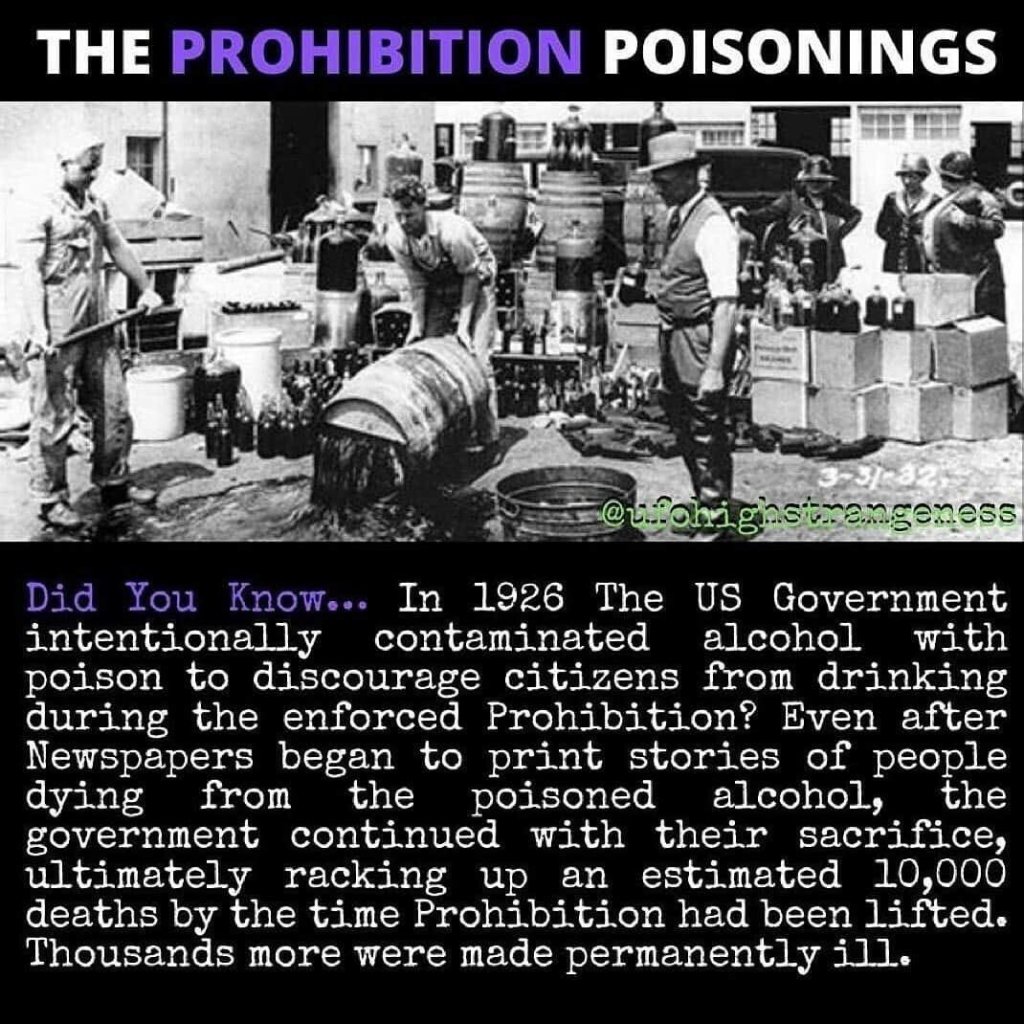
Why the Feds Intentionally Poisoned Americans During Prohibition, Killing Thousands—and Why You’ve Never Heard about It

I was recently invited to speak to a student group about alcohol prohibition. During the course of my talk, I shared with them perhaps the most chilling historical account of America’s failed experiment to ban the sale of alcohol.

The Prohibition Era (1920 -1933), which began with the passage of the Volstead Act, had many problems. Virtually overnight, millions of Americans became criminals for the “crime” of having a drink. Instead of people trading money for a jug of beer or a bottle of gin, they had to make their own or turn to the black market. It resulted in a surge of organized crime and the rise of many of the most notorious gangsters in history, including Al Capone, Dutch Schultz, and Charles “Lucky” Luciano.

“In the absence of Prohibition, we wouldn’t have had the kind of syndicated criminality that occurred. Prohibition was the catalyst,” explains Howard Abadinsky, professor of criminal justice at St. John’s University and the author of the book Organized Crime.

One might think the surge of organized crime—which resulted in a corresponding surge of law enforcement to suppress it—would be the darkest consequence of Prohibition. It was not.

Keep reading

One Year On… Navalny Poison Pulp Fiction – Surprisingly – Provides a Real Conclusion

There is no doubt Navalny is an asset for Western intelligence agencies assigned to subvert Russia from within with his scripted media antics.

The hallmark of a shoddy, pulp fiction story is it quickly fades from memory. It’s a bit like lots of other made-for-fast-consumption experiences: fast-food, trashy news, infotainment, drugs, or indeed propaganda stunts. It’s sold brashly with gaudy packaging but the intended substance is lacking. Hence, in a short period, the experience and memory vanish leaving a disappointing void.

The alleged poisoning of Russian blogger and political gadfly Alexei Navalny is a case in point. It was one year ago that he dramatically fell ill while on a flight from Siberia. He was rushed to hospital where the Russian doctors stabilized his condition. The medics found nothing extraneous in his body fluids and suggested he was suffering from a medical reaction. Two days later, Navalny was permitted by the Russian government to be flown on a private airplane for treatment in Germany. Within days, the Berlin authorities were claiming he had been poisoned with a Soviet-era nerve agent, Novichok. (After body samples had been analyzed at a Bundeswehr military laboratory!)

This was the same nerve poison that was allegedly used by Kremlin assassins against Russian traitor-spy Sergei Skripal and his daughter in England in March 2018. Remember the Western media kerfuffle over that drama, the diplomatic expulsions and sanctions? Where have all the expressions of concern about that obscure incident gone? Indeed, where are the Skripals now? The British authorities like a conjuror refuse to disclose the whereabouts of the disappeared. The silence is beyond bizarre.

As with the Skripal case, there then followed a torrent of accusations from Western governments and media claiming that Navalny had likewise been the victim of an assassination plot by the Kremlin. There were grave demands for Moscow to conduct a criminal investigation into the alleged poisoning of Navalny.

One year on, Western governments and media have stopped playing to the gallery with unsubstantiated claims about Navalny. Even the blogger himself, who is now serving three years in a Russian jail for financial corruption, has stopped talking about it. Last year, while allegedly convalescing in Germany for five months in violation of his probation terms for an earlier suspended conviction by a Russian court, Navalny made sensational claims that President Vladimir Putin had personally ordered his assassination. Western media indulged and amplified the slander. Then he returned to Russia in January, whereupon the Russian prison authorities detained him and converted his suspended sentence into jail time. Rightly so, too.

Laughably, the prisoner has been free to give interviews to prominent Western media outlets. So much for him being “persecuted in a penal colony”!

Last week, he wrote an opinion piece for the British Guardian and this week gave an interview to the New York Times. Strangely, however, he barely mentions the purported assassination plot that Putin had allegedly ordered. That shows, inadvertently, that not even Navalny has any conviction in peddling the preposterous story.

The contradiction and absurdities in the Navalny saga, as with the Skripal “prequel”, are legion. A detailed account of official communications from the Russian foreign ministry demonstrates how the German authorities have refused to follow basic standards of informational exchange with Moscow on the provenance of claims made by Navalny that have been amplified by Berlin and other Western governments. That refusal, like the British one over the Skripal affair, is a shocking dereliction of diplomatic standards and due process.

As with so many other anti-Russian tropes – from election meddling to cyber attacks – there is an absolute dearth of evidence provided to back up accusations. The accusations are recklessly repeated over and over and thereby take on the appearance of being established facts (The Big Lie technique of Josef Goebbels no less). When in fact the claims are always fiction.

Keep reading

America’s Drinking Water Is Surprisingly Easy to Poison

On Feb. 16, less than two weeks after a mysterious attacker made headlines around the world by hacking a water treatment plant in Oldsmar, Florida, and nearly generating a mass poisoning, the city’s mayor declared victory.

“This is a success story,” Mayor Eric Seidel told the City Council in Oldsmar, a Tampa suburb of 15,000, after acknowledging “some deficiencies.” As he put it, “our protocols, monitoring protocols, worked. Our staff executed them to perfection. And as the city manager said, there were other backups. … We were breached, there’s no question. And we’ll make sure that doesn’t happen again. But it’s a success story.” Two council members congratulated the mayor, noting his turn at the press conference where the hack was disclosed. “Even on TV, you were fantastic,” said one.

Get Our Top Investigations

Subscribe to the Big Story newsletter.Email address:

“Success” is not the word that cybersecurity experts use to describe the Oldsmar episode. They view the breach as a case study in digital ineptitude, a frightening near-miss and an example of how the managers of water systems continue to downplay or ignore years of increasingly dire warnings.

The experts say the sorts of rudimentary vulnerabilities revealed in the breach — including the lack of an internet firewall and the use of shared passwords and outdated software — are common among America’s 151,000 public water systems.

“Frankly, they got very lucky,” said retired Adm. Mark Montgomery, executive director of the federal Cyberspace Solarium Commission, which Congress established in 2018 to upgrade the nation’s defenses against major cyberattacks. Montgomery likened the Oldsmar outcome to a pilot landing a plane after an engine caught fire during a flight. “They shouldn’t celebrate like Tom Brady winning the Super Bowl,” he said. “They didn’t win a game. They averted a disaster through a lot of good fortune.”

Keep reading

Popular flea collar linked to almost 1,700 pet deaths. The EPA has issued no warning.

Rhonda Bomwell had never used a flea and tick collar before. Pierre, her 9-year-old Papillon service dog, was mostly an indoor animal.

Still, her veterinarian recommended she purchase one, so Bomwell went to the pet store near her home in Somerset, New Jersey, and selected Bayer’s Seresto collar. 

A day later, on June 2, 2020, Pierre had a seizure, collapsing while Bomwell was making dinner. Lying on his back, the dog stopped breathing and his eyes rolled back. 

Bomwell tried giving him CPR. Then she called the police. An officer helped her lift the dog into her car, and she rushed him to the hospital. Pierre died before he could receive medical treatment. Bomwell didn’t think to take off Pierre’s collar.

“I just didn’t put it together,” she said.

Bomwell isn’t alone. Seresto, one of the most popular flea and tick collars in the country, has been linked to hundreds of pet deaths, tens of thousands of injured animals and hundreds of harmed humans, U.S. Environmental Protection Agency documents show.

Yet the EPA has done nothing to inform the public of the risks.

Seresto, developed by Bayer and now sold by Elanco, works by releasing small amounts of pesticide onto the animal for months at a time. The pesticide is supposed to kill fleas, ticks and other pests but be safe for cats and dogs. 

Keep reading