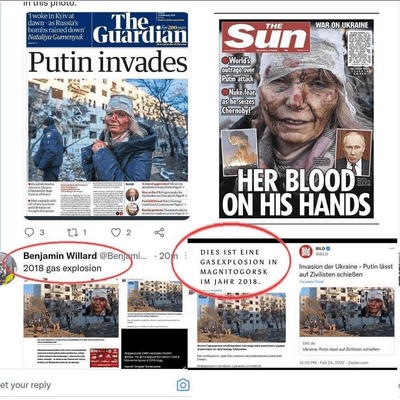
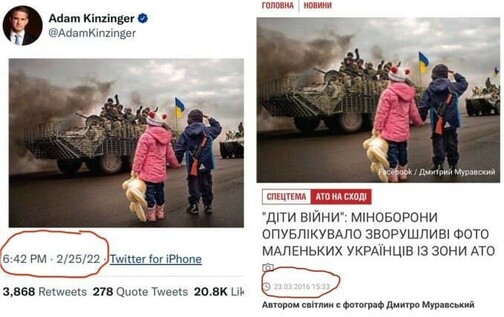
Still more fake headlines…

Duped by a troll account, US and Australian journalists have spread misinformation that Proud Boys are traveling to eastern Europe to fight for Russia.
“We have lift off! See you when we return Australia. Brothers staying behind look after this great nation. We will return with great gifts for all! #Ukraine #bridewive,” troll account “Proud Boys Southern Tablelands” tweeted Friday. [The account had around 10 followers at the time of the tweet.]
The clip uploaded by the Twitter account is taken from an old video posted by a YouTuber in 2018 flying from Sydney to Hong Kong.
The same troll account also posted: “Proud Boys Southern Tablelands is sending a group of 8 of their best on a flight from Sydney to Poland 1610 tomorrow. We will be rendezvousing with our Brothers from Proud Boys chapters all over the world and be making our way by foot to Ukraine to help Vlad. Pray for us. Uhuru!”
Predictably, the mainstream media took the bait. Before long, the hoax was soon picked up and spread by blue check personalities on Twitter who expressed collective shock and outrage that the right-wing group would attempt such a feat.
Among those who believed a troll account posting flight take-off footage from 2018 was current include Twitter-verified ABC (Australian Broadcasting Corporation) News journalist Max Walden and ABC’s RN Breakfast host Patricia Karvelas.
“I’m concerned about Russian disinformation spreading online, so today I wrote to the CEOs of major tech companies to ask them to restrict the spread of Russian propaganda,” US Senator Mark Warner tweeted on Friday.
Since then YouTube has announced that it has suppressed videos by Russian state media channels so that they’ll be seen by fewer people in accordance with its openly acknowledged policy of algorithmically censoring unauthorized content, as well as de-monetizing all such videos on the platform. Google and Facebook/Instagram parent company Meta both banned Russian state media from running ads and monetizing on their platforms in response to Russia’s invasion of Ukraine. Twitter announced a pause on ads in both Russia and Ukraine.
“Glad to see action from tech companies to reign in Russian propaganda and disinformation after my letter to their CEOs yesterday,” Warner tweeted on Saturday. “These are important first steps, but I’ll keep pushing for more.”
For years US lawmakers have been using threats of profit-destroying consequences to pressure Silicon Valley companies into limiting online speech in a way that aligns with the interests of Washington, effectively creating a system of government censorship by proxy. It would appear that we’re seeing a new expansion of this phenomenon today.
There is a common thread appearing from the establishment left as the Ukraine crisis unfolds — everyone who opposes US intervention in Ukraine is a “Russian sympathizer puppet of Vladimir Putin.”
This is a page directly out of the neocon war manual used to demonize anyone who doesn’t support the US war machine and it’s getting old.
Those old enough to recall, remember a time during the buildup to the Iraq war in which the phrase “you’re either with us, or you’re with the terrorists,” was oft repeated by the neocon Republican war hawks. Because 9/11 was fresh in the minds of Americans, many folks actually believed this nonsense that if you opposed the US war machine, you are a terrorist.
After decades of senseless wars in which thousands of Americans died and hundreds of thousands of innocent civilians were slaughtered — only then did Americans learn they made a mistake.
One particularly loud voice who stood up against the wars decades ago was Cenk Uygur, who began lashing out in the early 2000s at HuffPo. Uygur’s loud antiwar voice propelled him to a show on MSNBC and eventually his own show, The Young Turks.
But as many of his previous viewers likely noticed over the years, Uygur has gone full-on establishment shill. No longer does he question wars. Instead, he now ridicules others for daring to speak out and slanders entire groups of people who dare propose peaceful solutions to what could become World War 3.
How stupid does this have to get?
We are referring to Sleepy Joe’s chastisement of Vlad Putin regarding his intervention in the breakaway republics of the Donbas:
“Who in the Lord’s name does Putin think gives him the right to declare new so-called countries on territory that belonged to his neighbors?” Biden had questioned in his major Tuesday address from the White House the east room. “This is a flagrant violation of international law, and it demands a firm response from the international community.”
Good question to ask yourself, Joe!
This is you with the former president and prime minister of the breakaway republic of Kosovo, Hashim Thaci (who is now wanted for war crimes). It was taken after America bombed it free of its rightful owner, Serbia, thereby paving the way for this Independence Day celebration in May 2009 attended by Vice-President Biden.
Indeed, unlike the breakaway provinces of Donetsk and Luhansk, which are ethnically and linguistically Russian in a Ukrainian nation, the province of Kosovo was the cradle of Serbia’s cultural and national identity and thereby an integral part of Serbia’s sovereign territory.
So, far from being a case of one state committing aggression against another, this conflict was a classic civil war. And the aggressor was the province’s ethnic (Muslim) Albanians, who mounted an armed struggle to break free of Serbia and establish an independent state. And, of course, their ample modern arms and munitions, which were deployed with barbaric ferocity against the Serbs (who did likewise against the Albanians), were supplied by Washington.
As the U.N. human rights representative, Jiri Dienstbier, observed at the time:
…..spring ethnic cleansing by Serbs was “replaced by the fall ethnic cleansing of Serbs, Romas, Bosniaks and other non-Albanians accompanied by the same atrocities.”
Needless to say, these Washington agents weren’t little green men like the Russians who allegedly descended upon the Donbas back in 2014, but CIA, State Department and NED (National Endowment for Democracy) operatives functioning overtly under the banner of the stars and stripes.

+ Neo-Nazis in Ukraine, neo-Romanovs in Moscow, NATO expansionists in the western capitals, shale oil companies and natural gas conglomerates, if this devolves into a war it’s going to make World War I seem like a battle of clean hands.
+ Can we roll the tape back for a sec? Did Biden say, he’s “convinced Putin will invade” or that he’s “convinced Putin to invade?”
+ Chunk by chunk, Putin reconstructs the old Tsarist empire giving the US the excuse to cite “Russian expansionism” as justification for another massive build-up of the kind of big ticket transcontinental weaponry that had gone out of fashion during the Global War on Terror. It’s a win-win scenario for the two super powers & a blank check for weapons contractors. NATO, however, is exposed as an impotent entity, which should serve as a timely warning to any other nations seeking to join it. Tough luck for those caught in the crossfire, per usual.
+ I’ve never taken claims of Russian penetration of the US government too seriously, but if there’s one figure who seems to have served as an effective Russian agent, though an unwitting one, it would have to be the anti-Russia scold Victoria Nuland, whose bellicose taunting of the Kremlin in both the Obama and Biden administrations seems to have motivated Putin to acquire, or reacquire (depending on your point-of-view), not only Crimea but Donetsk and Luhansk on her own watch. Years from now, when the clue on Jeopardy! is: The American diplomat who lost Ukraine. The answer will be: Who is Victoria Nuland.
 Hellbound and Down
You must be logged in to post a comment.