Progressive critics of the Trump Administration’s response to the coronavirus pandemic like to point to Sweden and portray the Nordic country’s decision to forego lockdowns as a travesty motivated by greed. Such reductive, black-and-white interpretations are inevitably the result of a childlike analysis where every hero needs to have a hero and a villain. But although Sweden’s COVID-19 czar has admitted that he would have changed certain elements of the country’s response if he could go back in time, the country’s decision to skip lockdowns, and keep the country relatively open, has paid off – even if Sweden does have a significantly higher mortality rate than its neighbors (though still lower than all of the worst-hit western European countries).
Tag: pandemic
The COVID-Hysteria Campaign – The Ultimate Divide And Conquer Strategy
“It has frequently been observed that terror can rule absolutely only over people who are isolated against each other and that therefore one of the primary concerns of tyrannical government is to bring this isolation about. Isolation may be the beginning of terror; it certainly is its most fertile ground; it always is its result. This isolation is, as it were, pretotalitarian; its hallmark is impotence insofar as power always comes from people acting together, acting in concert; isolated people are powerless by definition.”
– Hannah Arendt, The Origins of Totalitarianism
Western civilization, led by the US government and media, has embarked upon a campaign of mass psychological terrorism designed to cover for the collapsing economy, set up a new pretext for Wall Street’s ongoing plunder expedition, radically escalate the police state, deeply traumatize people into submission to total social conformity, and radically aggravate the anti-social, anti-human atomization of the people.
The pretext for this abomination is an epidemic which objectively is comparable to the seasonal flu and is caused by the same kind of Coronavirus we’ve endured so long without totalitarian rampages and mass insanity.
The global evidence is converging on the facts: This flu is somewhat more contagious than the norm and is especially dangerous for those who are aged and already in poor health from pre-existing maladies. It is not especially dangerous for the rest of the population.
The whole concept of “lockdowns” is exactly upside down, exactly the wrong way any sane society would respond to this circumstance.
It’s the vulnerable who should be shielded while nature takes its course among the general population, who should go about life as usual. Dominionist-technocratic rigidity can’t prevent an epidemic from cycling through the population in spite of the delusions of that religion, especially since Western societies began their measures far too late anyway.
So it’s best to let herd immunity develop as fast as it naturally will, at which time the virus recedes from lack of hosts (and is likely to mutate in a milder direction along the way). This is the only way to bring a safer environment for all including the most vulnerable.
The fact that most societies have rejected the sane, scientific route in favor of doomed-to-fail attempts at a forcible violent segregation and sterilization is proof that governments aren’t concerned with the public health (as if we didn’t know that already from a thousand policies of poisoning the environment while gutting the health care system), but are very ardent to use this crisis they artificially generated in order radically to escalate their police state power toward totalitarian goals.
Will travel be safer by 2022?
It’s 2022 and you’ve just arrived at the travel destination of your dreams. As you get off the plane, a robot greets you with a red laser beam that remotely takes your temperature. You’re still half asleep after a long transoceanic flight, so your brain barely registers the robot’s complacent beep. You had just passed similar checks when boarding the plane hours ago so you have nothing to worry about and can just stroll to the next health checkpoint.
As you join the respiratory inspection queue, a worker hands you a small breathalyser capsule with a tiny chip inside. Conceptually, the test is similar to those measuring drivers’ alcohol levels, but this one detects the coronavirus particles in people’s breath, spotting the asymptomatic carriers who aren’t sick but can infect others. By now you know the drill, so you diligently cough into the capsule and drop it into the machine resembling a massive microwave. You wait for about 30 seconds and the machine lights up green, chiming softly. You may now proceed to immigration, so you fumble for your passport and walk on.
These technologies may sound like science fiction, yet they are anything but. If you had travelled earlier this year when countries began locking down, you may have already spotted the remote infrared thermometers used in airports. However, while thermometers are helpful, they aren’t ideal. People can have fevers for others reasons or may harbour coronavirus without symptoms. To spot early infections or asymptomatic carriers, one has to check for the coronavirus particles in their breath.
That’s where the breathalyser comes in. You haven’t yet seen it at transit hubs, but it already exists at the photonics lab of Gabby Sarusi, professor at Ben-Gurion University of the Negev in Israel. When Covid-19 struck and hospitals worldwide struggled to build fast and accurate biological diagnostic tests, Sarusi looked at the problem differently. As a physicist, he viewed the coronavirus’ spiky sphere not as a biological agent but as a nano-sized particle that can be sensed by specialised electrical equipment. When tossed into the midst of an electromagnetic field, the particles cause certain “interference” to the flow of electromagnetic waves, which can be detected. That’s what happens when the capsule is dropped into the microwave-resembling machine.
“We are taking the chip inside the capsule and we’re measuring it with a spectrometer that’s radiated with the magnetic waves,” Sarusi explained. If coronavirus particles are present, he said, “we can sense the shift.”
Fear is the new virtue…

Karen sez…

When It Comes To Masks, There Is No “Settled Science”
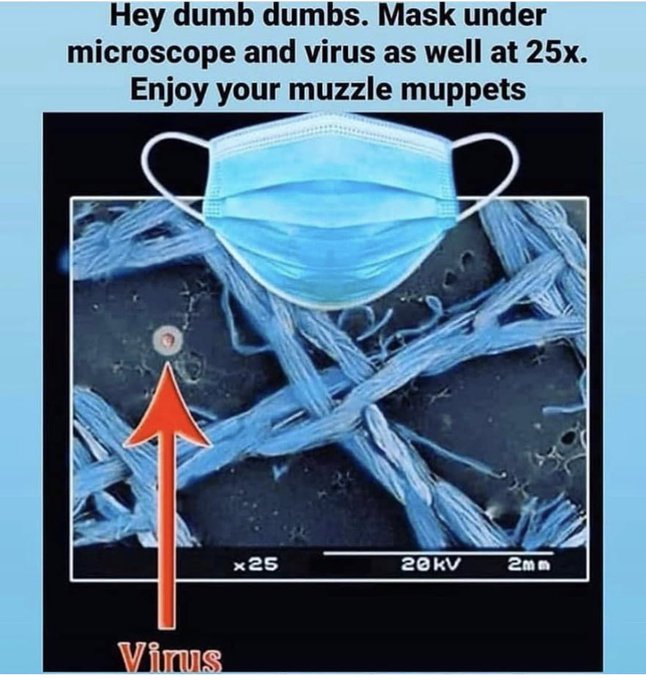
The literature on masks broadly looks at the efficacy of different types of masks and their efficacy at preventing particle penetration (controlled studies) and the likelihood of infectious spread (case studies of healthcare workers). Other studies question the detrimental effects of masks, particularly with prolonged use. Cloth masks, which have become the norm for public use, have been shown to have penetration rates as high as 97% according to a BMJ study (which used to stand for the British Medical Journal, but is now titled by its acronym). A study of the use of cloth masks during the far more serious 1918 influenza pandemic showed no beneficial results, and another study demonstrates that cloth masks are particularly ineffective compared with medical masks. Surgical and cotton medical masks fared better, but still with discouraging results overall (see here, here, here, here, and here).
As masks-for-all advocates are quick to point out, N95 respirators do show beneficial results in containing viral infections, but these are virtually unworn by the public (and they have only recently become available to those outside of the healthcare profession).
Hydroxychloroquine
If you’ve watched the news lately, you might be under the impression that a medicine President Trump touted as a possible game changer against coronavirus — has been debunked and discredited. Two divergent views of the drug, hydroxychloroquine, have emerged: the negative one widely reported in the press and another side you’ve probably heard less about. Never has a discussion about choices of medicine been so laced with political overtones. Today, how politics, money and medicine intersect with coronavirus.
The Key to Defeating COVID-19 Already Exists. We Need to Start Using It
As professor of epidemiology at Yale School of Public Health, I have authored over 300 peer-reviewed publications and currently hold senior positions on the editorial boards of several leading journals. I am usually accustomed to advocating for positions within the mainstream of medicine, so have been flummoxed to find that, in the midst of a crisis, I am fighting for a treatment that the data fully support but which, for reasons having nothing to do with a correct understanding of the science, has been pushed to the sidelines. As a result, tens of thousands of patients with COVID-19 are dying unnecessarily. Fortunately, the situation can be reversed easily and quickly.
I am referring, of course, to the medication hydroxychloroquine. When this inexpensive oral medication is given very early in the course of illness, before the virus has had time to multiply beyond control, it has shown to be highly effective, especially when given in combination with the antibiotics azithromycin or doxycycline and the nutritional supplement zinc.
On May 27, I published an article in the American Journal of Epidemiology (AJE) entitled, “Early Outpatient Treatment of Symptomatic, High-Risk COVID-19 Patients that Should be Ramped-Up Immediately as Key to the Pandemic Crisis.” That article, published in the world’s leading epidemiology journal, analyzed five studies, demonstrating clear-cut and significant benefits to treated patients, plus other very large studies that showed the medication safety.
Physicians who have been using these medications in the face of widespread skepticism have been truly heroic. They have done what the science shows is best for their patients, often at great personal risk. I myself know of two doctors who have saved the lives of hundreds of patients with these medications, but are now fighting state medical boards to save their licenses and reputations. The cases against them are completely without scientific merit.
Since publication of my May 27 article, seven more studies have demonstrated similar benefit. In a lengthy follow-up letter, also published by AJE, I discuss these seven studies and renew my call for the immediate early use of hydroxychloroquine in high-risk patients. These seven studies include: an additional 400 high-risk patients treated by Dr. Vladimir Zelenko, with zero deaths; four studies totaling almost 500 high-risk patients treated in nursing homes and clinics across the U.S., with no deaths; a controlled trial of more than 700 high-risk patients in Brazil, with significantly reduced risk of hospitalization and two deaths among 334 patients treated with hydroxychloroquine; and another study of 398 matched patients in France, also with significantly reduced hospitalization risk. Since my letter was published, even more doctors have reported to me their completely successful use.
Why aren’t you masked?

Divide and conquer…face mask edition…

You must be logged in to post a comment.