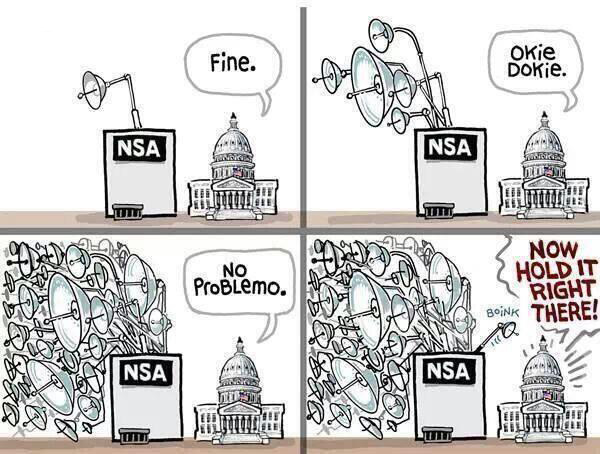
Sauce for the goose?

Enacted at the height of the Cold War, the NSA Act gives the agency radically sweeping powers to withhold any information from public disclosure. Specifically, Section 6 of the Act states “…nothing in this Act or any other law…shall be construed to require the disclosure of the organization or any function of the National Security Agency, or any information with respect to the activities thereof, or of the names, titles, salaries, or number of the persons employed by such agency.”
NSA has used that blanket authority to try to keep secret details about its lethal 9/11 intelligence failure. A Freedom of Information Act (FOIA) lawsuit I brought on behalf of the Cato Institute against the Defense Department (NSA’s parent organization) in January 2017 has, after over three-and-a-half years in federal court, partially punctured NSA’s veil of secrecy over the cancelled TRAILBLAZER and THINTHREAD digital network exploitation (DNE) programs.
In brief, during the five-year period leading up to the 9/11 attacks, a bureaucratic war raged inside of NSA over the best way to handle the exploding volume of digital communications the agency was trying to keep up with. On one side was a group of veteran NSA cryptographers, mathematicians and computer scientists who developed a cheap, extremely effective, and Constitutionally compliant in-house DNE system codenamed THINTHREAD. On the other side was then-NSA Director Michael Hayden, who favored an unproven, external, contractor developed DNE system called TRAILBLAZER. When then-GOP House Intelligence Committee staffer Diane Roark got the THINTHREAD team development money and language in the FY 2002 Intelligence Authorization bill directing wider deployment of the cheaper, off-the-shelf THINTHREAD system, Hayden refused to deploy it as directed — even though THINTHREAD, still in prototype development, was already producing intelligence NSA couldn’t get from any of its other existing systems.
The National Security Agency program that swept up details on billions of Americans’ phone calls was illegal and possibly unconstitutional, a federal appeals court ruled Wednesday.
However, the unanimous three-judge panel of the 9th Circuit Court of Appeals said the role the so-called telephone metadata program played in a criminal terror-fundraising case against four Somali immigrants was so minor that it did not undermine their convictions.
The long-awaited decision is a victory for prosecutors, but some language in the court’s opinion could be viewed as a rebuke of sorts to officials who defended the snooping by pointing to the case involving Basaaly Moalin and three other men found guilty by a San Diego jury in 2013 on charges of fundraising for Al-Shabaab.
Judge Marsha Berzon’s opinion, which contains a half-dozen references to the role of former NSA contractor and whistleblower Edward Snowden in disclosing the NSA metadata program, concludes that the “bulk collection” of such data violated the Foreign Intelligence Surveillance Act.
The call-tracking effort began without court authorization under President George W. Bush following the Sept. 11, 2001, terrorist attacks. A similar program was approved by the secretive FISA Court beginning in 2006 and renewed numerous times, but the 9th Circuit panel said those rulings were legally flawed.
The appeals court stopped just short of saying that the snooping was definitely unconstitutional, but rejected the Justice Department’s arguments that collecting the metadata did not amount to a search under a 40-year-old legal precedent because customers voluntarily share such info with telephone providers.



 Hellbound and Down
You must be logged in to post a comment.