
The Long Sordid Career of Creepy Joe Biden

I get complaints from people that I concentrate too much on Donald Trump. Basically, the message is, “But what about Biden?” I do write more about Trump, because he’s the face of the perceived opposition. The only Emmanuel Goldstein in town. I assume everyone reading me understands just who and what Joe Biden is.

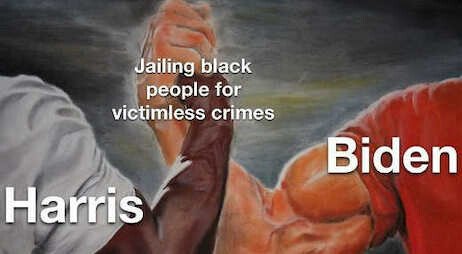
But people might not remember quite everything about Joe Biden’s lengthy career as a beloved resident of the Washington, D.C. swamp that Trump promised to drain. Biden was first elected as a U.S. Senator from Delaware in 1973. Even I was very young then. In 1981, the great “liberal” senator strongly supported the Intelligence Identities Protection Act, passed in the wake of CIA whistleblower Philip Agee’s disclosures about the Agency is his best-selling book Inside the Company. Biden declared that “I do not think anybody has any doubt about Mr. Agee. We should lock him away in my opinion.” The good senator really liked locking people up, it seems. As a strong supporter of the 1986 Anti-Drug Abuse Act, he took credit for a draconian provision that mandated a five year sentence for possessing small amounts of crack cocaine.

Little did Biden know that, decades later his own troubled son Hunter would be caught with enough crack cocaine to garner a long prison sentence under the original 1986 Act, which was softened a bit in 2010. With every ounce of “liberal” ardor that he could muster, Biden bragged at the time, “If you have a piece of crack cocaine no bigger than this quarter that I’m holding in my hand, one quarter of one dollar, we passed a law — with leadership of Sen. Thurmond and myself and others — a law that says: you’re caught with that, you go to jail for five years. You get no probation, you get nothing, other than five years in jail. Judge doesn’t have a choice.” Senator Biden also authored the horrendous 1994 crime bill which featured “three strike you’re out” and mandatory sentencing, significantly increasing the prison population.

A JFK assassination researcher attended a Joe Biden seminar in 2005. He was able to briefly question Biden about the assassination. As recounted on a discussion forum, this was the short conversation: “Senator Biden, do you believe JFK was killed as a result of a conspiracy?” Answer:  “No.” “So do you believe that Lee Harvey Oswald, alone and unaided, killed President Kennedy?” Answer:  “Yes.” This is hardly surprising, of course, but reflects Biden’s ironclad establishment mindset. In 2019, the American Prospect published a piece headlined, “Joe Biden’s Love Affair With the CIA.” Biden was very helpful to Reagan’s CIA Director William Casey, who praised him in a classified early 1980s memo to his intelligence staff. Biden would state, in a speech at Stanford, that the intelligence community had been compromised by leaks.

Keep reading

Living Everywhere in a Carceral Surveillance State

If you live in a Chinese city, or even in London, you are probably so used to surveillance cameras all around you – on lamp posts, the corners of buildings, and so on – that you would hardly bat an eyelid. Yet what contemporary city-denizens take for granted was not always the case, and most people would be surprised to know that surveillance has a long history, and was linked to modes of punishment from early on.

The thinker who brought us the history of punishment, linked with surveillance, was Michel Foucault, who died prematurely in 1984, and whose thesis of ‘panopticism’ I referred to in an earlier post. His work is an inexhaustible source of insight regarding the way in which one enters into a relationship with history – something that is not self-evident, but requires careful consideration of the contingent, usually unpredictable factors which have contributed to the present state of affairs. This insight also opens the way for a critique of current social practices, which may otherwise seem self-justifying and necessary. 

Foucault’s writings on enlightenment suggest that there is a fundamental difference between ‘enlightenment’ in the Kantian sense, which emphasised the universal moment of scientific and philosophical knowledge, and ‘enlightenment’ in the sense of a philosophy of the contemporary present, which would do justice to both the (Kantian) universal as well as what is contingent and particular, which is not subject to historical laws, deterministically conceived.

In his essay, What is enlightenment? (in The Foucault Reader, ed. Rabinow, P., New York: Pantheon Books, pp. 32-50), Foucault argues that Kant’s emphasis on the universal should be amplified by Baudelaire’s characterisation of the modern in terms of a tension between being and becoming (or the universal and the particular), in this way finding the ‘eternal’ (or enduringly valuable) in the transitory, historically contingent moment. For Baudelaire, this amounts to a species of self-invention.

Foucault, however, maintains that such self-invention would enable one to turn Kant’s critique into one that is pertinent for the present time, by inquiring what there is, in what we have been taught to accept as being necessary and universalwhich we no longer are, or want to be, thus practising a kind of ‘transgressive’ enlightenment. This, I would like to show, is highly germane to the time in which we find ourselves, and by scrutinising the history that has brought us to our fraught present, we should be in a better position to identify what it is that we no longer want to be.

Keep reading

I’m a former prosecutor. The ‘War on Drugs’ incentivizes convictions, not justice

Political campaigns are heating up, and politicians are jostling for clickbait by taking jabs and attacking the First Step Act. Not only do these attacks grievously mischaracterize a law that has been a boon to public safety – but they also mischaracterize some of the people involved in its passage, including a woman named Alice Marie Johnson.  

Her name might be familiar. Alice was sentenced to life in prison in 1997 as a first-time, nonviolent offender. She became the national face of criminal justice reform when she was granted clemency by President Trump in 2018 after Kim Kardashian, fueled by the unfairness of Alice’s prison sentence, lobbied for her release.  

I know Alice personally – I’ve worked with her since her release on many criminal justice reform issues, including the passage of the First Step Act. That’s why seeing her referred to in the media as a “career criminal” and “kingpin” is so shocking. But this is not the first time Alice has been misrepresented. Her story was first warped during her trial by prosecutors who manipulated drug laws – not to nab a drug “queen pin,” but to pin the blame on the little guy.

Keep reading

Circle the Wagons: The Government Is On The Warpath

“Once a government is committed to the principle of silencing the voice of opposition, it has only one way to go, and that is down the path of increasingly repressive measures, until it becomes a source of terror to all its citizens and creates a country where everyone lives in fear.”—Harry S. Truman

How many Americans have actually bothered to read the Constitution, let alone the first ten amendments to the Constitution, the Bill of Rights (a quick read at 462 words)?

Take a few minutes and read those words for yourself—rather than having some court or politician translate them for you—and you will be under no illusion about where to draw the line when it comes to speaking your mind, criticizing your government, defending what is yours, doing whatever you want on your own property, and keeping the government’s nose out of your private affairs.

In an age of overcriminalization, where the average citizen unknowingly commits three crimes a day, and even the most mundane activities such as fishing and gardening are regulated, government officials are constantly telling Americans what not to do.

Yet it was not always this way.

It used to be “we the people” giving the orders, telling the government what it could and could not do. Indeed, the three words used most frequently throughout the Bill of Rights in regards to the government are “no,” “not” and “nor.”

Compare the following list of “don’ts” the government is prohibited from doing with the growing list of abuses to which “we the people” are subjected on a daily basis, and you will find that we have reached a state of crisis wherein the government is routinely breaking the law and violating its contractual obligations.

For instance, the government is NOT allowed to restrict free speech, press, assembly or the citizenry’s ability to protest and correct government wrongdoing. Nevertheless, the government continues to prosecute whistleblowerspersecute journalists, criminalize expressive activities, crack down on large gatherings of citizens mobilizing to voice their discontent with government policies, and insulate itself and its agents from any charges of wrongdoing (or what the courts refer to as “qualified immunity”).

The government may NOT infringe on a citizen’s right to defend himself. Nevertheless, in many states, it’s against the law to carry a concealed weapon (gun, knife or even pepper spray), and the average citizen is permitted little self-defense against militarized police officers who shoot first and ask questions later.

The government may NOT enter or occupy a citizen’s house without his consent (the quartering of soldiers). Nevertheless, government soldiers (i.e., militarized police) carry out more than 80,000 no-knock raids on private homes every year, while maiming children, killing dogs and shooting citizens.

The government may NOT carry out unreasonable searches and seizures on the citizenry or their possessions, NOR can government officials issue warrants without some evidence of wrongdoing (probable cause). Unfortunately, what is unreasonable to the average American is completely reasonable to a government agent, for whom the ends justify the means. In such a climate, we have no protection against roadside strip searches, blood draws, DNA collection, SWAT team raids, surveillance or any other privacy-stripping indignity to which the government chooses to subject us.

The government is NOT to deprive anyone of life, liberty or property without due process. Nevertheless, the government continues to incarcerate tens of thousands of Americans whose greatest crime is being poor and not white. The same goes for those who are put to death, some erroneously, by a system weighted in favor of class and wealth.

Keep reading

Trump Advocates Mass Incarceration, ‘Tent Cities’ To Address Homelessness

On April 18, former President Donald Trump posted a video on his Truth Social account titled “Homelessness Plan.” In it, Trump alleged that “the homeless, the drug-addicted, and the violent and dangerously deranged” had ruined America’s cities, “turn[ing] every park and sidewalk into a place for them to squat and do drugs.” He promised, “When I’m back in the White House, we will use every tool, lever, and authority” to “end the scourge of homelessness and make our cities clean and safe and beautiful once again.”

How would he accomplish this? “Working with states, we will ban urban camping wherever possible…. We will then open up large parcels of inexpensive land; bring in doctors, psychiatrists, social workers, and drug rehab specialists; and create tent cities where the homeless can be relocated and their problems identified.”

Treatment would be catered to individual need: “For those who have addictions, substance abuse, and common mental health problems, we will get them into treatment. And for those who are severely mentally ill and deeply disturbed, we will bring them back to mental institutions where they belong, with the goal of reintegrating them back into society once they are well enough to manage.”

Trump’s plan may sound magnanimous, but it’s anything but. First off, there’s no telling what such a plan, or for that matter any plan, would cost. Advocates often say that the Department of Housing and Urban Development (HUD) estimates $20 billion as the cost of ending homelessness in America. But that number was an informal, unverified estimate of the annual cost in 2012. And as Nan Roman, president and CEO of the National Alliance to End Homelessness, told VERIFY in 2021, “It’s not so difficult to figure out what it would cost to end homelessness for everyone who is homeless tonight…. The problem is that more people BECOME homeless every day because they don’t earn enough to pay for housing – we’re 7 million housing units short to meet the needs of low-income people.”

Keep reading

BACKGROUND CHECK INDUSTRY PROFITS OFF ‘DIGITAL PUNISHMENT,’ DESPITE FLAWED DATA

Tony Taylor was not anticipating becoming the center of a class action lawsuit when he attempted to rent an apartment through Airbnb in 2020. But when a standard background check by a third-party provider turned up a violent felony on Taylor’s record, the short-term rental company informed him that it had permanently banned him from using their services.

Taylor was perplexed. He’d been through countless background and credit checks before. And he thought the crime in question was well behind him: In 2014, Taylor—who spent years working in the security and personal protection field—carried his Glock handgun into Minneapolis City Hall. Unbeknownst to Taylor, he was bringing a firearm into a building with a courthouse in it. And, as such, he was accidentally committing a felony under Minnesota law, even though he says he never removed his licensed weapon from its locked holster.

Minneapolis police arrested Taylor and charged him with “dangerous weapon possession in a courthouse.” His wife, Sarah, was also arrested during the incident.

Rather than take on the costs associated with a criminal trial, Taylor decided to plead guilty. He was sentenced to 30 days in jail. As part of the plea, his crime would be reduced to a misdemeanor if he completed three years of probation.

Six years later, Taylor assumed the consequences of his run-in with the criminal legal system had been laid to rest. He had completed his probation and maintained good legal standing since the arrest.

However, Inflection Risk Solutions, a private company that provides background checks for employers and services like Airbnb, had erroneously reported that Taylor was a violent criminal. After seeing errors on his background check, Taylor requested a report for his wife, who was convicted of the same charge, to ensure any mistakes could be corrected. Her records contained the same error, and Inflection Risk had even duplicated her charges, listing her as having two violent felonies.

“At this point, I’m pissed,” Taylor said in an interview with The Appeal. “How dare you call me a violent felon. The reason why I was in security was to keep people safe, not to hurt people.”

Neither Inflection Risk nor Airbnb responded to a request for comment.

As the Taylors fought to correct the record, they would soon discover that they were far from the only ones whom private background check companies like Inflection Risk had harmed.

Keep reading