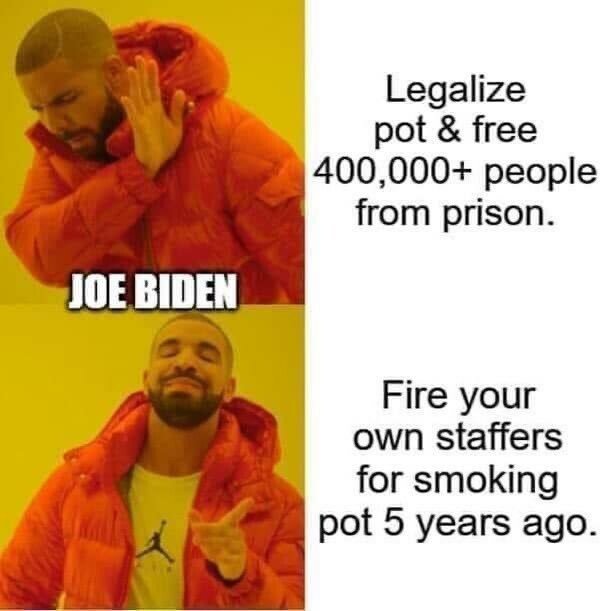
Fire Kamala next!

President Joe Biden’s White House reportedly has clamped down on staffers who admitted using marijuana in the past, even those from states where the drug has been legalized, with some being suspended or asked to resign, according to former staffers.
Although the Biden administration officially changed its marijuana guidelines to allow for “limited” use of the drug in the past, questions about past marijuana use were included on its background check form given to potential staffers. Some new hires reportedly were told that the White House would “overlook” anyone who answered yes, only to ask them to resign later.
“There were one-on-one calls with individual affected staffers — rather, ex-staffers,” one former staffer told The Daily Beast. “I was asked to resign.”
This staffer added “nothing was ever explained” on these calls, which White House Director of Management and Administration Anne Filipic led. “The policies were never explained, the threshold for what was excusable and what was inexcusable was never explained.”
Other staffers report being suspended or reassigned to remote work due to their past marijuana use.
We’ve already seen the influence of these corporate interests. In some instances, many of these same people have lobbied against consumer-friendly legalization provisions, such as the right for adults to cultivate marijuana in the privacy of their homes. These corporate entities also have pushed for statewide limits on the number of licensed cannabis producers and retailers, in an effort to keep prices and supply artificially limited — and to keep the economic benefits of legalization largely out of the reach of average Americans, especially people of color.
That’s their vision of legalization. NORML’s vision of legalization includes the right to personal cultivation and mandates low barriers of entry to the cannabis market so that every American who wishes to benefit from legalization can do so. Our vision includes the mass expungement of criminal records and provides justice to those communities that have been historically most impacted by the failed drug war. Our vision of legalization stops the discrimination in the workplace against those who choose to consume cannabis in their off-hours. Our vision includes low taxes and ready access to those adults who wish to legally obtain affordable cannabis products in a safe, licensed, regulated environment.

As TFTP reported, Pennsylvania State Troopers garnered national attention following a deadly officer-involved incident whereby a man was killed by a bulldozer commandeered by one of their officers. Gregory Longenecker, 51, was run over by the bulldozer and killed as the PA State Trooper and the dozer operated by the PA Game Commission were supposedly attempting to flush him out. After police refused to hold their own accountable, Longnecker’s family is seeking justice in the form of a lawsuit.
After battling for justice for several years, it was announced this week that the state of Pennsylvania will pay $475,000 to the Longnecker estate — an insultingly small amount considering this man was crushed to death by cops in a bulldozer for growing a plant that is legal in many states.
Researchers in Austria’s Klagenfurt Clinic are reporting promising results from CBD trials on Covid-19 ICU patients that show reduced inflammation and quicker recovery times.
Cannabidiol or CBD oil was used as part of the overall course of treatment for Covid-19 patients in the hospital’s ICU over the course of three weeks.
Rudolf Likar, head of intensive care medicine at the clinic, started by administering a dose of 200 milligrams of CBD per day which later increased to 300 milligrams.
“We have seen that the inflammation parameters in the blood go down and people leave the hospital faster than the comparison group,” Likar said. “CBD supports the immune system.”


 Hellbound and Down
You must be logged in to post a comment.