
Get one while you’re still allowed to HERE!

Get one while you’re still allowed to HERE!
Liberals would have you believe that strong teacher unions equate with strong schools and solid results, but a new study found the exact opposite.
Of the states included in the study, blue states with the strongest teacher unions also happened to have the lowest reading scores.
Conversely, red states cited in the study, which give less attention to teacher unions, score much higher.
FOX News reports:
Powerful teachers’ unions share striking link with states struggling to teach kids to read
States with stronger teachers’ unions tend to have weaker literacy performance and have adopted fewer of the policies credited with improving reading outcomes, according to a new analysis from a center-left think tank.
Eight of the 10 states to score among the worst in the Progressive Policy Institute’s (PPI) assessment of early-literacy policies were home to powerful teachers’ unions. Among the top 60% of states in terms of early-literacy policy scores, only four had strong teachers’ unions.
Mississippi, Arkansas, Georgia, Louisiana, South Carolina and Indiana, all Republican-leaning states with weak unions, were among the states with the best literacy outcomes. Maine, New York, Illinois, Hawaii, Washington and Rhode Island, blue states, were among the worst.
The pattern isn’t universal. Maryland, a blue state with a strong teachers’ union, has posted strong reading results, while South Dakota, a red state with a weaker union, has struggled. The differences suggest union strength and party control alone don’t explain states’ reading performance.
It’s kind of amazing, isn’t it?
California high school students are scoring more straight A’s than ever – but it’s not necessarily because they’re getting smarter, according to data and education experts.
The number of college applicants reporting flawless GPAs of 4.0 or higher has doubled over the past decade even as state testing shows a post-pandemic plunge in reading and math comprehension — revealing a grade-inflation crisis that’s sending students who can’t even do fractions into top universities.
Over the past decade, the number of students applying to the University of California system with straight A’s skyrocketed from 52,989 in 2015 to 103,138 for the class of 2025, with a notable jump during the COVID-19 pandemic between 2020 and 2022, according to UC data reviewed by The Post.
It’s part of a dangerous slide in grading standards as teachers are backhandedly encouraged to hand out inflated marks, according to critics like Glenn Sacks, who teaches social studies in the Los Angeles Unified School District.
Results from a recent global assessment indicate that reading scores for American high school students have dropped over the past three years, while math and science performance still falls behind their peers in several other developed countries.
The Program for International Student Assessment (PISA), which tests 15-year-olds in math, science, and reading proficiency as metrics for college and career readiness, conducted its last tests in 2025.
The initial findings, released on Sept. 8, indicate that children from Singapore, Japan, South Korea, Australia, Canada, and the United Kingdom continue to outperform American public-school children in those three subjects.
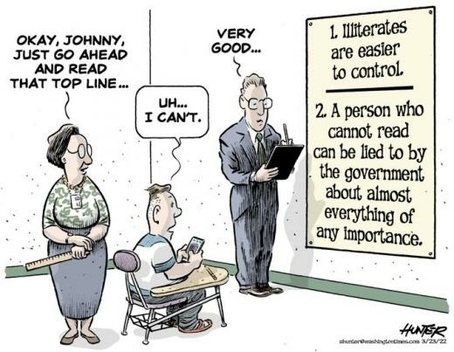
Americans are reading less than at any point in decades, and reading proficiency continues to decline. As the gap between readers and nonreaders widens, those who continue to read may gain an increasingly significant educational, economic, and leadership advantage.
The long-term decline in reading habits among Americans is well documented. National Endowment for the Arts (NEA) data tracked through the American Time Use Survey show the share of adults who read a book for pleasure in the past 12 months falling from 61% in 1992 to 49% in 2022. The same peer-reviewed analysis found that the share of Americans reading for pleasure on an average day fell from 28% in the early 2000s to 16% in 2023.
Among children, the decline is even sharper. National Assessment of Educational Progress (NAEP) long-term trend data show that the share of 13-year-olds who read for fun almost every day fell from 35% in 1984 to just 14% in both 2023 and 2025, the lowest level since the question was first asked. Nine-year-olds show a similar pattern, with the share falling from 53% in 1984 to 37% in 2025.
Reading proficiency is also declining across all grade levels. Roughly 40% of fourth graders and one-third of eighth graders now score below the NAEP Basic level, the largest shares since 2002 and the highest in NAEP history, respectively. Twelfth graders posted their lowest average reading score in more than three decades in 2024: 283 on NAEP’s 500-point scale.
That was three points below the 2019 average and 10 points below the first assessment in 1992. Only 35% were considered prepared for entry-level college reading coursework, down from 37% in 2019. The decline extends into adulthood. Programme for the International Assessment of Adult Competencies (PIAAC) data show that U.S. adults’ literacy scores fell by 12 points from 2017 to 2023. Today, 28% of adults, or 58.9 million people, score at Level 1 proficiency or below, up from 19% in 2017.
The decline is not uniform. NAEP’s own percentile breakdowns show scores for top-performing students holding roughly steady while scores for the lowest performers fall sharply, widening the gap to its largest margin on record at both the 12th grade and 13-year-old level. NCES’s commissioner has described this as “a dwindling middle” in U.S. skills.
A small subset of heavy readers accounts for a disproportionate share of all reading. A December 2025 YouGov survey found that 19% of Americans account for the majority of books read nationally. Separate data show that only about 14% of adults read 20 or more books per year.

“Where the press is free, and every man able to read, all is safe.”
Thomas Jefferson
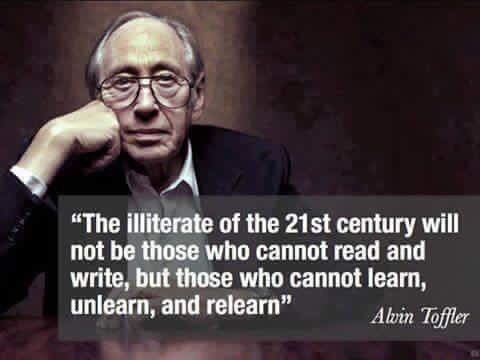
“The illiterate of the 21st century will not be those who cannot read and write, but those who cannot learn, unlearn, and relearn.”
Alvin Toffler


You must be logged in to post a comment.