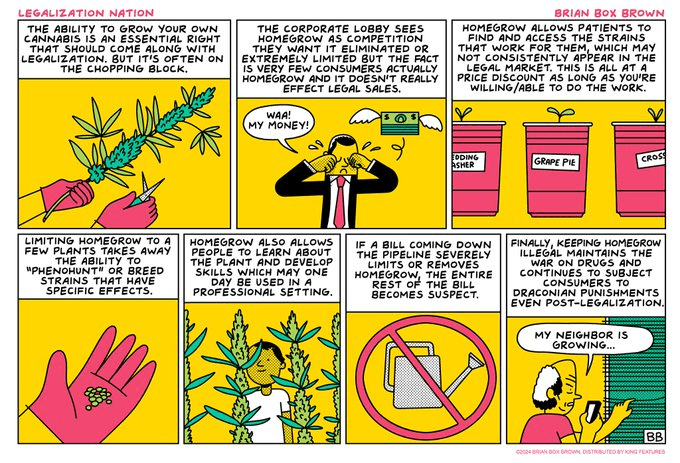
Grow your own!

As Ohio moves closer to launching its adult-use marijuana market, regulators have distributed supplemental guidance on the rules for opening day events, advertising and more.
The Division of Cannabis Control (DCC) has been issuing the state’s first dual certificates of operation for marijuana growers, processors and testing labs in recent weeks so they can begin working with both medical and recreational cannabis. Numerous existing retail dispensaries have been granted provisional licenses as well, but so far none of them have been certified to begin operations
Things are moving forward, however, as regulators have commenced inspections of certain marijuana dispensaries to ensure they’re meeting updated compliance requirements as one of the final steps before they’re able to open shop. And in anticipation of those first openings, DCC sent applicants new guidance materials to “prepare for dual-use operations.”
One way that the division is preparing prospective dual licensees is by reminding them of what they can and can’t do to mark their opening day. For example, businesses cannot allow on-site consumption, offer samples (infused or non-infused), have music or food trucks outside the shop, promote the opening with celebratory decor on the exterior or hold a ribbon cutting ceremony outside.
However, they are permitted to have music inside as long as it’s not a live performance. They can also offer complimentary non-alcoholic beverages and promote the opening by holding a ribbon cutting ceremony inside the dispensary.
DCC also advised applicants that, until new advertising rules are enacted, all businesses must still adhere to the existing regulations in place under the state’s medical marijuana law. To help dual licensees, the division provided a template for what they can post without requiring independent approval.
Advertising material for dual licensees may include the opening date, approved dispensary name, dispensary logo, a note about adults 21 years being allowed to access the shop, location and hours of operation, the business website and social media handles and information about whether online orders, drive-thru services and curbside pickup are available.
If the Drug Enforcement Administration (DEA) ultimately decides not to move forward with marijuana rescheduling, many small and minority-owned cannabis business will have to close shop, “resulting in major economic losses and unemployment,” according to a new industry report. But enacting the reform, in contrast, would grow the sector, adding more than 50,000 jobs by 2030.
The Minority Cannabis Business Association (MCBA) included the data from the report that was conducted by Whitney Economics in a public comment submitted to DEA ahead of Monday’s deadline for stakeholders to weigh in on cannabis rescheduling, offering a detailed economic analysis as the agency had specifically requested in its call for expert input.
The MCBA survey of 206 marijuana licensees across 32 states revealed some troubling trends in the cannabis industry, with just 27 percent of respondents reporting that their operations are profitable, compared to 41 percent that are breaking even and 36 percent that are losing money.
More than 80 percent of the businesses cited finances and tax issues as major economic problems. And MCBA said those issues could be largely resolved in DEA does move marijuana from Schedule I to Schedule III of the Controlled Substances Act (CSA) as the Justice Department has proposed because it would mean that the sector could finally take federal tax deductions they’re currently barred from under an Internal Revenue Service (IRS) code known as 280E.
The “economic data indicates this Proposed Rule would positively impact all 42,125 state-issued marijuana licenses, and in particular small and minority-owned businesses,” it says. “The excess tax payments imposed as a result of IRC § 280E currently prevent marijuana businesses from deducting ordinary business expenses, resulting in higher taxable income and federal tax expense.”
A GOP congressman says “I don’t care” whether rolling back the Biden administration’s marijuana rescheduling move under a potential Trump presidency would hurt the Republican party, because he feels more strongly that the modest reform would endanger public health.
At the Republican National Committee conference last week, longtime prohibitionist Rep. Andy Harris (R-MD) was asked about the potential political ramifications of a rescheduling reversal under a second Trump administration and GOP-controlled Congress.
He put it bluntly: “I don’t care whether it’s good for the party or not. I don’t care. It’s not good for your health.”
“My opinion is always the same: It’s not healthy for you. It’s bad. I think it’s bad policy,” Harris told Marijuana Moment.
The congressman is well known for his opposition to cannabis reform. In addition to championing a long-standing appropriations rider that’s blocked Washington, D.C. from legalizing marijuana sales for a decade, he’s also pushed the head of the Drug Enforcement Administration (DEA) to reject the Justice Department proposal to move cannabis from Schedule I to Schedule III of the Controlled Substances Act (CSA), for example.
But while Harris suggested that the rescheduling move would increase access to a substance he views as dangerous, a Schedule III reclassification would not federally legalize marijuana. The main effects of the policy change would be removing research barriers linked to Schedule I drugs and allowing state-licensed cannabis businesses to take federal tax deductions available to other industries.
The congressman said in the new interview with Marijuana Moment that he has “no idea” how former President Donald Trump, who was officially named the party’s presidential nominee for the third time at the GOP convention, will approach marijuana policy issues. “You’ve got to ask Mr. Trump,” he said.
Pressed on the fact that red and blue states alike have increasingly moved to enact legalization, Harris claimed that he’s “in the company” of experts such as National Institute on Drug Abuse (NIDA) Director Nora Volkow in opposing the policy.
“If we’re outliers, well, you know, sometimes outliers are right,” he said.
Harris has previously suggested that the NIDA director “adamantly opposed” the rescheduling proposal—despite the fact that her agency officially concurred with the recommended policy change, as well as the Volkow’s repeated public comments criticizing research barriers imposed by cannabis’s current Schedule I status.
Isaac Newton said he lost money on the South Sea Bubble financial collapse because, although he could track the movement of stars, he could not calculate the madness of men.
In Canada, the legalization of cannabis in October 2018, unleashed a mania that has seen nearly 1,000 companies receive federal production licences and retailers open nearly 3,500 stores selling cannabis products across the country. It is a short street indeed that doesn’t have a pot shop on it.
The Cannabis Act was a cornerstone piece of legislation for the Trudeau government — a welcome end to 94 years of failed prohibition and an attempt to make Canada safer by closing down the black market in unregulated pot.
It hasn’t quite worked out that way and now there are dire warnings that the onerous federal regulatory and tax regime is in danger of killing the nascent licensed production market.
The Justice Department is doubling down on its position that medical marijuana patients who possess firearms “endanger public safety,” “pose a greater risk of suicide” and are more likely to commit crimes “to fund their drug habit”—justifying, in the government’s eyes, a federal ban on gun ownership by cannabis consumers.
Following a U.S. Supreme Court ruling last month that upheld the constitutionality of governments setting certain gun restrictions in a case centered around domestic violence-related prohibitions, the justices remanded a pending cannabis and Second Amendment rights case back to the lower court for reconsideration.
Late last week, plaintiffs and DOJ submitted briefs in a separate case that responded to the potential implications of the high court’s latest decision for the federal statute barring gun ownership by cannabis consumers.
In the filings submitted to the U.S. Court of Appeals for the Eleventh Circuit, DOJ urged the panel to affirm an initial district court ruling that deemed the cannabis and firearms ban to be constitutional, while appellants are requesting a reversal of the order.
This is the latest development in the two-year case, with a group of Florida medical cannabis patients arguing that their Second Amendment rights are being violated because they cannot lawfully buy firearms so long as they are using cannabis as medicine, despite acting in compliance with state law.
Hawaii’s governor has signed into law a bill to create a task force charged with crafting legislation that would expunge certain criminal records, likely including some past marijuana arrests and convictions.
Gov. Josh Green (D) signed the so-called Clean Slate Expungement Task Force bill on Tuesday, a day before a signature deadline for measures passed this session by lawmakers. The legislation does not explicitly mention cannabis, but marijuana-related offenses are widely expected to be included in the task force’s discussions, and organizations named as members of the new body have focused significantly on cannabis this session.
Reform advocates welcomed the news, saying that removing blemishes from peoples’ criminal records would help remove barriers to housing, education and employment.
“I believe in redemption. I believe in second chances,” Rep. David Tarnas (D), the bill sponsor, said at a press conference alongside the governor on Tuesday. “And in Hawaii, we have a system for record clearance and expungement, which is very challenging. There are tens of thousands of individuals who qualify to have their records expunged, and yet it is so difficult to do that. Very few people do it.”
The new law will “bring together people in a task force to figure out what is the best way for us to have a comprehensive framework for all clemency efforts in the state, including pardons, expungement and record sealing, so that we make it more accessible to people.”
Carrie Ann Shirota, policy director for ACLU of Hawai’i, told Marijuana Moment that the group strongly supports Clean Slate laws that expand expungement and record-sealing through the use of technology.
“SB 2706 creates an Expungement Task Force that brings us one step closer to ensuring that all people have access to opportunity,” she said. “Having a record should not be a barrier to helping individuals provide for themselves and their families, nor should it be a life sentence to poverty. At its heart, Clean Slate is about a shot at redemption and facilitating workforce development.”
Research shows that a year after record clearance, people are more likely to be employed and earn higher wages, Shirota added.
The new body will include state officials—including the attorney general, chief justice, public defender and some prosecutors—as well as representatives from various advocacy groups, including ACLU, the Last Prisoner Project (LPP), the Hawaii Innocence Project and others.
In a statement to Marijuana Moment, LPP said it’s “honored to be part of the expungement task force to ensure all Hawaiians with cannabis charges have their records expunged.”
“Our appointment to the Clean Slate task force will help ensure the state-initiated cannabis expungement bill signed by Governor Green is implemented with fidelity,” said LPP Policy Manager Adrian Rocha, “and can serve as the foundation for broader record relief moving forward.”
The U.S. Supreme Court has sent a case concerning gun rights for marijuana consumers back down to a lower court after issuing a potentially relevant ruling in a separate Second Amendment case, and the Justice Department is now reiterating its position that cannabis use warrants a ban on firearm ownership.
The high court has remanded several gun cases to their respective lower courts in light of the ruling in United States v. Rahimi, which affirmed the government’s right to restrict gun rights for a man with restraining orders for domestic violence. The cases heading back to lower levels include at least one related to the cannabis ban, and DOJ is now arguing that the SCOTUS decision “undermines” a federal court’s ruling that deemed the prohibition for marijuana consumers to be unconstitutional last year.
In a supplemental letter brief to the U.S. Court of Appeals for the Fifth Circuit, where the United States vs. Daniels case was remanded by SCOTUS, the Justice Department said history “supports the government’s authority to disarm categories of persons whose firearm possession would endanger themselves or others.”
“Consistent with that principle, Congress may temporarily disarm unlawful users of controlled substances during periods of active drug use, when they present a special danger of firearm misuse,” it said. “The Supreme Court’s decision in Rahimi also is in tension with this Court’s opinion in United States v. Daniels, which made some of the very methodological errors that Rahimi corrected to find Section 922(g)(3) unconstitutional as applied to a marijuana user. The district court’s judgment should be reversed.”
DOJ has argued in multiple federal cases over the couple year that the statute banning cannabis consumers from owning or possessing guns is constitutional because it’s consistent with the nation’s history of disarming “dangerous” individuals.
A New York marijuana dispensary is taking steps to help eradicate illicit cannabis businesses that have proliferated in the state by offering discounts and benefits to people who transition to the legal market.
Housing Works, the parent company of the state’s first legal adult-use dispensary Housing Works Cannabis Co, announced the “illegal cannabis buyback” program on Thursday. As regulators continue their push to shut down unlicensed operators, the company is providing consumers with incentives to transition to the legal market.
From July 1 to September 1, any person who provides proof of membership at an illicit operator will get a free membership at Housing Works Cannabis Co’s “co-conspirator program,” which includes 25 percent off their first purchase and a 10 percent discount on all their purchases for the next year. The membership normally costs $25.
“This buyback initiative is crucial not only for the health and safety of our customers, which is always our top priority, but also for the legal business operators and those who have fought hard for a place in New York’s legal cannabis market,” Sasha Nutgent, director of retail at Housing Works Cannabis Co, told Marijuana Moment.
The Portland Pickles baseball organization will become the first sports team in the United States to sell marijuana-based products during a live sporting event legally.
In an announcement, the Pickles revealed they have a new partnership with Cycling Frog, which sells THC-based seltzer drinks.
The team will start selling the THC-based seltzer drinks at their stadium on June 18th.
According to Oregon Live, the Seltzer drink contains 2MG of THC and 4MG of CBG and is available in lemon and passion fruit flavors.
Ross Campbell, the Pickles’ VP of Business Development, said, “The Portland Pickles have a responsibility in the sports industry to take leaps and set a precedent of innovative partnerships.”
Fans who want to purchase the drink must be over 21.
 Hellbound and Down
You must be logged in to post a comment.