From Iraq to Ukraine, the American Press Loves a War

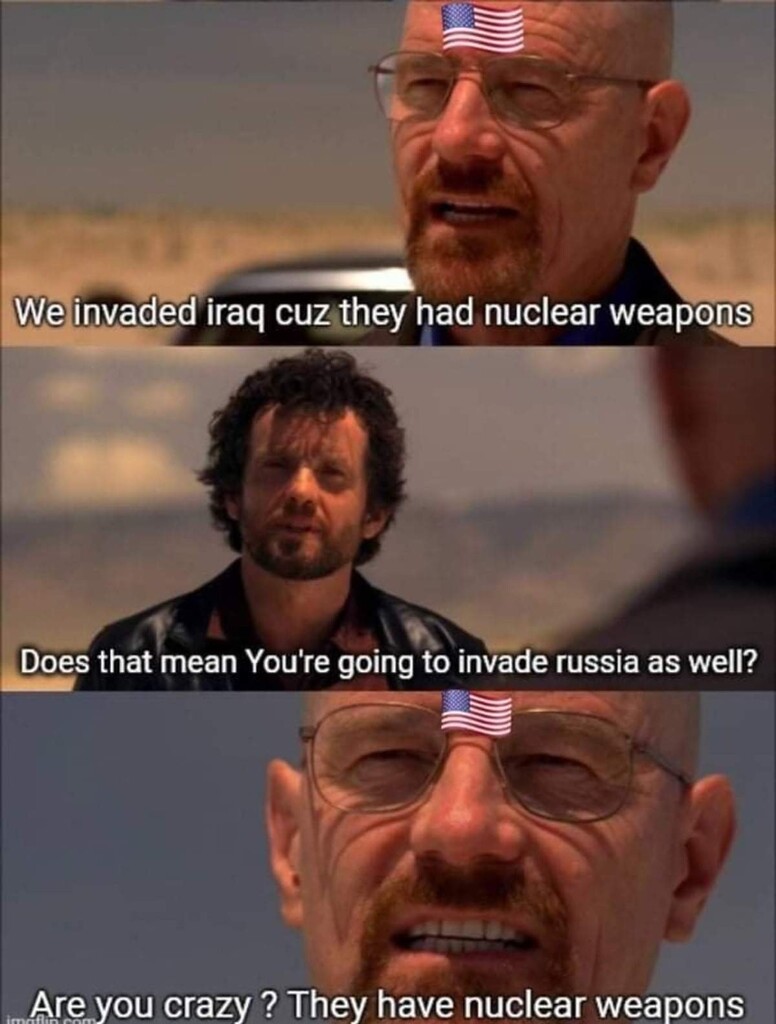
On this day in 2003, the United States launched its air invasion of Iraq, with the ground component beginning one day later. It was the first stage of a war that would ultimately drag on for over eight years, killing thousands of American soldiers and hundreds of thousands of Iraqi civilians as the U.S. and its allies sought to overthrow Saddam Hussein’s government.

Nineteen years on, Americans watch as a conflict embroils Eastern Europe. Russian President Vladimir Putin’s large-scale invasion of Ukraine beginning last month has brought frequent reports of deaths of innocents and strikes on civilian spaces.

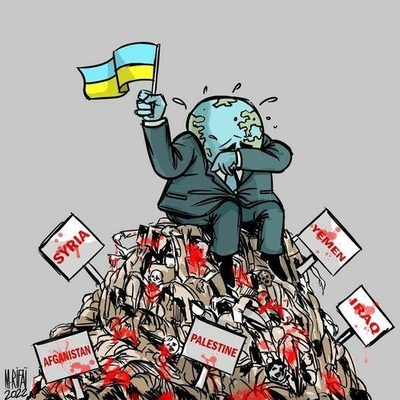
Horrific scenes from the conflict in Ukraine have fetched headlines much like those published during the Iraq War. But there is a difference between journalistic reporting on a conflict and coverage that trends more toward activism. Reporters operating under the guise of objectivity repeatedly trended toward the latter approach during the Iraq War. Now, as establishment journalists not-so-subtly agitate for a more interventionist U.S. policy in Ukraine, it’s worth keeping an eye on these tried-and-trued hawkish tendencies.

In a press conference on March 15, reporters pelted White House Press Secretary Jen Psaki with questions regarding the Biden administration’s opposition to certain military support for Ukraine. There were over one dozen questions mentioning military assistance—including five distinct mentions of a no-fly zone—and only one question about the potential American role in facilitating negotiations between Russia and Ukraine.

Neither were the numerous questions about military assistance purely fact-based. “Zelenskyy and other Ukrainian officials have made so clear that what they believe they need the most is more warplanes and fighter jets. So why is the U.S. assessing something different?” asked a reporter. “Why does the U.S. believe they know better what Ukraine needs than what Ukrainian officials are saying they need the most?”

Keep reading

US Hid True Toll of Air Wars; Thousands of Dead Civilians, Many of Them Children

Thousands of previously hidden Pentagon documents show that the US air wars in the Middle East have been marked by “deeply flawed intelligence” and have killed thousands of civilians, many of them children, according to a shocking new report in the New York Times Saturday afternoon.

The 5-year Times investigation received more than 1,300 reports examining airstrikes in Iraq and Syria from September 2014 to January 2018, more than 5,400 pages in all. None of these records show any findings of wrongdoing on the actions of the US military.

The Times reporting confirms many of the previous reports by whistleblowers Daniel Hale, Chelsea Manning and others. On July 27, 2021, whistleblower Hale was sentenced to 45 months in federal prison for exposing the true civilian toll of the US drone program. “I am here because I stole something that was never mine to take — precious human life,” Hale said at his sentencing.

From the Times report:

The trove of documents — the military’s own confidential assessments of more than 1,300 reports of civilian casualties, obtained by The New York Times — lays bare how the air war has been marked by deeply flawed intelligence, rushed and often imprecise targeting and the deaths of thousands of civilians, many of them children, a sharp contrast to the American government’s image of war waged by all-seeing drones and precision bombs.

The documents show, too, that despite the Pentagon’s highly codified system for examining civilian casualties, pledges of transparency and accountability have given way to opacity and impunity. In only a handful of cases were the assessments made public. Not a single record provided includes a finding of wrongdoing or disciplinary action. Fewer than a dozen condolence payments were made, even though many survivors were left with disabilities requiring expensive medical care. Documented efforts to identify root causes or lessons learned are rare.

The air campaign represents a fundamental transformation of warfare that took shape in the final years of the Obama administration, amid the deepening unpopularity of the forever wars that had claimed more than 6,000 American service members. The United States traded many of its boots on the ground for an arsenal of aircraft directed by controllers sitting at computers, often thousands of miles away. President Barack Obama called it “the most precise air campaign in history.”

Keep reading

Following Debacles In Iraq And Afghanistan, Failed Interventionists Are Now Agitating For Wars In Ukraine And Taiwan

If you thought for one moment that the embarrassing multi-decade debacle in Afghanistan would lead to some soul-searching from the failed interventionists responsible for America’s 21st-century Vietnam, think again. Instead of taking a step back to understand exactly why and how their grandiose plans to use the mightiest military in history to impose a top-down, secular, Western-style democracy didn’t quite pan out, they’re doubling down on failure.

When you’re a hammer, everything is a nail, and when you’re a global interventionist, wars fix everything. This time, their target is Ukraine. And Taiwan. Because why start a war with Russia when you can start a war with Russia and a war with China?

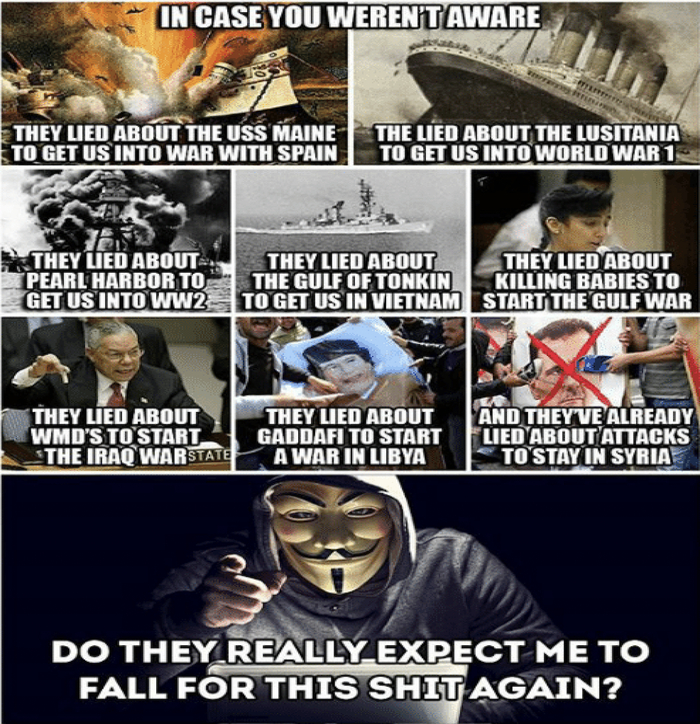
According to the same foreign policy blob that brought us such hits as “Saddam Hussein is going to nuke us with all his WMDs” and “Donald Trump is totally getting blackmailed by Vladimir Putin over a magical sex tape,” America needs to prepare for war with Russia because Russia is allegedly massing troops on…its own border with Ukraine.

America’s porous border with Mexico, across which hundreds of thousands of illegal immigrants have been flooding unimpeded since the day President Joe Biden took office, is apparently no big deal at all and not remotely worthy of an American military presence. But Ukraine’s border with Russia? To the failed foreign policy blob, that is priority numero uno.

The Russia-Ukraine border must be defended, with American blood and treasure, at all costs. And if you suggest that maybe America should fix America’s border first, it’s because you’re racist or something.

Keep reading

The Media’s Lies About Colin Powell’s Lies

Former Secretary of State and Joint Chiefs of Staff chair Colin Powell received virtually wall-to-wall adulation in corporate media coverage of his death last week.

In the New York Times (10/19/21), Bret Stephens called Powell “an exemplary military leader and presidential adviser.” Stephens’ Times colleague Maureen Dowd (10/23/21) said Powell was “the best America had to offer” and a “great man.” Theodore R. Johnson wrote in the same paper (10/21/21) that “we should take inspiration from Mr. Powell’s accomplishments.”

Powell led, as David Ignatius tells it in the Washington Post (10/18/21), an “extraordinary life of service,” characterized by “a sterling career of public service.” Like Ignatius, Peggy Noonan of the Wall Street Journal (10/21/21) lacked a thesaurus, describing Powell as “a great man” and one of “the great ones.” In another Journal piece, Paula Dobriansky (10/20/21) called him “a true inspiration and a model not only for military leaders and diplomats but all Americans,” a “hero of our time.”

This gratuitous fawning deflects readers from reckoning with Powell’s record. Consider the heinous acts the “great man” admitted to carrying out in Vietnam.  (See Consortium News7/8/96.) In his memoir, My American Journey, Powell said of his unit in Vietnam: “We burned down the thatched huts, starting the blaze with Ronson and Zippo lighters.” The “hero of our time” wrote:

Why were we torching houses and destroying crops?  Ho Chi Minh had said the people were like the sea in which his guerrillas swam…. We tried to solve the problem by making the whole sea uninhabitable. In the hard logic of war, what difference did it make if you shot your enemy or starved him to death?

Similarly, Powell’s “sterling career of public service” involved obstructing the truth of US war crimes in Vietnam. After the My Lai Massacre, when Powell was an Army major posted in Saigon, he was tasked with investigating a soldier’s letter describing US barbarism against the Vietnamese (Columbia Journalism Review4/3/09). Powell denied the charges, writing, “In direct refutation of this portrayal is the fact that relations between American soldiers and the Vietnamese people are excellent.”

Keep reading

Biden Isn’t Withdrawing Troops From Iraq, He’s Relabeling Their Mission

Iraqi Prime Minister Mustafa al-Kadhimi and President Biden announced last week that Washington will end its combat mission in Iraq by the end of the year. However, these long-serving U.S. soldiers are not coming home: many of the 2,500 American service members are expected to remain in the country for “training and advisory” purposes.

The United States and Iraq had issued a joint statement in April that the U.S. combat mission would be ending, but the timeline remained unclear. The timing of the recent announcement appears intended to boost Kadhimi’s prospects in October’s parliamentary elections — he faces domestic demands to oust U.S. forces, yet remains dependent on American support to maintain some semblance of control.

Many of the militia groups he now struggles to control initially assembled to fight the so-called Islamic State, or Daesh, starting in 2014. The Popular Mobilization Forces, or al-Ḥashd ash-Shaʿbī, many of whose fighters are Iraqi Shi’a, were supported by both the U.S. and Iran to defeat the  Islamic State. The mobilization of these militias would not have been necessary if Paul Bremer and the Pentagon had not made the foolish decision to disband Iraq’s military following the U.S. invasion in 2003, as Iraq would still have possessed a functional army.

Keep reading