For the environment!


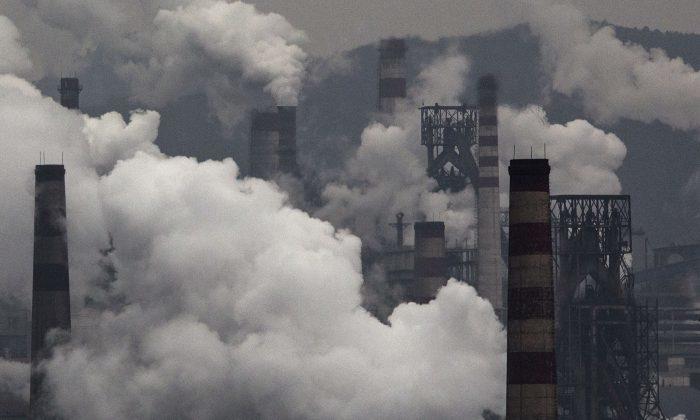
China emits more carbon dioxide in 16 days than Australia does in one year, according to new research published by a free-market think tank.
Australia’s net-zero emissions target would therefore be cancelled out by China in just two weeks, the Institute of Public Affairs (IPA) said in a press release on Wednesday.
According to the report, China operates 57 times as many coal-fired power stations as Australia. This figure is set to increase with China currently constructing 92 coal-fired power stations.
The report also added that while Australia’s carbon emissions per capita have declined by 15.4 percent since 2004, China’s emissions per capita over the same period have increased by 83.5 percent.
Climate czar John Kerry said during an appearance on “CBS This Morning” that we have nine years left to avert a climate catastrophe and there’s “no room for B.S.” when it comes to climate change.
Kerry told CBS News’ Ben Tracey that, given the 2018 projection that we had 12 years left to avoid a climate disaster, three years later we now have nine years left. He also said that initial mandates put forth in the 2016 Paris Climate Accord will not be enough.
A wind turbine’s blades can be longer than a Boeing 747 wing, so at the end of their lifespan they can’t just be hauled away. First, you need to saw through the lissome fiberglass using a diamond-encrusted industrial saw to create three pieces small enough to be strapped to a tractor-trailer.
The municipal landfill in Casper, Wyoming, is the final resting place of 870 blades whose days making renewable energy have come to end. The severed fragments look like bleached whale bones nestled against one another.
“That’s the end of it for this winter,” said waste technician Michael Bratvold, watching a bulldozer bury them forever in sand. “We’ll get the rest when the weather breaks this spring.”
Tens of thousands of aging blades are coming down from steel towers around the world and most have nowhere to go but landfills. In the U.S. alone, about 8,000 will be removed in each of the next four years. Europe, which has been dealing with the problem longer, has about 3,800 coming down annually through at least 2022, according to BloombergNEF. It’s going to get worse: Most were built more than a decade ago, when installations were less than a fifth of what they are now.
Environmentalists continue to warn that Apple AirPods (which also catch fire) are adding to already dangerously high levels of unrecyclable toxic E-Waste. Of course, AirPods aren’t the only popular wearables being manufactured, purchased, and fated to become E-Waste (see 1, 2, 3).
So those who buy wearables are being increasingly chastised even though tech proponents continue to promote Internet of Things (IoT) technology as being essential to a healthier environment. This doesn’t make sense. IoT has a high failure rate as well as enormous cybersecurity and privacy risks (see 1, 2, 3, 4). Therefore, frequent replacement of IoT technology will also create more E-Waste. So it’s not unreasonable to suspect those who promote IoT for sustainability as being completely misguided.
Microsoft founder Bill Gates is pushing drastic and ‘fundamental’ changes to the economy in order to immediately halt the release of greenhouse gasses – primarily carbon dioxide – and ‘go to zero’ in order to save the planet from long-prognosticated (and consistently wrong) environmental disaster.
Changes we’ll need to make in order to realize Gates’ vision include:
And since producing plants to make fake meat emits gases as well, Gates has backed a company which uses fungus to make sausage and yogurt, which the billionaire calls “pretty amazing.”
“When you say fungi, do you mean like mushroom or a microbe?” asked Anderson Cooper in a recent “60 Minutes” interview to promote Gates’ new book, “How to Avoid a Climate Disaster.”
“It’s a microbe,” replied Gates, adding “The microbe was discovered in the ground in a geyser in Yellowstone National Park. Without soil or fertilizer it can be grown to produce this nutritional protein — that can then be turned into a variety of foods with a small carbon footprint.”
A Massachusetts climate official said people who heat their homes and fuel their cars will need to have their “will” broken in order to combat emissions and climate change.
“I know one thing that we found in our analysis is that 60% of our emissions come from … residential heating and passenger vehicles,” said David Ismay, Massachusetts, undersecretary for climate change, during a virtual meeting with the Vermont Climate Council. “Let me say that again: 60% of our emissions that need to be reduced come from you, the person on your street, the senior on fixed-income. Right now, there is no bad guy left, at least in Massachusetts, to point the finger at and turn the screws on and now break their will, so they stop emitting. That’s you. We have to break your will.”
Ismay reasoned that climate agencies were running out of options.
“We can’t have no offshore wind, no transmission, no solar, and have clean energy,” he said. “Something has to give. There has to be some mechanism we trust to find a place to site a transmission line.”
But Ismay also admitted his remarks would not be popular.
“I can’t even say that publicly,” Ismay said.
That prediction seemingly came to fruition when the state’s Republican Gov. Charlie Baker got wind of the statements, which he insisted “no one who works in our administration should ever say or think.”
Most people seem to believe that wind and solar panels produce no waste and have no negative environmental impacts. Unfortunately, these people are wrong.
In reality, everything that humans do has an environmental impact, whether it be mining, using a coal-fired power plant, or even tourism. When it comes to energy and environmental policy, the real question to ask is not “will there be an impact?” but rather, “can the impacts be minimized?” and “do the benefits outweigh the costs?”
Because everything has an effect on the environment, it is important that everyone understands the impacts of all energy sources so we can make the best possible energy decisions. We are constantly making trade-offs in our lives whether we recognize it or not.

You must be logged in to post a comment.