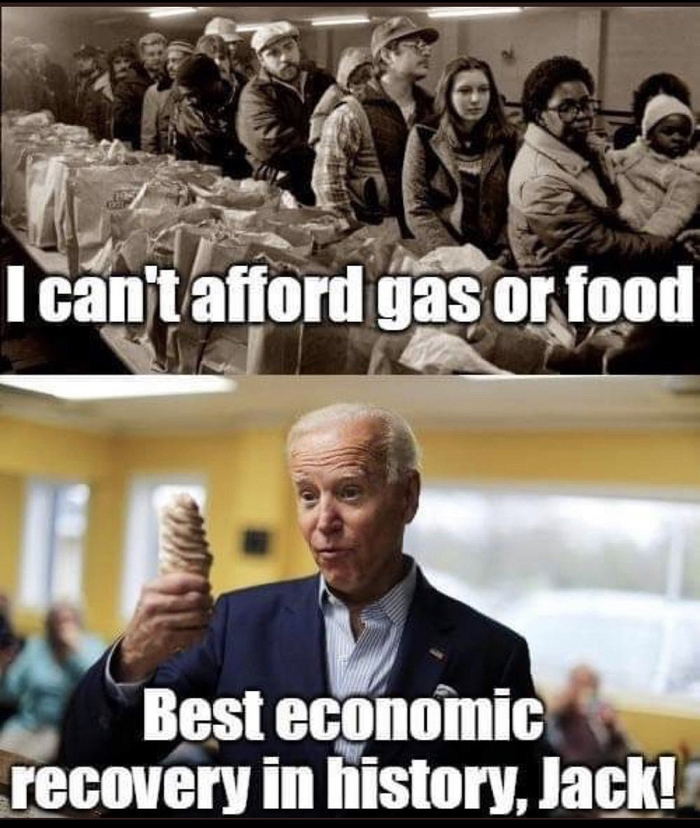
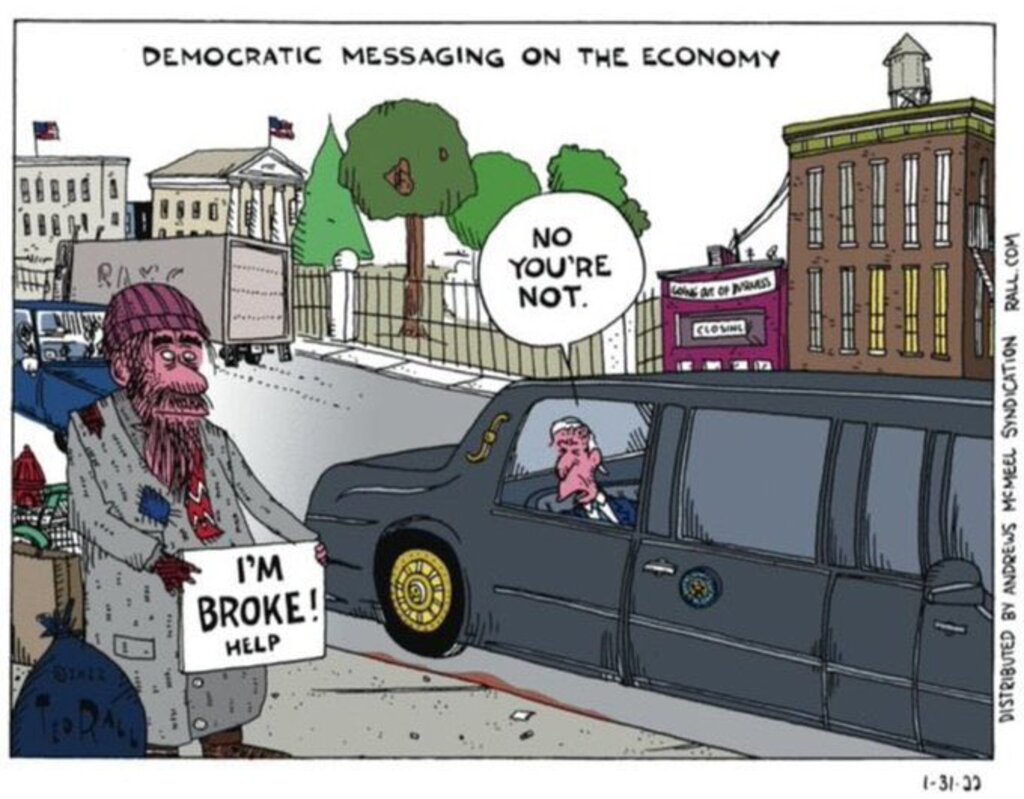
Average American worker down $3400 in annual income since Biden took office

The average American worker has lost $3,400 in annual income since Biden took office in January 2021.

Since Biden’s inauguration, the cost of living, including prices at the grocery store and prices at the gas pump have steadily risen. While Biden seeks to blame the COVID-19 pandemic and Russian President Vladimir Putin for the state of the economy, Americans enduring hardship have had little to fall back on.

Biden’s economic challenges were compounded even further with the release of this month’s Consumer Price Index report, which surged to 9.1% year-over-year in June.

The increase was significantly higher than previously predicted by economists, marking the CPI at its highest level since November 1981, according to the Bureau of Labor Statistics on Wednesday.

Keep reading

Confusion swirls as Colorado imposes new retail delivery fee, catching businesses by surprise

Colorado consumers will start noticing a 27-cent fee on receipts for almost everything that gets delivered to them, including restaurant food, after Colorado’s new “retail delivery fee” took effect July 1.

The fee must be collected and paid to the state by retailers “on all deliveries by motor vehicle to a location in Colorado with at least one item of tangible personal property subject to state sales or use tax,” according to the new law.

The new fee is occurring at a time of record-setting inflation, spiking home prices, and a general sense of how unaffordable living in Colorado has become, particularly in metro Denver. It’s also occurring even as elected officials promise to do everything in their power to lift the economic burden on residents.   

Keep reading

Rationing Has Already Started In Europe As The Entire Globe Plunges Into A Horrific Economic Nightmare

Up until the past couple of years, many of us in the western world always considered shortages to be something that only “unsophisticated” poor countries on the other side of the planet had to deal with.  But the last couple of years have shown us that painful shortages can happen to wealthy countries in the western world too.  At first we were told that they were “just temporary”, but the months went by and we just kept having more shortages.  In fact, in 2022 “supply problems” have become so serious that many supermarkets in Europe have been forced to strictly ration essential items at various times.  For example, it was being reported that due to the war in Ukraine flour, sunflower oil and sugar were all being rationed by stores in Greece

After limiting the sale of some flours and sunflower oil online, Greek supermarkets are turning to rationing the sale of sugar as well, now including in their stores, over supply problems.

The AB Vassilopoulos is setting a maximum limit on the purchase of all brands of corn and sunflower oil and of flour per customer while Mymarket put a ceiling on sunflower oil purchases and Sklavenitis has added sugar to the rationed sales of corn oil through its online store, with a maximum of four packs, the products in high demand from restaurants, some of which said they have to stop selling french fries and other fried foods.

Over the past few months we have seen similar measures implemented in other major European nations as well.  For example, the war in Ukraine prompted some pretty severe rationing in Spain

Sporadic shortages of products like eggs, milk, and other dairy products also hit Spain since the war in Ukraine began. And major supermarkets including Mercadona and Makro began rationing sunflower oil earlier this month.

Now, stores will temporarily be allowed to limit “the number of goods that can be bought by a client,” according to information in the Official State Gazette published on Wednesday.

Looking forward, natural gas rationing is the next big thing that many people in Europe are talking about.  The flow of Russian natural gas into Europe has been cut back, and it appears that this may soon cause widespread rationing in Italy

Italy may start rationing natural-gas consumption to certain industrial giants, after Russia’s Gazprom halved supplies on Friday.

On the weekend, the newspaper Corriere della Sera reported that the Italian government and energy industry would meet Tuesday and Wednesday to discuss the crisis, with the likely outcome being the introduction of a state of alert under the country’s gas emergency protocol.

And CNN is reporting that Germany is “one step closer to rationing supplies” now that Russia has decided to reduce the flow of natural gas going to that country…

Europe’s biggest economy is now officially running short of natural gas and is escalating a crisis plan to preserve supplies as Russia turns off the taps.

Germany on Thursday activated the second phase of its three-stage gas emergency program, taking it one step closer to rationing supplies to industry — a step that would deliver a huge blow to the manufacturing heart of its economy.

Of course there are other parts of the globe that are dealing with problems that are far, far more serious than what Europe is facing right now.

As I discussed in an article that I posted earlier this week, significant numbers of people are starting to literally drop dead from starvation in portions of eastern Africa.  Global food supplies just keep getting tighter, and the head of the UN is openly telling us that the world is heading into an “unprecedented global hunger crisis”.

So if you have plenty of food to eat tonight, you should be thankful.

Here in the United States, economic conditions are deteriorating fairly rapidly, and most Americans are completely and totally unprepared for any sort of a major economic downturn.  Earlier today, I came across yet another survey that shows that about 60 percent of all Americans are currently living paycheck to paycheck

“We find that consumers in all income brackets — including those who make more than $100,000 annually — are living paycheck to paycheck. PYMNTS’ research finds that 61% of U.S. consumers were living paycheck to paycheck in April 2022, marking a 9 percentage point increase from 52% in April 2021, meaning that approximately three in five U.S. consumers devote nearly all of their salaries to expenses with little to nothing left over at the end of the month.”

So what is going to happen when those people start losing their jobs in large numbers?

Keep reading

The Engineered Stagflationary Collapse Has Arrived – Here’s What Happens Next

In my 16 years as an alternative economist and political writer I have spent around half that time warning that the ultimate outcome of the Federal Reserve’s stimulus model would be a stagflationary collapse. Not a deflationary collapse, or an inflationary collapse, but a stagflationary collapse. The reasons for this were very specific – mass debt creation was being countered with MORE debt creation while many central banks have been simultaneously devaluing their currencies through QE measures. On top of that, the US is in the unique position of relying on the world reserve status of the dollar and that status is diminishing.

It was only a matter of time before the to forces of deflation and inflation met in the middle to create stagflation. In my article “Infrastructure Bills Do Not Lead To Recovery, Only Increased Federal Control”, published in April of 2021, I stated that:

Production of fiat money is not the same as real production within the economy… Trillions of dollars in public works programs might create more jobs, but it will also inflate prices as the dollar goes into decline. So, unless wages are adjusted constantly according to price increases, people will have jobs, but still won’t be able to afford a comfortable standard of living. This leads to stagflation, in which prices continue to rise while wages and consumption stagnate.

Another Catch-22 to consider is that if inflation becomes rampant, the Federal Reserve may be compelled (or claim they are compelled) to raise interest rates significantly in a short span of time. This means an immediate slowdown in the flow of overnight loans to major banks, an immediate slowdown in loans to large and small businesses, an immediate crash in credit options for consumers, and an overall crash in consumer spending. You might recognize this as the recipe that created the 1981-1982 recession, the third-worst in the 20th century.

In other words, the choice is stagflation, or deflationary depression.”

Keep reading