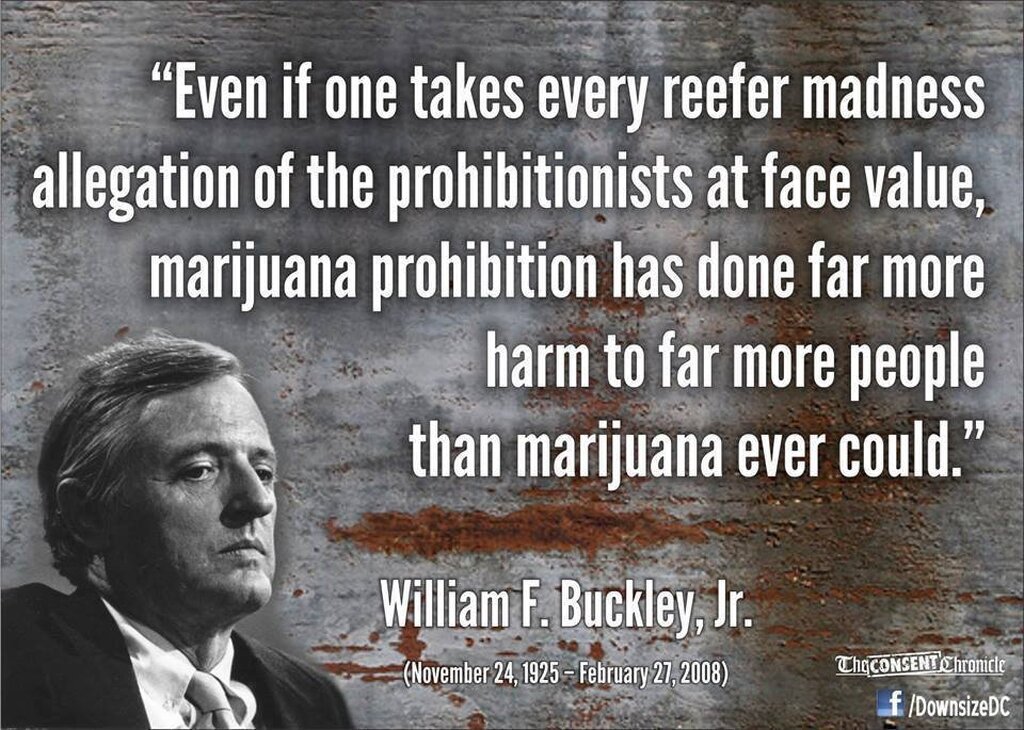
William F. Buckley jr. on the war on (some) drugs…

A federal law barring marijuana users from possessing guns violates the Constitution, a federal judge in Oklahoma ruled.
The decision cites last year’s landmark Supreme Court ruling that affirmed an individual right to carry firearms in public for self-defense.
The ruling came as challenges to gun laws across the nation have escalated since the Supreme Court struck down a restrictive New York firearms law in June 2022. The high court held that there is a constitutional right to carry a gun outside the home, leading states such as New York, New Jersey, California, and Illinois to respond by doubling down on firearms restrictions.
In that precedent, New York State Rifle and Pistol Association v. Bruen, the Supreme Court held that gun restrictions must be deeply rooted in American history if they are to survive constitutional scrutiny.
On Feb. 3, Oklahoma City-based U.S. District Judge Patrick Wyrick, who was appointed by former President Donald Trump, threw out an indictment against Jared Michael Harrison, who was charged with violating the ban.
Harrison was pulled over for a traffic stop on May 20, 2022. Police officers searched the car and found marijuana and a loaded revolver. Officers did not conduct a field sobriety test nor did they seek to draw Harrison’s blood for drug testing. On Aug. 17, 2022, a federal grand jury indicted him for possessing a firearm while being an unlawful user of marijuana.
As of October 2022, 19 states allowed the recreational use of marijuana while 37 states permitted its medical use, but it remains illegal at the federal level. Oklahoma currently allows medical, but not recreational, use of marijuana.
Governor Glenn Youngkin’s administration is trying to stop the sale of some potentially unsafe cannabis products.
Youngkin is asking lawmakers for more resources to bolster enforcement in his proposed budget, which will set the tone for debate in the 2023 session. Meanwhile, state officials say existing efforts to expand oversight have not resulted in any criminal penalties or lost permits to date.
Sarah Grant, general manager of “THE Dispensary” in Richmond, said state inspectors have stopped by three times since lawmakers took steps to enhance oversight last summer. They were asked to voluntarily remove all of their hemp-derived Delta-8 and Delta-10 edibles, which account for at least 40% of sales, according to Grant.
“We would at least have to cut staff and then we would have to look at closing our doors,” Grant said.
Grant says Delta-8 and Delta-10 are found naturally in small amounts in hemp, which is legal to sell. But a lack of regulation has allowed potentially unsafe synthetics with inaccurate labels to proliferate, according to some experts.
Grant said they’re currently defending the safety and legality of their products through an administrative hearing, which state officials described as an informal fact-finding conference.
Officials within Germany’s federal government are reportedly pushing for a bill to legalise cannabis in the country to be drawn up “as soon as possible”.
Kirsten Kappert-Gonther, a Green MP within the German parliament, has called for the Federal Health Minister to present a draft law that would legalise cannabis in the country “as soon as possible”, a report on Wednesday has claimed.
The issue has been a hot-button topic within the Bundestag for some time, despite the fact that the country has also largely failed to address its woeful energy situation which has seen inflation rise to its highest level in the country’s post-war history last year.
According to a report by Die Welt, Kappert-Gonther, who serves as the Green party’s health spokeswoman within parliament, emphasised that cannabis legalisation has already been agreed upon within Germany’s three-party ruling coalition, which consists of the Greens with the Social Democratic Party of Germany (SPD, red), as well as the Free Democratic Party (FDP, yellow).
Now, the main issue getting in the way of legalisation is the country’s Health Minister, Karl Lauterbach, who has yet to publish a draft bill that would legalise the substance.
“The controlled release of cannabis is agreed in the coalition agreement,” the health representative said. “The Minister of Health must now present a draft law in a timely manner.”
“I’m committed to making it happen as soon as possible,” the Green MP went on to say.
Die Welt goes on to note that — while the country’s government does want to legalise the drug — it is possible that Eurocrats from Brussels may block the legislation should they feel it interferes with EU law.
A terminally-ill Kansas man’s hospital room was raided by cops because he used a weed vape and THC paste to ease the symptoms of the cancer that will kill him within weeks.
Greg Bretz, 69, was targeted by police in Hays Medical Center on December 23. He was after officers found marijuana products within his room, and ordered to appear in court on January 2 – despite being so sick he cannot get out of bed or even move.
Kansas is one of only three US states where medical marijuana is still illegal. Bretz told the Kansas City Star his doctor had told him to use whatever was necessary to relieve his pain, including products containing THC – the active ingredient in cannabis.
But another member of staff is believed to have snitched on Bretz and sparked the subsequent raid.
Banning a plant with hundreds of industrial and medical uses was never going to work out well, but 2022 saw marijuana prohibition reach peak absurdity, not to mention peak confusion for consumers and new businesses trying to make sense of it all.
At first glance, cannabis reform appears to be humming along smoothly. Maryland, Missouri and Rhode Island approved legalization initiatives in 2022 as states such as New Mexico and New York raced to establish regulations for legal recreational sales. New laws in mostly blue states expunged cannabis arrests from criminal records for thousands of people. President Joe Biden made moves to pardon federal marijuana prisoners and reconsider the federal “scheduling” of marijuana, a baby step toward potentially ending federal prohibition administratively. Lawmakers debated cannabis reform bills in Congress, even if the vast majority were never passed into law.
A look under the hood, however, reveals regulatory chaos in a nation where marijuana remains illegal at the federal level. For many people, 2022 will be remembered as the year “legal THC” hit the shelves, including in almost every state still under prohibition. The hemp industry, which previously brought us non-inebriating CBD in countless forms, leveraged sketchy chemistry and legal loopholes to evade regulation and sell various synthetic THC products that will absolutely get customers high regardless of where they live, making a mockery of what remains of prohibition.
Unlike traditional cannabis sold in legalized states, researchers know little about the potential risks of using synthetic THC, but “legal THC” products are now commonly sold online and in convenience stories. Sales are booming in states where traditional marijuana remains illegal, particularly among novice consumers and medicine seekers who prefer to avoid running afoul of the law. While the hemp industry has expanded access to cannabis edibles that can relieve conditions such as pain and insomnia, unregulated vapes and powerfully psychoactive synthetics are raising public health concerns.
Oregon lawmakers are looking to crack down on illegal marijuana growers who aren’t abiding by the state’s 2014 laws governing recreational use and cultivation.
Year-to-date, approximately 95 metric tons of illegally grown marijuana have been seized across the state, according to the Oregon-Idaho High Intensity Drug Trafficking Area task force. In 2019, they seized just 8 metric tons.
The 2014 legislation was supposed to eliminate problems caused by “uncontrolled manufacture” of the drug, however growers haven’t all magically agreed to the taxes and red tape that accompanied the legalization. Now, officials who have heard complaints from everyone from legal growers to the police are looking to crack down, AP reports.
Now, a draft bill set for introduction in the 2023 legislative session would double the maximum fine and prison sentence for illegal grows to 10 years and $250,000 for those growing more than 100 plants, or possession in excess of 32 times the legal limits.
Ed Rosenthal is a legend in cannabis known for bucking the rules. The longtime cultivation author went up against the feds for providing marijuana to medical patients in 2003 and was ultimately sentenced to a single day in prison, time served. Rosenthal’s devoted his life promoting cannabis—he’s responsible for proliferating the classic South African landrace Durban Poison, partnered with at least 50 European seed companies for multiple books in his Big Book of Buds series, and even has a cultivar, Ed Rosenthal Super Bud, named after him—but he’s never released his own genetics. That is, until now. Back in April, the DEA quietly acknowledged that cannabis seeds are legal. Rosenthal began releasing seed packs alongside his books in May. Since then, rapper and Cookies clothing mogul Berner has also embraced the idea, offering seed packs along with his recent From Seed to Sale album release.
The DEA’s reasoning behind the affirmation that cannabis seeds are legal in the U.S. had to do with the 2018 Farm Bill that legalized hemp, defining and separating it from the pot we smoke as Cannabis sativa with less than .03% delta-9 THC. When questioned about the legality of seeds, tissue culture, and “other genetic material” the agency response was that marihuana (yes, they still spell it like that) seeds that contain less than .03% delta-9 THC meet the definition of hemp and are therefore, not a controlled substance under the Controlled Substances Act.
Starting on January 1, 2023, the state says records of approximately 44,000 residents will have cases cleared, including some that date back more than 30 years ago.
Two very different reasons were provided by Governor Ned Lamont as to why the convictions will be erased, the first and most obvious being that the state legalized recreational marijuana in July 2021, allowing adults over 21 to carry 1.5 ounces on their person or five ounces in a locked container or locked glove compartment or trunk.
“On January 1, thousands of people in Connecticut will have low-level cannabis convictions automatically erased due to the cannabis legalization bill we enacted last year,” the governor commented.
The other reason, according to Gov. Lamont, is the state’s job market, which seeks to fill “hundreds of thousands” of open positions.
 Hellbound and Down
You must be logged in to post a comment.