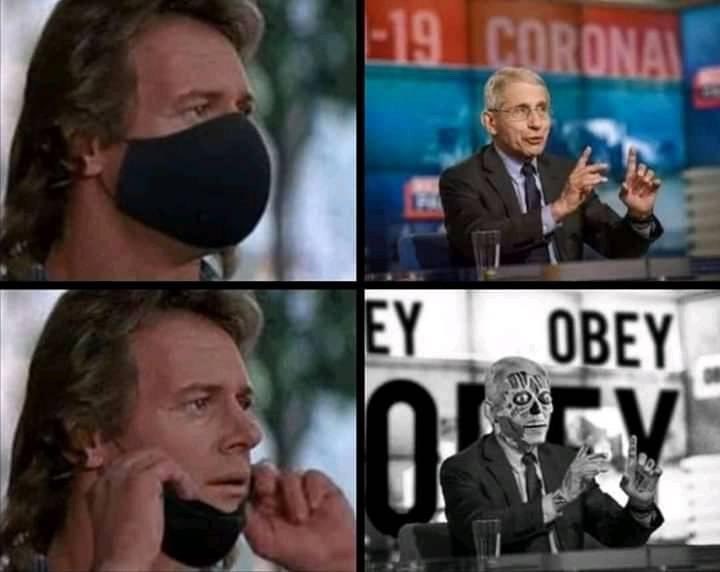
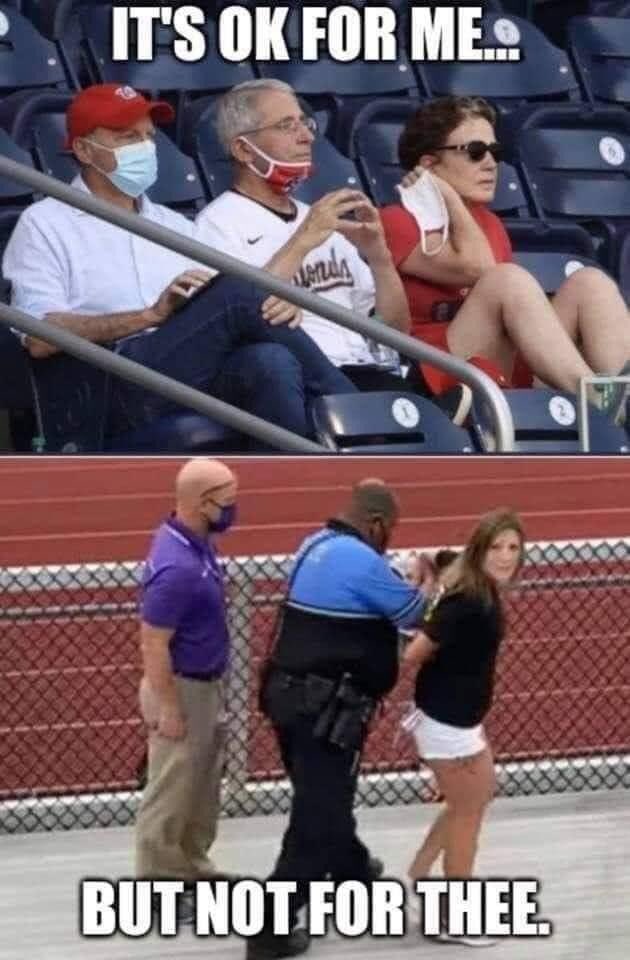
Social distancing, masks still necessary after getting COVID-19 vaccine: Fauci

Dr. Anthony Fauci said Sunday that it will still be necessary to social distance, wear masks and take other COVID-19 precautions after a vaccine becomes available to Americans.

“I would recommend to people to not to abandon all public health measures just because you’ve been vaccinated,” Fauci told CNN anchor Jake Tapper on “State of the Union.”

“Because even though for the general population it might be 90 to 95 percent effective, you don’t necessarily know for you how effective it is.”

Keep reading

New York Times report may prove Rand Paul correct in cross-immunity disagreement with Dr. Anthony Fauci during testimony

Sen. Rand Paul seized on a New York Times report showing many school-aged children already have antibodies from infection with other coronaviruses associated with common colds that could block the new SARS-CoV-2 strain causing the pandemic.

During a testy Sept. 23 Senate hearing, Paul repeatedly questioned Dr. Anthony Fauci, the nation’s top infectious disease expert, on the role preexisting cross-reactive immunity could play in stopping the spread of COVID-19. Paul cited countries in Asia that had seen slower spreads of the disease, noting that it’s possible their success could be attributed to immunity built up through coronavirus strains present in widespread common colds in those countries.

Fauci insisted no evidence suggested that was the case, instead pointing to mask mandates and social distancing efforts as being solely responsible for slowing the spread.

“You are not listening to what the director of the CDC said,” Fauci said. “If you believe 22% is herd immunity, I believe you’re alone in that.”

Fauci then claimed a recent study contradicted Paul’s hypothesis.

“I’d like to talk to you about that also because there was a study that recently came out that preexisting immunity to coronaviruses that are common cold do not cross-react with the COVID-19,” Fauci said.

Fauci did not immediately respond to a Washington Examiner request for comment on what study he was referencing.

Keep reading

Anthony Fauci: 40 Years of Lies From AZT to Remdesivir

In fact, not outlining the facts, but saying the untruth and not answering is a characteristic behaviour that runs through Fauci’s entire 36 years in which the now 79-year-old has been director of the National Institute of Allergy and Infectious Diseases (NIAID). And this has very serious consequences.

Because with a current annual budget of almost six billion dollars, Fauci’s institute is a giant in AIDS, tuberculosis, malaria and autoimmune research — while he himself is perhaps the most powerful man in the global virus circus.

The abundance of lies Fauci puts into the world is so great that you don’t even know where to start to enumerate them all. One of the many topic fields he is sending out factually untenable statements to the whole world is without question COVID-19.

Keep reading

Pandemic analyst finds herd immunity could be slowing COVID spread — yet Dr. Fauci still warns against it

At the moment, nobody knows exactly what the threshold of population infection needs to be at to attain herd immunity. Mike Ryan, executive director of the World Health Organization’s health emergencies program, said most scientists believe 60% to 80% of the population needs to be vaccinated or have natural antibodies to achieve herd immunity.

Researchers from Stockholm University in Sweden and the University of Nottingham in Britain published a new study in the journal Science on Friday.The scientists estimate that herd immunity could be achieved at a population-wide infection rate of approximately 40%.

Youyang Gu, a computer scientist whose coronavirus projections are one of 34 pandemic models tracked by the CDC, believes that herd immunity could help in the fight against COVID-19.

“Immunity may play a significant part in the regions that are declining,” Gu told MIT Technology Review. Gu estimates that approximately 35 million Americans have now been infected, which is more than 10% of the country’s population.

Keep reading

Doctors Pen Open Letter To Fauci Regarding The Use Of Hydroxychloroquine for Treating COVID-19

Since the start of the pandemic, physicians have used hydroxychloroquine to treat symptomatic COVID-19 infections, as well as for prophylaxis. Initial results were mixed as indications and doses were explored to maximize outcomes and minimize risks. What emerged was that hydroxychloroquine appeared to work best when coupled with azithromycin. In fact, it was the President of the United States who recommended to you publicly at the beginning of the pandemic, in early March, that you should consider early treatment with hydroxychloroquine and a “Z-Pack.” Additional studies showed that patients did not seem to benefit when COVID-19 infections were treated with hydroxychloroquine late in the course of the illness, typically in a hospital setting, but treatment was consistently effective, even in high-risk patients, when hydroxychloroquine was given in a “cocktail” with azithromycin and, critically, zinc in the first 5 to 7 days after the onset of symptoms. The outcomes are, in fact, dramatic.

Keep reading

Dr. Anthony Fauci says chance of coronavirus vaccine being highly effective is ‘not great’

White House coronavirus advisor Dr. Anthony Fauci said Friday that the chances of scientists creating a highly effective vaccine — one that provides 98% or more guaranteed protection — for the virus are slim.

Scientists are hoping for a coronavirus vaccine that is at least 75% effective, but 50% or 60% effective would be acceptable, too, Fauci, director of the National Institute of Allergy and Infectious Diseases, said during a Q&A with the Brown University School of Public Health. “The chances of it being 98% effective is not great, which means you must never abandon the public health approach.”

“You’ve got to think of the vaccine as a tool to be able to get the pandemic to no longer be a pandemic, but to be something that’s well controlled,” he said. 

The Food and Drug Administration has said it would authorize a coronavirus vaccine so long as it is safe and at least 50% effective. Dr. Stephen Hahn, the FDA’s commissioner, said last month that the vaccine or vaccines that end up getting authorized will prove to be more than 50% effective, but it’s possible the U.S. could end up with a vaccine that, on average, reduces a person’s risk of a Covid-19 infection by just 50%.

Keep reading