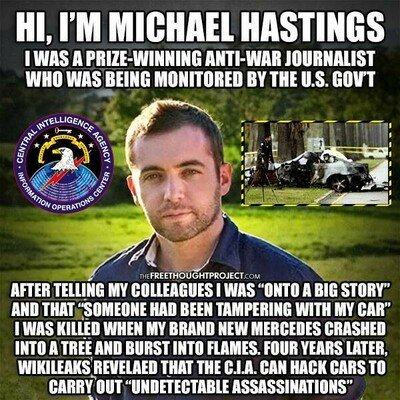
Never forget…

Biden’s divergence from the Obama administration’s less authoritarian position on the matter should not come as much of a surprise, since he took an absurdly hard line against WikiLeaks after the first publications of the earth-shattering Manning leaks in 2010.
“I would argue it is closer to being a hi-tech terrorist than the Pentagon papers,” Biden said of Assange at the time. “But, look, this guy has done things that have damaged and put in jeopardy the lives and occupations of people in other parts of the world.”
It should also come as no surprise because, all things considered, this administration has not been much different from the previous one in terms of actual policy. The policy of regime change interventionism in Venezuela is the same. The policy of hawkishness toward China is the same. The policy of starvation sanctions against Iran is effectively the same. In a recent CNN interview Secretary of State Tony Blinken could not speak highly enough of Trump’s more incendiary foreign policy decisions like moving the US embassy to Jerusalem and recognizing the illegally occupied Golan Heights as Israeli territory.
There are far, far more similarities between the Trump administration and the Biden administration than there are differences. As is consistently the case with US presidents, the narratives are different, the campaign platforms are different, the political parties are different, but the actual policies and behaviors remain more or less the same.
Just a day after a coalition of press freedom groups urged President Joe Biden to drop his predecessor’s effort to prosecute Julian Assange, a spokesperson for the Department of Justice said Tuesday that the new administration intends to challenge a British judge’s rejection last month of the U.S. attempt to extradite the WikiLeaks publisher.
“We continue to seek his extradition,” Marc Raimondi, a spokesperson for the DOJ’s National Security Division, told Reuters just days before the Friday deadline to appeal Judge Vanessa Baraitser’s ruling, which denied the U.S. extradition request on the grounds that America’s brutal prison system would pose a threat to Assange’s life.
Charged by the Trump Justice Department in 2019 with 17 counts of violating the Espionage Act for publishing classified documents that exposed U.S. war crimes overseas, Assange would likely face up to 175 years in a maximum-security prison if the extradition effort is successful.
Have you ever noticed how whenever someone inconveniences the dominant western power structure, the entire political/media class rapidly becomes very, very interested in letting us know how evil and disgusting that person is? It’s true of the leader of every nation which refuses to allow itself to be absorbed into the blob of the US-centralized power alliance, it’s true of anti-establishment political candidates, and it’s true of WikiLeaks founder Julian Assange.
Corrupt and unaccountable power uses its political and media influence to smear Assange because, as far as the interests of corrupt and unaccountable power are concerned, killing his reputation is as good as killing him. If everyone can be paced into viewing him with hatred and revulsion, they’ll be far less likely to take WikiLeaks publications seriously, and they’ll be far more likely to consent to Assange’s imprisonment, thereby establishing a precedent for the future prosecution of leak-publishing journalists around the world. Someone can be speaking 100 percent truth to you, but if you’re suspicious of him you won’t believe anything he’s saying. If they can manufacture that suspicion with total or near-total credence, then as far as our rulers are concerned it’s as good as putting a bullet in his head.
Those of us who value truth and light need to fight this smear campaign in order to keep our fellow man from signing off on a major leap in the direction of Orwellian dystopia, and a big part of that means being able to argue against those smears and disinformation wherever they appear. Unfortunately I haven’t been able to find any kind of centralized source of information which comprehensively debunks all the smears in a thorough and engaging way, so with the help of hundreds of tips from my readers and social media followers I’m going to attempt to make one here. What follows is my attempt at creating a tool kit people can use to fight against Assange smears wherever they encounter them, by refuting the disinformation with truth and solid argumentation.

A British judge has rejected a US request to extradite WikiLeaks founder Julian Assange to America, ruling that such a move would be “oppressive” by reason of his mental health.The 49-year-old Australian has been charged in the US under the Espionage Act for his role in publishing classified military and diplomatic cables.”I have decided that extradition would be oppressive and I order his discharge,” judge Vanessa Baraitser said in her ruling Monday.Despite ruling that Assange would be afforded a “fair trial” in the event of extradition to the United States, the judge considered that the “special administrative measures” Assange would most likely be held in would have a severe, negative impact on his mental health.Baraitser said Assange had “remained either severely or moderately clinically depressed,” throughout his stay at London’s Belmarsh prison and that he was now considered a suicide risk.She also said that the increased isolation he would face in detention in the US would further increase that risk, adding that Assange had the intellect to circumvent anti-suicidal measures that would be put in place.In her full ruling, published online, Baraitser wrote: “I accept that oppression as a bar to extradition requires a high threshold … However, I am satisfied that, in these harsh conditions, Mr. Assange’s mental health would deteriorate causing him to commit suicide with the ‘single minded determination’ of his autism spectrum disorder.””I find that the mental condition of Mr. Assange is such that it would be oppressive to extradite him to the United States of America,” she added.
BY 2013, the Obama administration had concluded that it could not charge WikiLeaks or Julian Assange with crimes related to publishing classified documents — documents that showed, among other things, evidence of U.S. war crimes in Iraq and Afghanistan — without criminalizing investigative journalism itself. President Barack Obama’s Justice Department called this the “New York Times problem,” because if WikiLeaks and Assange were criminals for publishing classified information, the New York Times would be just as guilty.
Five years later, in 2018, the Trump administration indicted Assange anyway. But, rather than charging him with espionage for publishing classified information, they charged him with a computer crime, later adding 17 counts of espionage in a superseding May 2019 indictment.The alleged hacking not only didn’t happen, according to expert testimony, but it also couldn’t have happened.
The computer charges claimed that, in 2010, Assange conspired with his source, Chelsea Manning, to crack an account on a Windows computer in her military base, and that the “primary purpose of the conspiracy was to facilitate Manning’s acquisition and transmission of classified information.” The account enabled internet file transfers using a protocol known as FTP.
New testimony from the third week of Assange’s extradition trial makes it increasingly clear that this hacking charge is incredibly flimsy. The alleged hacking not only didn’t happen, according to expert testimony at Manning’s court martial hearing in 2013 and again at Assange’s extradition trial last week, but it also couldn’t have happened.
The new testimony, reported earlier this week by investigative news site Shadowproof, also shows that Manning already had authorized access to, and the ability to exfiltrate, all of the documents that she was accused of leaking — without receiving any technical help from WikiLeaks.

Julian Assange and WikiLeaks have been the subject of numerous false, unfounded smears of connection to the Russian government, particularly in relation to WikiLeaks’ 2016 publication of DNC emails. In this brief we recount some of the most pervasive claims and correct the record.
Julian Assange has a long-standing policy never to reveal his sources. However, in this case, he has stated that his source of the 2016 releases was not a state party. Regardless of the source, WikiLeaks will publish what it receives provided the material is verifiable and newsworthy.
 Hellbound and Down
You must be logged in to post a comment.