At The FBI, The Rotten Apple Doesn’t Fall Far From The Tree

You can’t make this up.

The apple doesn’t fall far from the tree.

Put these clichés together and you have the chilling saga of two FBI agents linked by blood whose conduct has forever stained the Bureau’s reputation.

One bad apple is former FBI Deputy Director Larry A. Potts. He was in a supervisory role during the Waco raid and demoted in the 1990s following the Ruby Ridge fallout, two of the bloodiest incidents in FBI history.

The other is Walter Giardina, who was among several senior FBI officials terminated by Director Kash Patel in August 2025. His firing came after months of Senate Oversight letters citing whistleblower allegations about his role in Trump-related investigations.

As I recount in my new book “I Went To Prison So You Won’t Have To,” Giardina was also the FBI agent who put handcuffs and leg irons on me after orchestrating my circus-style arrest at Reagan National Airport, an ambush that dragged my fiancée into the spectacle as collateral damage.

Here’s the you can’t make this up kicker: Potts is Giardina’s father-in-law.

Potts: A Study in Bad Apple FBI Culture

In the early 1990s, Larry A. Potts rose quickly at FBI headquarters, eventually becoming the Bureau’s second-in-command as deputy director. His ascent coincided with the Ruby Ridge tragedy of 1992. Potts was in the Washington oversight chain when the Bureau abandoned its standard deadly-force policy and adopted special “rules of engagement” for that operation.

Under normal FBI policy, agents were authorized to use lethal force only when facing an imminent threat of death or grievous bodily harm. At Ruby Ridge, however, the rules were rewritten. The order declared that “any armed adult male observed in the vicinity of the Weaver cabin could and should be shot.”

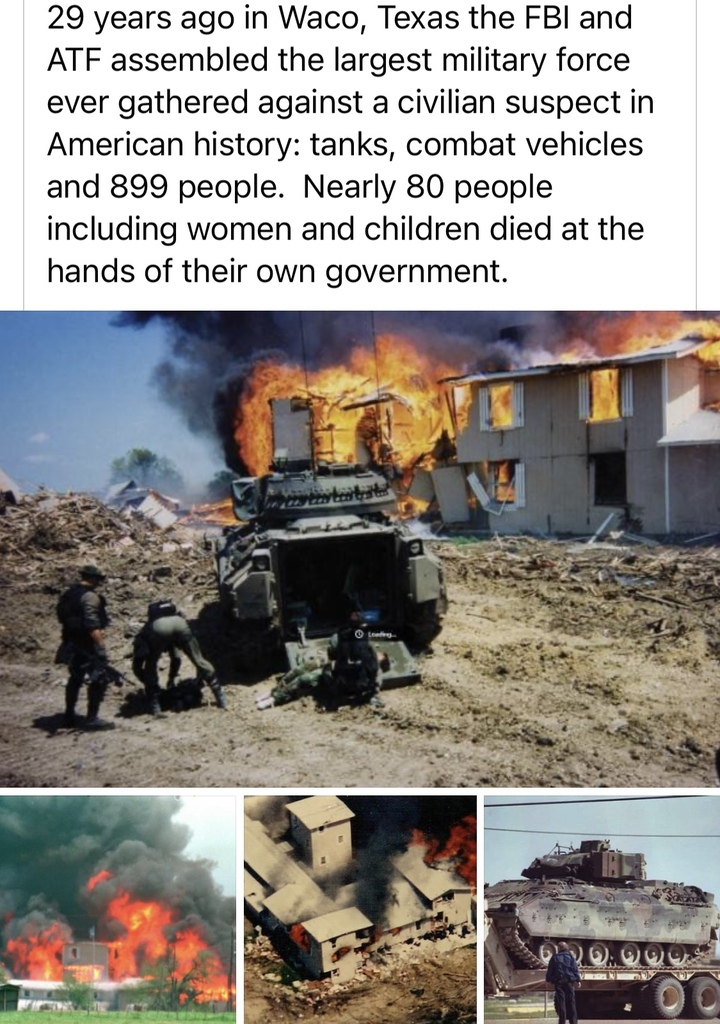
This was not the restrained standard of constitutional policing. It was a license to kill. Within 24 hours, Randy Weaver’’ 14-year-old son was dead, as was Vicki Weaver, killed while holding her infant daughter in her arms. Barely a year later came Waco. After a 51-day standoff, the FBI’s siege — armored vehicles, CS gas, aggressive psychological tactics — ended in a fire that killed 76 men, women, and children.

Under intense scrutiny, FBI Director Louis Freeh demoted Potts; he then retired in 1997.

But not before “Pottsgate.”

To justify billing the Bureau for Potts’ lavish retirement dinner, senior managers created paperwork for an ironically named “ethics conference” at Quantico. When exposed, letters of censure followed. Rank-and-file agents fumed: falsify records as a line agent and you’re fired; do it for a boss’s party and you get a slap on the wrist. (DOJ OIG—Potts retirement; GAO).

Potts would later sit at the family table with his daughter and son-in-law Walter Giardina. Giardina is not just the FBI thug who put me in handcuffs; he also tried, in my view, to take down Donald John Trump.

Keep reading

Brother of Murdered Inmate Alleges FBI Role in OKC Bombing, Waco, and Decades of Domestic Spying, “Justice Will Come From Exposing PATCON”

A newly released book and an upcoming documentary are reviving attention on one of the FBI’s most secretive and controversial domestic spy programs known as “PATCON,” which was unmasked after a 30-year FOIA fight by Utah attorney Jesse Trentadue to prove his brother was murdered while in custody by federal agents in 1995.

Trentadue has uncovered, and is litigating to uncover, a total 2 million pages of documents so far. Two of his seven federal FOIA suits are still ongoing.

Trentadue is still litigating the release of government records from 1995, where his current case involves a request made in 2015 that the FBI sat on for 8 years and refused to respond to, involving records related to federal sting operations involving Timothy McVeigh from before the April 19, 1995 Oklahoma City bombing.

Yet his revealations to date has shown not just government lies about the Oklahoma City bombing, but also a domestic spying and criminal operations that extends into the nation’s newsrooms, courtrooms, centers of power, and more.

Despite new attention on the case and a wave of public interest in PATCON caused by the release of Margaret Roberts’ book “Blowback: The Untold Story of the FBI and the Oklahoma City Bombing” two weeks ago, Trentadue says he does not expect any federal agent or informant to face prosecution for his brother’s killing or for related crimes.

He’s hopeful, rather, that the documented evidence he has uncovered about FBI spying on the political right can be stopped, and that will be the most justice his family will ever find.

Keep reading

30 Years Later, Waco is Still Damning

Thirty years ago, FBI tanks smashed into the ramshackle home of the Branch Davidians outside Waco, Texas. After the FBI collapsed much of the building atop the residents, a fire erupted and 76 corpses were dug out of the rubble. Unfortunately, the American political system and media have never honestly portrayed the federal abuses and political deceit that led to that carnage.

What lessons can today’s Americans draw from the FBI showdown on the Texas plains 30 years ago?

Purported Good Intentions Absolve Real Deadly Force

Janet Reno, the nation’s first female attorney general, approved the FBI’s assault on the Davidians. Previously, she had zealously prosecuted child abuse cases in Dade County, Florida, though many of her high-profile convictions were later overturned because of gross violations of due process. Reno approved the FBI assault after being told “babies were being beaten.” It is not known who told her about the false claims of child abuse; Reno claimed she couldn’t remember. Her sterling reputation helped the government avoid any apparent culpability for the deaths of 27 children on April 19, 1993. After Reno publicly promised to take responsibility for the outcome at Waco, the media conferred instant sainthood upon her. At a press conference the day after the fire, President Bill Clinton declared, “I was frankly—surprised would be a mild word—to say that anyone that would suggest that the Attorney General should resign because some religious fanatics murdered themselves.” According to a Federal News Service transcript, the White House press corps applauded Clinton’s comment on Reno.

It Is Not an Atrocity If the U.S. Government Does It

Shortly before the Waco showdown, U.S. government officials signed an international Chemical Weapons Convention Treaty pledging never to use nerve agents, mustard gas, and other compounds (including tear gas) against enemy soldiers. But the treaty contained a loophole permitting governments to gas their own people. On April 19, 1993, the FBI pumped CS gas and methyl chloride, a potentially lethal, flammable combination, into the Davidians’ residence for six hours, disregarding explicit warnings that CS gas should not be used indoors. Benjamin Garrett, executive director the Chemical and Biological Arms Control Institute in Alexandria, Virginia, observed that the CS gas “would have panicked the children. Their eyes would have involuntarily shut. Their skin would have been burning. They would have been gasping for air and coughing wildly. Eventually, they would have been overcome with vomiting in a final hell.” A 1975 U.S. Army publication on the effects of CS gas noted, “Generally, persons reacting to CS are incapable of executing organized and concerted actions and excessive exposure to CS may make them incapable of vacating the area.”

Rep. Steven Schiff (R-NM) declared that “the deaths of dozens of men, women and children can be directly and indirectly attributable to the use of this gas in the way it was injected by the FBI.” Chemistry professor George Uhlig testified to Congress in 1995 that the FBI gas attack probably “suffocated the children early on” and may have converted their poorly ventilated bunker into an area “similar to one of the gas chambers used by the Nazis at Auschwitz.” But during those 1995 hearings, congressional Democrats portrayed the CS gas as innocuous as a Flintstone vitamin.

Keep reading

ATF Honors Agents Who Kicked Off the Waco Slaughter of Women, Children

The ATF is honoring its agents who were killed as they kicked off the slaughter of American women and children at the Waco, Texas Branch Davidians compound in 1993, in an event widely known as the “Waco Massacre.”

The Bureau of Alcohol Tobacco Firearms and Explosives Houston, Texas office posted to Twitter this week to mark the 30th anniversary of the beginning of the Waco Siege, that led to the Waco Massacre. Included in the ATF’s tweet was a photograph of four agents “standing post” at the “Waco Peace Officer Memorial in Waco, TX in honor of Special Agents Conway LeBleu, Todd McKeehan, Robert Williams, and Steve Willis.”

The ATF was blasted in the responses to its tweet by a chorus of Twitter users, including prominent accounts like those of Jake Shields and Mindy Robinson.

“We mourn for the innocent women and children you burned alive,” Shields commented on the ATF’s tweet.

“Oh, you mean the baby killers?” Mindy Robinson wrote. “Are they standing guard so real patriots don’t dance on their graves? Yea, it takes a real man to shoot, kill, poison, and set innocent women and children on fire for their own “safety.”

Keep reading