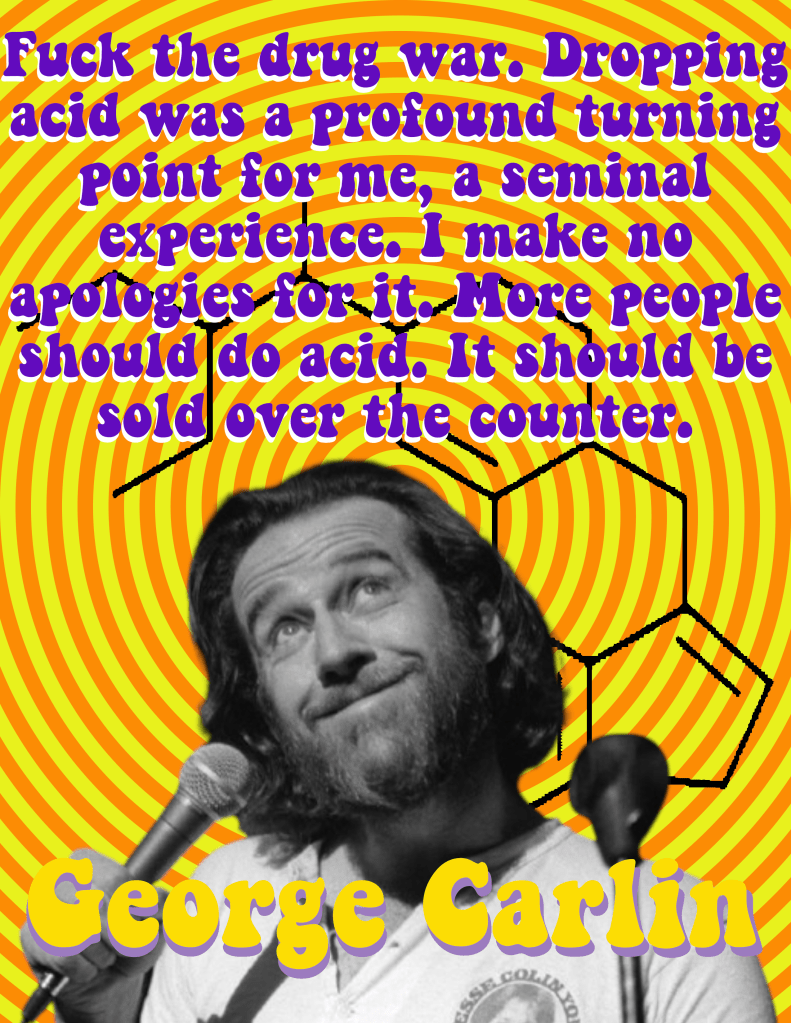
George Carlin on LSD…

Seth Ferranti was driving his Ford pickup on a southeastern Nebraska stretch of the interstate in November 2024 when law enforcement pulled him over, claiming that he had wobbled onto the hard shoulder.
As the Seward County sheriff’s deputies questioned Ferranti, a filmmaker who had spent 21 years in prison for distributing LSD, they allegedly smelled cannabis. Declaring this probable cause for a search, they searched the vehicle and discovered more than 400 pounds of marijuana.
But were those the actual reasons for the stop and search? When Ferranti went on trial, his attorneys presented a license plate reader report produced by the security communications company Motorola Solutions. It revealed Ferranti had been consistently monitored prior to his arrest, including by the local sheriff on the day he was apprehended. (Neither the sheriff’s office nor Motorola responded to Reason‘s requests for comment.)
Ferranti’s legal team argued that it was unconstitutional to surveil somebody based on his previous crimes. The argument did not carry the day: Last month their client was sentenced to up to two and a half years for possession of cannabis with intent to distribute. But the case still raises substantial moral and constitutional questions about both the scale of these public-private surveillance partnerships and the ways they’re being used.
Ferranti had long been a celebrity in the drug-reform world, going back to that LSD arrest in the early ’90s. After that first bust, he jumped bail, went on the lam, landed on the U.S. Marshals’ 15 Most Wanted Fugitives list, and even staged his own drowning to evade the authorities. After he started serving his sentence in 1993, he became a prolific prison journalist, writing the “I’m Busted” column for Vice. The New Jersey native always insisted that his crimes were nonviolent and that the drugs he sold, LSD and cannabis, had medicinal or therapeutic benefits.
After Ferranti came out of prison, his 2017 documentary White Boy—the true story of a teenage FBI informant who became a major cocaine trafficker—was a success on Netflix. He produced a number of further films, including 2023’s Secret History of the LSD Trade. And apparently, the government kept watching him.
It’s been watching a lot of people—and Motorola isn’t the only company helping it. Flock Safety was founded in 2017, and within five years it had tens of thousands of cameras operational. As the American Civil Liberties Union (ACLU) has warned, Flock’s AI-assisted automated license plate recognition (ALPR) system has been undergoing an “insidious expansion” beyond its supposed purposes of identifying vehicles of interest, such as stolen cars and hit-and-run suspects. Immigration and Customs Enforcement has used it to locate illegal migrants, and law enforcement in Texas used it to investigate a self-administered abortion, foreshadowing its potential use as a predictive policing tool for all Americans. Lee Schmidt, a veteran in Virginia, recently learned that the system logged him more than 500 times in four months.
“I don’t know whether law enforcement officers are using [ALPRs] to do predictive policing,” says Joshua Windham of the Institute of Justice, a public interest law firm that is campaigning to stop the warrantless use of license plate reader cameras. “We know that [Customs and Border Patrol] is using ALPRs generally to stop cars with what they deem ‘suspicious’ travel patterns.”
After reviewing the document cataloguing the Ferranti’s vehicle monitoring, Windham adds: “The records are consistent with an officer either looking up a car in his system to see where else that car was captured by ALPRs, or that car showing up as a ‘hot list’ alert in the Motorola system. But it’s hard to tell, from the records alone, whether the stop was a ‘predictive policing’ stop.”
Ferranti is convinced it was. “There were no warrants, investigations, informants, state police, DEA, or FBI involvement, just Seward County Sheriff’s office [and an] AI-assisted license plate tracking service to perpetuate their outdated War on Drugs mission,” he said in an Instagram post published by his family following his sentencing. “Traveling the highways as a person with a record is now considered [suspicious] activity by the AI.”
Arizona lawmakers are considering at a pair of measures that would make the act of creating “excessive” amounts of marijuana smoke a nuisance crime punishable by jail time, even if the person is using cannabis in compliance with state law in their own homes.
Sen. J.D. Mesnard (R) is sponsoring the two proposals—one that would amend state statute legislatively that would put the issue before voters at the ballot. Members of the Senate Judiciary and Elections Committee are set to consider the proposals this week.
The lawmaker said he decided to push the issue due to the smell of marijuana in his own neighborhood.
Both versions of Mesnard’s legislation stipulate that “it is presumed that a person who creates excessive marijuana smoke and odor causes a condition that endangers the safety or health of others.”
The reason behind having both a proposed bill and resolution is related to the potential legal challenges of lawmakers changing the voter-approved marijuana legalization law.
The legislation would establish “a presumption that the creation of excessive marijuana smoke and odor is injurious to health, indecent, offensive to the senses and an obstruction to the free use of property that interferes with the comfortable enjoyment of life or property,” a summary of the proposal says.
If enacted, the loosely defined offense of creating “excessive” marijuana smoke under the bill and resolution would be considered a class 3 misdemeanor, punishable by up to 30 days in jail, a maximum $500 fine and up to one year of probation.
“I’m hearing from some people that, depending on their neighbor situation, they may not be able to have their kids go outside because the marijuana smoke is so potent,” Mesnard, the sponsor, said. “It can even creep into your own house or, in my case, into my garage.”
“But experiencing now what’s happened, even in my own neighborhood, is a pretty frustrating situation,” he told The Arizona Daily Star. “You should be responsible neighbors if you’re going to smoke pot… It can be a real issue for families, especially with kids.”
Asked about the seeming double standard given that no such nuisance offenses exist for smoking cigarettes or cigars on a private property, the senator said, “I’ll concede I hadn’t thought about it.”

Cannabis is the most used illicit drug in the United States. Though cannabis possession and consumption are prohibited federally, states are increasingly implementing laws that legalize this substance, initially for medical and, more recently, for recreational use. We study the impact of recreational cannabis laws on child maltreatment reports. To do so, we employ difference-in-differences and event-study methods to analyze administrative data on child maltreatment reports as well as child injury-related deaths 2010-2022. We find that recent efforts to legalize cannabis for recreational consumption have not led to an increase in child maltreatment reports and may reduce particularly severe maltreatment.
The attorney general of Florida and several business and anti-marijuana groups are telling the state Supreme Court to block a cannabis legalization initiative, calling it “fatally flawed” and unconstitutional as advocates work against the clock to qualify the measure for the November ballot.
In a series of briefs submitted to the court on Friday, Attorney General James Uthmeier (R), Drug Free America Foundation, Florida Chamber of Commerce, Florida Legal Foundation, Associated Industries of Florida and a former judge made similar arguments contesting the initiative from Smart and Safe Florida.
The parties generally contend that the proposal is written in a way that’s affirmatively misleading, runs counter to federal law prohibiting cannabis and violates the state’s single subject rule for ballot initiatives.
The attorney general called the measure “fatally flawed,” arguing that it “misleads voters in a way designed to garner greater approval, is flatly invalid under the federal Constitution, and violates the single-subject requirement. The Court should therefore strike the proposed amendment from the ballot.”
Each of those reasons alone, the brief said, “warrants removal from the ballot.”
The attorney general’s office last month asked the state Supreme Court to review the constitutionality of the legalization initiative. The court accepted the request and set a schedule for state officials and the cannabis campaign to file briefs this month. Proponents of the measure have until January 12 to submit response briefs, then the opposition has until January 20 to reply.
The Justice Department should “take about 20 years” to finish the marijuana rescheduling process, a GOP congressman who staunchly opposes cannabis reform tells Marijuana Moment.
With the proposal to move marijuana from Schedule I to Schedule III of the Controlled Substances Act (CSA) still pending, Rep. Andy Harris (R-MD) is in no rush to have DOJ see the process through—despite President Donald Trump’s December executive order directing the attorney general to quickly finalize the rule.
“Last I looked, it hasn’t been rescheduled. The president said to look into it,” Harris said in an interview on Thursday, adding that he hasn’t directly communicated with the Justice Department about the issue but that “everybody understands what I want it to look like.”
“I don’t think I’ve been subtle about it,” Harris said. “All I know is every day that goes by and it’s not rescheduled is another good day.”
The prohibitionist congressman said he isn’t sure if internal disagreements within DOJ are to blame for the delayed rescheduling action, but “the wheels grind a little slowly around here sometimes.”
“On this one, they should take about 20 years to grind,” he said.
In December, Harris separately said Trump doesn’t have the authority to unilaterally reschedule marijuana via executive order. But while lawmakers could overrule any administrative move to enact the reform, it would be a “heavy lift” in the Republican-controlled Congress, he acknowledged.
For what it’s worth, the congressman may be at risk of being unseated in November due to redistricting in his state.
The Maryland House of Delegates earlier this month approved a congressional redistricting proposal that would leave anti-cannabis Harris especially vulnerable in the next election, according to analysts, giving Democrats an advantage in the state’s first congressional district for the first time since the last map was drawn in 2011. It remains to be seen whether the Senate will follow the House’s lead to pass the legislation, however.
Meanwhile, another GOP lawmaker on the other side of the debate, Congressional Cannabis Caucus co-chair Rep. Dave Joyce (R-OH), recently told Marijuana Moment that while marijuana rescheduling might not be at the top of the agenda for the Justice Department or White House amid competing interests, he and bipartisan colleagues will be ready when “opportunity does present itself.”
Joyce separately said last month that he doesn’t think the attorney general would seek to undermine the president’s executive order to move marijuana to Schedule III despite any personal reservations she may have about the policy change.
Steve Hilton announced the first findings from the newly formed California Department of Government Efficiency, led by Jenny Ray LaRue, alleging large-scale fraud involving state funds.
Speaking outside the California Department of Tax and Fee Administration, Hilton said the new department had begun examining financial activity within state agencies and tracking alleged misuse of taxpayer money.
“Welcome everyone. We are here outside the California Department of tax defeat administration. This is where your money goes. This building is where your money goes into the Democrats bottomless money pit,” Hilton said.
Hilton referenced a prior estimate released weeks earlier, which he said projected at least $250 billion in fraud statewide.
“Our estimate, as you may remember, that we put out a few weeks ago, at least $250 billion of fraud in California,” Hilton said.
“And today, we’re announcing our first findings since we got to work in Cal DOGE just a few weeks ago, just a couple of weeks ago, and here it is. It’s a classic.”
At some point, you have to ask what exactly the left is fighting for.
Because when a man is caught with 57 pounds of meth, this probably isn’t the hill you should die on. Clearly, something has gone very wrong in the Democrat Party. America is drowning in drugs, and families are being ripped apart by addiction. US cities are buckling under fentanyl and meth epidemics, and yet in Minneapolis, left-wing activists showed up to physically try to block ICE from arresting an illegal caught with enough meth to poison entire communities.
This is what the left-wing “resistance” has become… fighting tooth and nail for the rights of illegal drug smugglers.
How will that look on a campaign poster?
American voters reelected President Trump on a promise to restore order, secure the border, and remove Biden’s dangerous illegals from our communities. That mandate was crystal clear. But in Minneapolis, activists decided the will of the voters doesn’t matter. Apparently, “democracy” now includes saving drug smugglers from arrest.
The Virginia House of Delegates has approved a bill to protect the rights of parents who use marijuana in compliance with state law.
The legislation from Del. Nadarius Clark (D) is consistent with a measure he sponsored last session that advanced through the legislature, only to be vetoed by then-Gov. Glenn Youngkin (R). The latest version passed the House in a 62-37 vote on Tuesday.
Under the proposal, possession of use of cannabis by a parent or guardian on its own “shall not serve as a basis to deem a child abused or neglected unless other facts establish that such possession or consumption causes or creates a risk of physical or mental injury to the child.”
“A person’s legal possession or consumption of substances authorized under [the state’s marijuana law] alone shall not serve as a basis to restrict custody or visitation unless other facts establish that such possession or consumption is not in the best interest of the child,” the text of the bill, HB 942, states.
When the bill was on the floor for second reading on Monday, Clark said that the measure “fully preserves judicial discretion requiring a court to act when a child is in danger, but grounding those decisions in individualized evidence-based findings instead of presumptions tied to lawful conduct.”
Youngkin claimed in his veto message last year that the prior measure introduced “unnecessary complications and risks exposing children to harm.”
“The bill disregards clear evidence linking substance use to child endangerment, particularly in the wake of increased incidents of children ingesting cannabis-infused substances following the legalization of marijuana,” he argued. “By broadly prohibiting courts from considering parental marijuana use in custody and visitation determinations, [the bill] risks prioritizing drug use over the health and well being of children.”
The then-governor also vetoed an even earlier version of the bill in 2024.
 Hellbound and Down
You must be logged in to post a comment.