
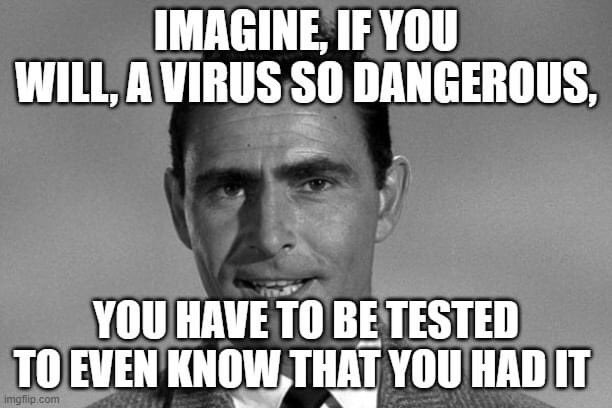
Schrodinger’s virus…

More than 600,000 people in Tricare, a health care program of the United States Department of Defense Military Health System, received emails July 17 asking if they would donate blood for research as “survivors of COVID-19.”
But just 31,000 people affiliated with the U.S. military have been officially diagnosed with the coronavirus, which prompted confusion, Military.com reported last week.
“Just wondering [if] anybody [got] an email from Tricare saying since you are a COVID survivor, please donate your plasma.?? I have NOT been tested,” wrote a beneficiary on Facebook. “Just remember all those people inputting data are human and make mistakes.”
The mass email went to every beneficiary located near a collection point.
Trust is the one thing required in getting people to follow COVID-19 safety guidelines. But, several incidents that happened in Florida over the past few weeks have raised questions about the authenticity of COVID positive numbers given by the laboratories. According to netizens, Florida COVID numbers are wrong. Let’s do a fact check.
The alarming figure of more than 15,000 people testing positive on one day in Florida has disturbed everyone. The state made international headlines for the record-breaking number of positive cases in a day.
People are questioning if the labs are providing accurate details or tampered results. Read as we break down the news of 33 Labs Busted in Florida for cooking the books.
Florida Gov. Ron DeSantis says he’s concerned about the accuracy of COVID-19 test results.
In a news conference Monday, he said there have been several cases where people received positive results, even though they had never been tested in the first place.
“For that to come back positive, when there was no specimen submitted, is problematic. So I’ve heard it enough to be concerned about it,” said DeSantis.
People have said they submitted their contact information at a COVID-19 testing site, but after seeing how long the line was, they decided not to wait an hour or more to get the test. Nevertheless, a few days later, they got an email or a phone call telling them that they tested positive.
Coronavirus testing has been a hot-button issue since the beginning of the pandemic. First, there weren’t enough coronavirus tests to go around. Now, a new issue has emerged—just how accurate the tests people are getting actually are. According to a July 17 study published in the International Journal of Geriatrics and Rehabilitation, 50 percent of nucleic acid coronavirus tests distributed by the Centers for Disease Control and Prevention (CDC) provided inaccurate results.
The study’s lead author, Sin Hang Lee, MD, director of Milford Molecular Diagnostics Laboratory, found that the testing kits gave a 30 percent false-positive rate and a 20 percent false-negative rate.
AFlorida hospital handling COVID-19 tests confirmed to media this week that its near-100% positivity rate was overstated by a factor of 10, raising already-heightened concerns that numerous labs are over reporting the number of confirmed infections.
The Florida Division of Emergency Management posts a daily coronavirus update on its website, which features a list of the positivity rates of every COVID testing facility in the state. Hundreds of labs and hospitals throughout Florida are regularly testing state residents for the coronavirus.
In recent days, numerous facilities have begun reporting 100% positivity rates, figures significantly higher than the statewide average of around 15%. Many of those labs claim to have tested only one patient, though others with 100% rates report testing dozens and sometimes hundreds of patients.
 Hellbound and Down
You must be logged in to post a comment.