
Somebody’s about to get it…

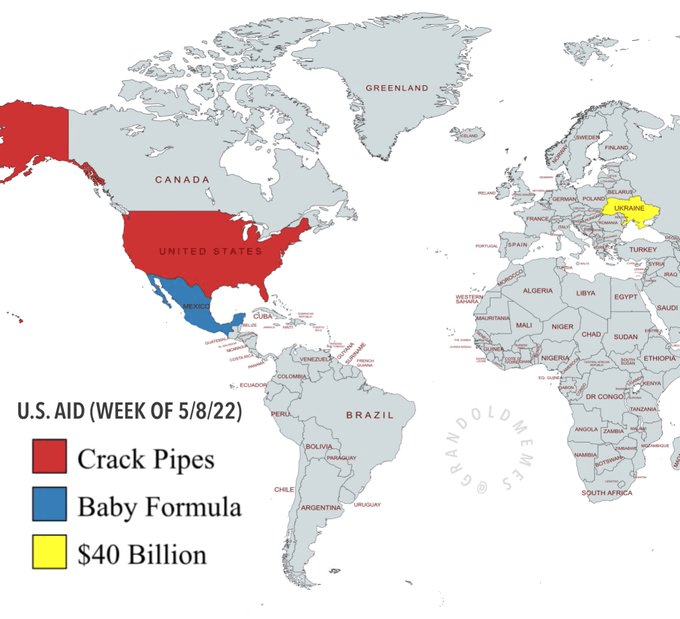
House Speaker Nancy Pelosi belatedly jumped into America’s baby formula crisis on Friday, calling nationwide shortages “unconscionable” and setting an emergency vote next week. But while she tried to get Democrats caught up on a crisis that caught them by surprise, her administrative office was busy ramping up new perks for lawmakers.
House members were alerted to two new perks this week compliments of the chamber’s Democrat leadership: fully paid memberships to Peloton gyms as well as a brand new liquor and drinks outlet.
Republicans immediately seized on the optics, saying doling out additional benefits to lawmakers when everyday Americans are struggling to fill gas tanks, grocery carts or baby bottles was a bridge too far, even for Washington.
“Washington Dems couldn’t be more out of touch,” Rep. Drew Ferguson (R-Ga.) wrote as he tweeted out a new announcement by the House Chief Administrative Officer announcing a new “House Drinks storefront” in the Rayburn House Office Building where lawmakers and staff can buy beverages, wine and liquor.
“Whether you’re hosting a meeting or an office event or just want to stock up on your favorite drinks, House Drinks sells water, soda, juice, alcohol and spirits,” the announcement boasted. “Six, twelve and 24-packs are available depending on the drink.”
The House of Representatives is planning to announce they will give staffers in Washington, D.C., and in district offices, free Peloton memberships using taxpayer dollars each month amid skyrocketing inflation.
According to a draft email obtained by FOX Business from the office of the Chief Administrative Officer (CAO), the “premier employee benefit,” which will also be made available to all Capitol Police, will provide staffers with both Peloton All-Access and a Peloton App membership at no monthly cost.
Beginning May 18, the government contract with fitness giant Peloton, under efforts from the House Center for Well-Being, will be offered to the estimated 10,000 people on staff working for the House of Representatives and about 2,300 Capitol Police officers.
A source familiar with the matter told FOX Business that the contract cost is a $10,000 upfront payment to Peloton, plus an extra $10 per month charge for each staffer or officer that utilizes the benefit. If 12,000 staffers took advantage of the benefit, it would cost taxpayers $120,000 a month.
For other Americans, a Peloton All-Access Membership costs $39 per month and a Peloton App Membership costs $12.99 per month.
After Joe Biden announced his extraordinary request for $33 billion more for the war in Ukraine — on top of the $14 billion the U.S. has already spent just ten weeks into this war — congressional leaders of both parties immediately decided the amount was insufficient. They arbitrarily increased the amount by $7 billion to a total of $40 billion, then fast-tracked the bill for immediate approval. As we reported on Tuesday night, the House overwhelmingly voted to approve the bill by a vote of 388-57. All fifty-seven NO votes came from Republican House members. Except for two missing members, all House Democrats — every last one, including all six members of the revolutionary, subversive Squad — voted for this gigantic war package, one of the largest the U.S. has spent at once in decades.
While a small portion of these funds will go to humanitarian aid for Ukraine, the vast majority will go into the coffers of weapons manufacturers such as Raytheon, Lockheed Martin, Boeing and the usual suspects. Some of it will go to the CIA for unspecified reasons. The extreme speed with which this was all approved means there is little to no oversight over how the funds will be spent, who will profit and how much, and what the effects will be for Ukraine and the world.
To put this $54 billion amount in perspective, it is (a) larger than the average annual amount that the U.S. spent on its own war in Afghanistan ($46 billion), (b) close to the overall amount Russia spends on its entire military for the year ($69 billion), (c) close to 7% of the overall U.S. military budget, by far the largest in the world ($778 billion), and (d) certain to be far, far higher — easily into the hundreds of billions of dollars and likely the trillion dollar level — given that U.S. officials insist that this war will last not months but years, and that it will stand with Ukraine until the bitter end.

From the start of the Russian invasion of Ukraine on February 24, the Biden White House has repeatedly announced large and seemingly random amounts of money that it intends to send to fuel the war in Ukraine. The latest such dispatch, pursuant to an initial $3.5 billion fund authorized by Congress early on, was announced on Friday; “Biden says U.S. will send $1.3 billion in additional military and economic support to Ukraine,” read the CNBC headline.
This was preceded by a series of new lavish spending packages for the war, unveiled every two to three weeks, starting on the third day of the war:
Those amounts by themselves are in excess of $3 billion; by the end of April, the total U.S. expenditure on the war in Ukraine was close to $14 billion, drawn from the additional $13.5 billion Congress authorized in mid-March. While some of that is earmarked for economic and humanitarian assistance for Ukraine, most of it will go into the coffers of the weapons industry — including Raytheon, on whose Board of Directors the current Secretary of Defense, Lloyd Austin, sat immediately before being chosen by Biden to run the Pentagon. As CNN put it: “about $6.5 billion, roughly half of the aid package, will go to the US Department of Defense so it can deploy troops to the region and send defense equipment to Ukraine.”
As enormous as those sums already are, they were dwarfed by the Biden administration’s announcement on April 28 that it “is asking Congress for $33 billion in funding to respond to the Russian invasion of Ukraine, more than double the $14 billion in support authorized so far.” The White House itself acknowledges that the vast majority of that new spending package will go to the purchase of weaponry and other military assets: “$20.4 billion in additional security and military assistance for Ukraine and for U.S. efforts to strengthen European security in cooperation with our NATO allies and other partners in the region.”
It is difficult to put into context how enormous these expenditures are — particularly since the war is only ten weeks old, and U.S. officials predict/hope that this war will last not months but years. That ensures that the ultimate amounts will be significantly higher still.
The amounts allocated thus far — the new Biden request of $33 billion combined with the $14 billion already spent — already exceed the average annual amount the U.S. spent for its own war in Afghanistan ($46 billion). In the twenty-year U.S. war in Afghanistan which ended just eight months ago, there was at least some pretense of a self-defense rationale given the claim that the Taliban had harbored Osama bin Laden and Al Qaeda at the time of the 9/11 attack. Now the U.S. will spend more than that annual average after just ten weeks of a war in Ukraine that nobody claims has any remote connection to American self-defense.
Even more amazingly, the total amount spent by the U.S. on the Russia/Ukraine war in less than three months is close to Russia’s total military budget for the entire year ($65.9 billion). While Washington depicts Russia as some sort of grave and existential menace to the U.S., the reality is that the U.S. spends more than ten times on its military what Russia spends on its military each year; indeed, the U.S. spends three times more than the second-highest military spender, China, and more than the next twelve countries combined.

We are once again witnessing history being made, folks. Today, in the Year of our Lord two thousand and twenty-two, we get the great privilege of bearing witness to the single most American thing that has ever happened.
The Biden administration has asked top Democrats to decouple the federal government’s Covid relief spending package from its much larger bill for funding of the US proxy war against Russia in Ukraine, because one of those two things is too controversial and contentious to pass quickly.
Guess which one.
Politico reports:
Congressional Democratic leaders reached a bipartisan accord to send $39.8 billion to Ukraine to bolster its monthslong battle against a brutal Russian assault.
And that deal is now expected to move swiftly to President Joe Biden’s desk after Democrats agreed to drop another one of their top priorities — billions of dollars in pandemic aid that has stalled on the Hill. The Ukraine aid could come to the House floor for a vote as soon as Tuesday, according to a person familiar with the discussions who spoke candidly on condition of anonymity.
That nearly $40 billion worth of proxy war funding eclipses the paltry $10 billion in Covid relief funding that was being debated in congress, and is in fact well in excess of the already massive $33 billion sum requested by the White House.
“President Joe Biden and top Democrats have agreed to a GOP demand to disentangle a stalled COVID-19 response package from a separate supplemental request for military and humanitarian aid to Ukraine so the latter can move more quickly,” Roll Call reports. “At the same time, House and Senate Democrats have upped the price tag on the Ukraine package by $6.8 billion above Biden’s initial $33 billion request. Democrats proposed including an additional $3.4 billion for food aid and $3.4 billion more to replace U.S. military equipment sent to Ukraine, according to a source familiar with the offer.”
After hounding the US and other NATO members for weeks about his need for heavy weapons to defend against Russia’s ongoing “special military operation”, Ukraine’s President, Volodymyr Zelensky, appears to have been granted his wish.
The US Congress, on April 28, passed legislation that breathed life into a World War II-era law that would allow the US to quickly supply weapons to Ukraine on loan.
By a vote of 417 to 10, the House of Representatives sent the revised 80-year-old law to the desk of President Joe Biden, where he is expected to sign it (the US Senate had earlier passed the legislation unanimously.)
“Passage of that act enabled Great Britain and Winston Churchill to keep fighting and to survive the fascist Nazi bombardment until the United States could enter the war,” said Representative Jamie Raskin, a Democrat from Maryland who has been at the forefront of anti-Russian legislation over the years. “President Zelensky has said that Ukraine needs weapons to sustain themselves, and President Biden has answered that call.”
The Congressional action comes on the heels of President Biden approving an additional $33 billion in military aid on top of the nearly $3 billion already provided to Ukraine since the start of the conflict with Russia. While much of the earlier weapons shipments focused on light weaponry such as anti-tank missiles and man-portable air defense systems, the new support package places an emphasis on heavy weaponry, such as howitzers and armored fighting vehicles, which Ukraine needs to replace equipment destroyed or damaged in battle.
Beware of what you wish for.
General Omar Bradley, a famous American military commander during World War II who knew more than a thing or two about killing Nazis, is attributed with saying “amateurs talk strategy, professionals talk logistics.” For every piece of heavy equipment that the Ukrainian military is about to receive as part of this massive infusion of military aid provided by the US there is attached the unspoken yet critical reality of the issue of maintenance and sustainability. Simply put, if it’s broke, you can’t use it. And military equipment breaks – frequently – especially when subjected to the strains and stress of unending modern combat.
 Hellbound and Down
You must be logged in to post a comment.