
One of the most memorable passages in the memoir of the escaped slave Frederick Douglass is where he describes how one group of slaves would argue with another group of slaves over whose master was richer or stronger. Exhibiting a mixture of Stockholm syndrome with delusions of grandeur, these slaves, according to Douglass, “seemed to think that the greatness of their masters was transferable to themselves.” Moreover, Douglass noted that the slaves tended to not judge the behavior of their masters by any set objective standards, but in comparison to other masters. Douglass himself, when a slave, had fallen into this mode of thinking, as recounted in this passage:
I have been frequently asked, when a slave, if I had a kind master, and do not remember ever to have given a negative answer; nor did I, in pursuing this course, consider myself as uttering what was absolutely false; for I always measured the kindness of my master by the standard of kindness set up among slaveholders around us. Moreover, slaves are like other people, and imbibe prejudices quite common to others. They think their own better than that of others. Many, under the influence of this prejudice, think their own masters are better than the masters of other slaves; and this, too, in some cases, when the very reverse is true. Indeed, it is not uncommon for slaves even to fall out and quarrel among themselves about the relative goodness of their masters, each contending for the superior goodness of his own over that of the others. At the very same time, they mutually execrate their masters when viewed separately. It was so on our plantation. When Colonel Lloyd’s slaves met the slaves of Jacob Jepson, they seldom parted without a quarrel about their masters; Colonel Lloyd’s slaves contending that he was the richest, and Mr. Jepson’s slaves that he was the smartest, and most of a man. Colonel Lloyd’s slaves would boast his ability to buy and sell Jacob Jepson. Mr. Jepson’s slaves would boast his ability to whip Colonel Lloyd. These quarrels would almost always end in a fight between the parties, and those that whipped were supposed to have gained the point at issue. They seemed to think that the greatness of their masters was transferable to themselves. It was considered as being bad enough to be a slave; but to be a poor man’s slave was deemed a disgrace indeed!
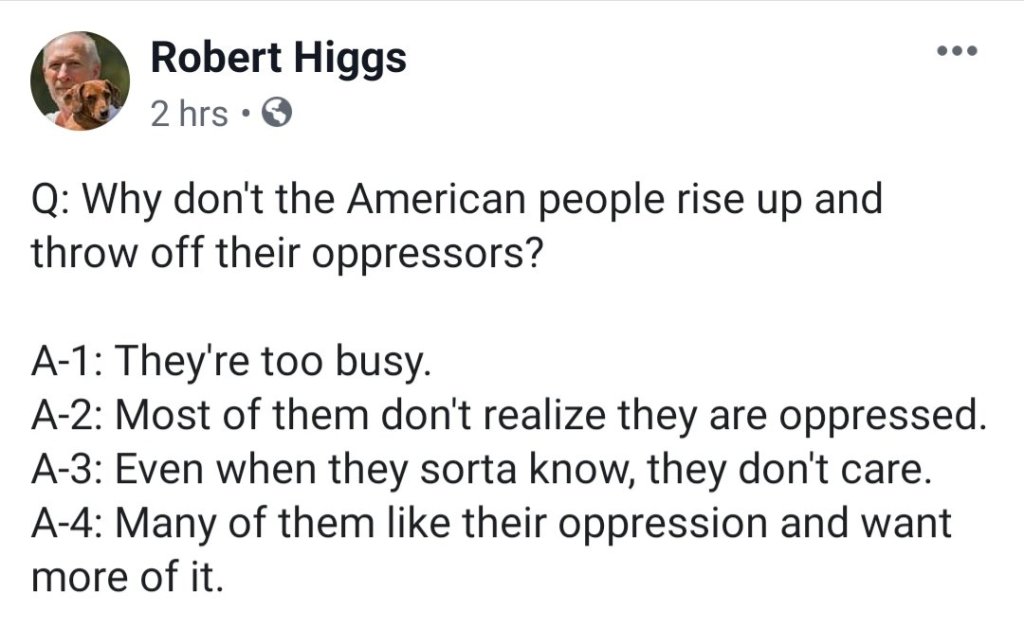
We can see here an analogue to countless discussions among Americans in which Americans think themselves quite privileged to be dominated and exploited by the current American ruling oligarchy. Why? It is often because these victims of the regime judge their masters to be less awful than some other masters. But, not content with concluding one set of overlords to be merely less bad than another, these willing serfs then go a step further and attribute to their masters great virtue and kindness.






 Hellbound and Down
You must be logged in to post a comment.