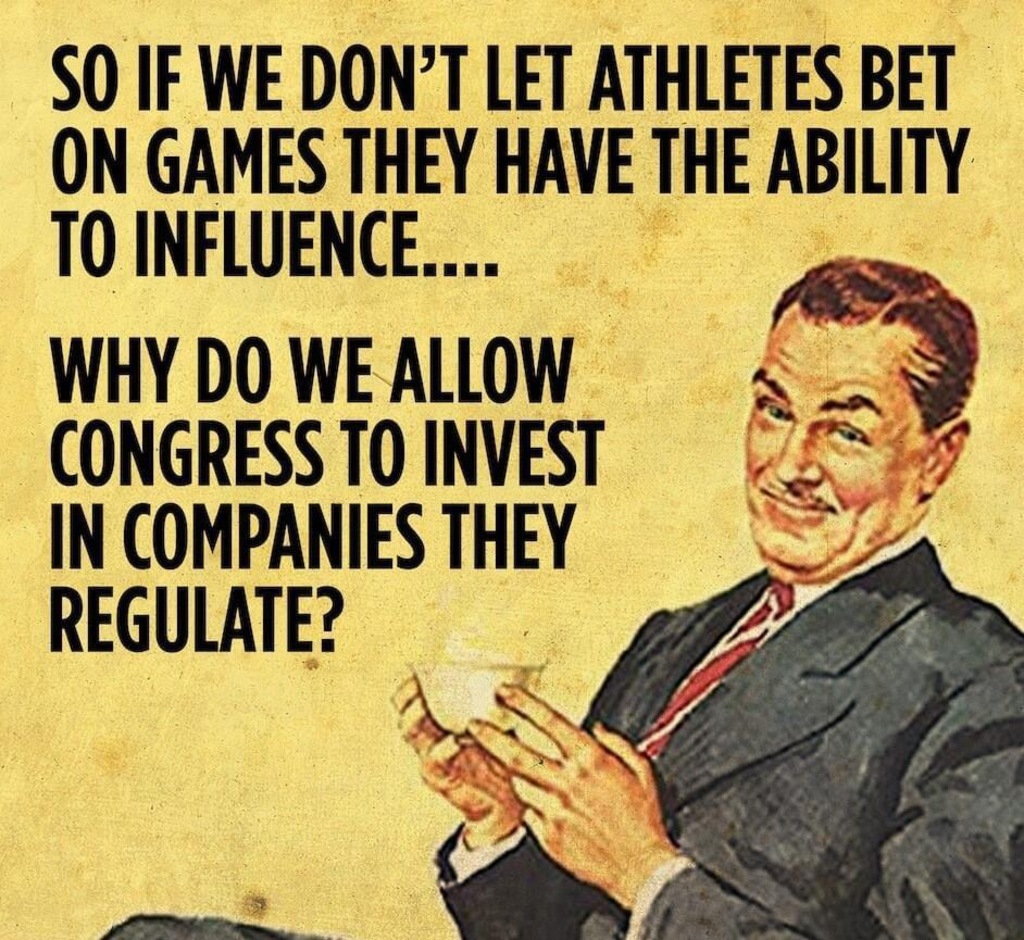
Busted: These 6 members of Congress violated a federal conflicts-of-interest law

At least six more members of Congress have violated the STOCK Act by failing to disclose transactions — up to $376,280 collectively — within a 45-day federal deadline, according to Raw Story analysis of congressional financial documents.

The majority of the late disclosure dollars came from Rep. Jonathan Jackson (D-IL) who was late in disclosing up to $300,000 in stock transactions from a joint trust.

He is joined by five other lawmakers who were late in disclosing transactions in the $1,000-to-$15,000 range: Rep. Debbie Dingell (D-MI), Rep. Russ Fulcher (R-ID), Rep. Marcy Kaptur (D-OH), Rep. Deborah Ross (D-NC) and Rep. John Sarbanes (D-MD).

The lawmakers aren’t alone in violating the Stop Trading on Congressional Knowledge (STOCK) Act this week.

Rep. Zoe Lofgren (D-CA), who last year led Democratic House leadership’s self-aborted effort to ban congressional stock trading, violated the STOCK Act with up to $265,000 in late financial disclosuresRaw Story reported on Wednesday.

Raw Story also broke the news last week that Rep. Dan Bishop (R-NC) was late in disclosing up to $5 million in U.S. Treasury note purchases.

The ongoing violations come at a time when a bipartisan group of lawmakers have introduced several similar bills aimed at banning congressional stock trading.

Keep reading

NBA Takes Steps to Ease Cannabis Restrictions: This Week in Cannabis Investing

The NBA took a major step forward this week by allowing players to invest in and promote cannabis brands. 

Michele Roberts, a former executive director of the NBA Players Association and now a member of the board of directors at Cresco Labs (CRLBF(opens in new tab)), previously predicted that NBA would consider changing its policies around cannabis. 

As of the terms listed in the leagues’ new collective bargaining agreement, cannabis will also be removed from the banned substances list for players. This is a welcome change for a cannabis industry seeking additional sources of capital while it continues to erode the old-world stigmas created by previous generations. 

We’ve seen a number of professional athletes getting involved in the cannabis industry after their sports careers. They are a group that is keen on the benefits cannabis provides for pain and inflammatory management, and many are also passionate about making a difference. Former NBA veteran Al Harrington’s Viola Brands(opens in new tab) immediately comes to mind as a trailblazer here. We’re excited to welcome more athletes, especially those as passionate about building their brands and business ventures as they are about their active profession.

Keep reading

Wall Street, the Nazis, and the Crimes of the Deep State

The response to the “Covid-19 pandemic” has much in common with the birth of the Third Reich. Agamben (2021, 8), for example, likens the emergency legislation passed in 2020 to the suspension of the Weimar Constitution in 1933, and Davis (2021b) explains how, through a raft of legislation being rammed through Parliament while the population’s attention is focused elsewhere, the UK is being turned into a constitutional dictatorship. UK government agencies now have the mandates to commit crimes with impunity; protests will be effectively criminalized or shut down under extraordinary police powers; online dissent will be censored; and journalists will no longer be allowed to report any information deemed contrary to the “national interest” (Davis 2021b).

The “Covid-19 pandemic” functions as the Big Lie on which this is all premised, i.e. a lie so huge that ordinary people would not imagine it to be possible. To quote Mein Kampf:

“Because the […] masses […] are always more easily corrupted in the deeper strata of their emotional nature than consciously or voluntarily; and thus in the primitive simplicity of their minds they more readily fall victims to the big lie than the small lie, since they themselves often tell small lies in little matters but would be ashamed to resort to large-scale falsehoods. It would never come into their heads to fabricate colossal untruths, and they would not believe that others could have the impudence to distort the truth so infamously. Even though the facts which prove this to be so may be brought clearly to their minds, they will still doubt and waver and will continue to think that there may be some other explanation.”(Hitler 1969, 134)

As Rancourt et al. (2021) demonstrate scientifically, there was no viral pandemic, only what Davis (2021a), based on several hundred pages of argumentation, calls a “pseudopandemic,” modelled on the fake “swine flu pandemic” of 2009 (Fumento 2010). Yet, because of the propaganda and the applied behavioural psychology deployed as part of the psychological warfare targeting the unconscious mind, cognitive dissonance prevents many people from seeing or admitting this, even when presented with the evidence. Propaganda specialist Mark Crispin Miller reflects: “I used to think it tasteless to compare our system to Nazi Germany. I no longer think so” (2021, 30 mins).

Hitler was, perhaps, the first to see that liberal democracy can be subverted by playing on the unconscious fears of the masses. If an existential threat is presented, the masses can be induced to sacrifice liberty for the promise of security. At a visceral level, they are

“far more satisfied by a doctrine which tolerates no rival [promises security] than by the grant of liberal freedom. They neither realize the impudence with which they are […] terrorized, nor the outrageous curtailment of their human liberties, for in no way does the delusion of this doctrine dawn on them.”(cited in Fromm 1942, 191)

This is the model of imposing authority in a climate of terror. The masses can be terrorized into surrendering their liberties, and it will never occur to them that they have been lied to on a monumental scale — that the threat was fictitious. Thus, for example, while Hitler lambasted international bankers and reparation payments for bringing Germany to its knees, the truth was that German reparations payments fell to around one eighth of previous levels following the Hoover Moratorium (1931) and Lausanne Agreement (1932), the Bank for International Settlements managed Nazi gold, and the Nazis continued to honour their Young Plan obligations even during World War II.

The same playbook of using a Big Lie to generate mass fear for authoritarian purposes has been evident in “Covid-19.” Klaus Schwab practically announced as much in June 2020:

“Most people, fearful of the danger posed by COVID-19 [in a] a life-or-death kind of situation […] will agree that in such circumstances public power can rightfully override individual rights. Then, when the crisis is over, some may realize that their country has suddenly been transformed into a place where they no longer wish to live.”(Schwab and Malleret 2020, 117)

By the time the lie is exposed, it is too late, “for the grossly impudent lie always leaves traces behind it, even after it has been nailed down, a fact which is known to all expert liars in this world and to all who conspire together in the art of lying” (Hitler 1969, 134). Again, Schwab seems familiar with this principle: there will be no going back to how things were, because “the cut which we have now is much too strong in order not to leave traces” (cited in Clark 2020). Schwab’s protégé, Yuval Noah Harari, also belongs to the conspiracy of expert liars: “If you repeat a lie often enough,” he claims, “people will think it’s the truth. And the bigger the lie, the better, because people won’t even think about how something so big can be a lie.”

Keep reading

Pelosis Sold Google Stock One Month Before DOJ Announced Antitrust Lawsuit

Democratic California Rep. Nancy Pelosi and her husband, Paul, unloaded more than $1.5 million in Alphabet stock one month before the Department of Justice announced an antitrust lawsuit against the tech giant.

The Pelosis sold 30,000 shares of Alphabet, the holding company for Google and several other firms, on Dec. 20, 21, and 28. They received between $1.5 million and $3 million for the total sale, netting capital gains of more than $600, according to a financial disclosure form Pelosi, filed on Jan. 12. The DOJ announced its lawsuit against Alphabet on Tuesday.

Pelosi’s office did not immediately respond to the Daily Caller’s request for comment on the matter.

Keep reading

Paul Pelosi exercises up to $5 million in Google call options ahead of stock ban bill unveiling

House Speaker Nancy Pelosi’s husband, Paul Pelosi, exercised call options on $1 million to $5 million worth of stock for Alphabet Inc., Google’s parent company, as legislation was being drafted to ban Capitol Hill lawmakers and immediate family members from purchasing individual stocks, according to House document dated Oct. 14.

The transaction date of the House’s Periodic Transaction Report is Sept. 16. At that time, several different stock ban bills had been proposed in the House. The House Democratic leadership’s version was rolled out about one week after Pelosi, a wealth investor, exercised his call options.

A call option is a financial contract that gives the buyer the option, but not the obligation, to buy a stock, bond, commodity or other asset.

Speaker Pelosi ultimately did not put the stock ban legislation up for a vote before the House recess began. 

Keep reading

SEC Fakes Approval For New Climate Regulations From Activists, Foreign Investors While Ignoring American Companies’ Mass Opposition

The U.S. Securities and Exchange Commission is relying on a network of foreign investors to present an illusion of broad support for the agency’s proposed climate disclosure rule, which threatens to increase structural risks to the American economy.

In March, the trade agency outlined new regulations requiring firms to report their estimated energy emissions. While the SEC technically only has jurisdiction over publicly traded companies, the broad nature of the agency’s proposal aims to coerce private businesses into carbon calculations that track the behavior of their customers. Firms that fail to comply with government standards are subject to fines and lawsuits.

The new rules are “a disingenuous power grab by the SEC,” Will Hild, the executive director of Consumers’ Research, said in an interview.

“By requiring the corporations the SEC regulates to make scope 2 emissions disclosures, those corporations will be forced to require the businesses they source from to calculate and disclose their emissions or stop doing business with them,” Hild told The Federalist. “So even if a business is private (not publicly traded) but their customers are public companies, then the SEC will have effectively forced them to participate in the disclosures scheme.”

According to an analysis of the SEC’s proposal from the Western Energy Alliance, a coalition of predominantly small independent oil and gas producers, more than 80 percent of asset managers cited by the agency as supportive of the new regulations are foreign. Just 7 percent of American asset managers support the disclosure rules.

The white paper from the Alliance published in June outlines how activist investors are masquerading as representative of majority sentiment on Wall Street despite just a handful of firms forming multiple coalitions. According to the report, seven major climate change advocacy organizations cited by SEC as behind the agency on mandated disclosure include the same investor coalition groups working in close collaboration. It’s as if the same 50 members of Congress formed 100 different caucuses that pledged support to particular legislation to show proof of consensus.

Keep reading

As Covid Hit, Washington Officials Traded Stocks With Exquisite Timing

In January 2020, the U.S. public was largely unaware of the threat posed by the virus spreading in China, but health officials were on high alert and girding for a crisis.

A deputy to top health official Anthony Fauci reported 10 sales of mutual funds and stocks totaling between $157,000 and $480,000 that month. Collectively, officials at another health agency, Health and Human Services, reported 60% more sales of stocks and funds in January than the average over the previous 12 months, driven by a handful of particularly active traders.

By March, agencies across the government were working on wide-reaching measures to prop the economy and markets. Then-Transportation Secretary Elaine Chao purchased more than $600,000 in two stock funds while her agency was involved in the pandemic response and her husband, Republican Sen. Mitch McConnell, was leading negotiations over a giant, market-boosting stimulus bill.

And as the government was devising a loan package aimed specifically at helping companies including Boeing Co. and General Electric Co., a Treasury Department official involved in administering the aid acquired shares of both companies.

Federal officials owned millions of dollars of stock in industries most affected by the pandemic and the government’s response. About 240 officials at health agencies and at the Pentagon, a key player in the vaccine rollout, reported owning a total of between $9 million and $28 million in stocks of drug, manufacturing and biotechnology companies that won federal contracts related to Covid-19 in 2020 and 2021, the Journal’s analysis found.

Nearly 400 officials across 50 agencies reported owning stocks in airline, resort, hotel, restaurant and cruise companies in early 2020, the review found.

By March, every major agency was drawn into the pandemic response. That month was the most active for trading by officials across the federal government, including at HHS, in the Journal’s analysis of financial disclosure forms for about 12,000 officials spanning 2016 to 2021. Federal officials reported more than 11,600 trades that month, 44% more than in any other month in the analysis.

The health agencies didn’t respond to requests for comment. A Pentagon spokeswoman said most defense personnel don’t work on matters affecting large defense contractors or affecting the finances of private companies, and said the department is “committed to preventing conflicts of interest.”

Senior federal officials are required to disclose their financial assets and transactions and those of their spouses and dependent children in annual reports.

Federal employees are barred from working on matters in which they have a significant financial stake, from trading on nonpublic information learned on the job and from taking any official action that creates an appearance of a conflict of interest.

Agency ethics officials rarely have a complete picture of what employees are working on or privy to, especially during a fast-moving, governmentwide mobilization in response to a national emergency.

Most agencies’ ethics rules focus on what kinds of stocks officials can trade, not when they can trade. And there are no restrictions on federal officials’ investing in diversified mutual funds, which were more volatile than usual early in the pandemic. Ethics officials certified that the employees identified by the Journal were in compliance with these rules.

Three days into January 2020, top U.S. health officials were alerted to an unexplained virus sickening people in China.

By late January, Centers for Disease Control and Prevention leaders were rushing to develop accurate tests, National Institutes of Health officials were taking the first steps toward developing a vaccine, and the Food and Drug Administration was racing to facilitate prevention and treatment options for the novel coronavirus.

On Jan. 24, four days after the CDC publicly reported the first confirmed U.S. Covid-19 infection, Hugh Auchincloss, principal deputy director at the NIH’s National Institute of Allergy and Infectious Diseases, summed up the state of his agency in an email: “New coronavirus all the time.”

That same day, while the stock market remained lofty, Dr. Auchincloss reported selling $15,001 to $50,000 of a stock mutual fund. Days later he sold two more mutual funds and a stock, Chevron Corp., according to his financial disclosures, which give wide dollar ranges. That was just the beginning.

Dr. Auchincloss was invited to a Jan. 29 meeting of an NIH working group called the International Clinical Research Subcommittee. The top agenda item was “Wuhan coronavirus—plans for a response,” according to emails released in response to public-records requests.

On the last day of January, an email sent to Dr. Auchincloss and his boss, Dr. Fauci, signaled the severity of the threat. Public Health Service officers had been told they could be deployed, a health official wrote, and could assist with “quarantine efforts.”

Dr. Auchincloss disclosed six sales of mutual funds that day, totaling between $111,006 and $315,000 in value.

His January sales amounted to the largest number of transactions he had reported for a single month since 2018, according to his financial disclosures.

Each holding he sold fell sharply in the market downturn that soon followed, as the public and investors started paying attention to the threat posed by Covid-19.

Dr. Auchincloss, who retained some other holdings, didn’t respond to requests for comment. The National Institute of Allergy and Infectious Diseases declined to make him available for an interview.

The agency said that financial disclosure reports are routinely reviewed by NIH ethics officials to ensure compliance with reporting requirements and resolve potential conflicts of interest. It declined to say whether Dr. Auchincloss made the trades himself or had a managed account.

“As a matter of employee privacy, we will not disclose the additional information requested because it is beyond the public financial disclosure reporting requirements,” the agency said.

Among officials involved in the CDC’s early pandemic response was Stephen Redd, a veteran epidemiologist serving as deputy director for Public Health Service and Implementation Science at the agency. His role involved collecting information about the state of the virus and the federal response in order to brief lawmakers.

The CDC had a clear view of the virus’s threat by the end of January, Dr. Redd later told a student interviewer in Atlanta. “It was easy to see it was going to be a really big problem,” he said.

Dr. Redd disclosed sales of between $95,004 and $250,000 in stocks and bonds in January. He reported the sale in February of $100,001 to $250,000 of bonds, along with purchases of between $2,002 and $30,000 of short-term bond funds, a low-risk investment.

Dr. Redd said he had no advance knowledge of these trades, which he said were in his wife’s retirement account and made by a financial adviser. He said he didn’t learn of them until that summer, although he was required by law to report any trades made in his or his wife’s accounts within 30 days.

He acknowledged that federal officials are “responsible for knowing” about their financial transactions. He said neither he nor his wife knew why the adviser made the trades.

Keep reading

The House fails to pass bill barring lawmakers from stock trading

Democrat Rep. Abigail Spanberger of Virginia excoriated her party leadership including House Speaker Nancy Pelosi and House Majority Leader Rep. Steny Hoyer for delaying a potential vote this week meant to ban lawmakers from holding and trading in stocks. Spanberger even called for new leadership in the Democrat party.

Spanberger had partnered with Rep. Chip Roy (R-Tex.) to introduce the Transparent Representation Upholding Service and Trust in Congress Act on Jan. 15, 2021. The legislation had 71 co-sponsors, ranging from Republican Rep. Matt Gaetz of Florida to squad member Rep. Ilhan Omar of Minnesota.

The legislation would have required lawmakers and immediate family members to place stocks in a blind trust. 

Business Insider magazine’s Conflicted Congress investigation in December 2021 revealed dozens of STOCK Act violations, and numerous potential conflicts of interests driven by lawmakers’ stock holdings, as well as paltry enforcement of anti-insider trading rules. Forty-nine members of Congress and 182 senior congressional staffers violated laws aimed at preventing insider trading.

Keep reading

Pharmaceutical Industry Suffers Billions In Losses After States Legalize Marijuana, New Study Finds

The pharmaceutical industry takes a serious economic hit after states legalize marijuana—with an average market loss of nearly $10 billion for drugmakers per each legalization event—according to a first-of-its-kind study.

The peer-reviewed research article, published in the journal PLOS ONE on Wednesday, looked at stock return and prescription drug sales data for 556 pharmaceutical companies from 1996 to 2019, analyzing market trends before and after the enactment of medical and adult-use cannabis legalization laws at the state level.

The stock returns were “1.5-2 percent lower at 10 days after legalization,” the study authors founds. “Returns decreased in response to both medical and recreational legalization, for both generic and brand drugmakersInvestors anticipate a single legalization event to reduce drugmaker annual sales by $3 billion on average.”

Keep reading