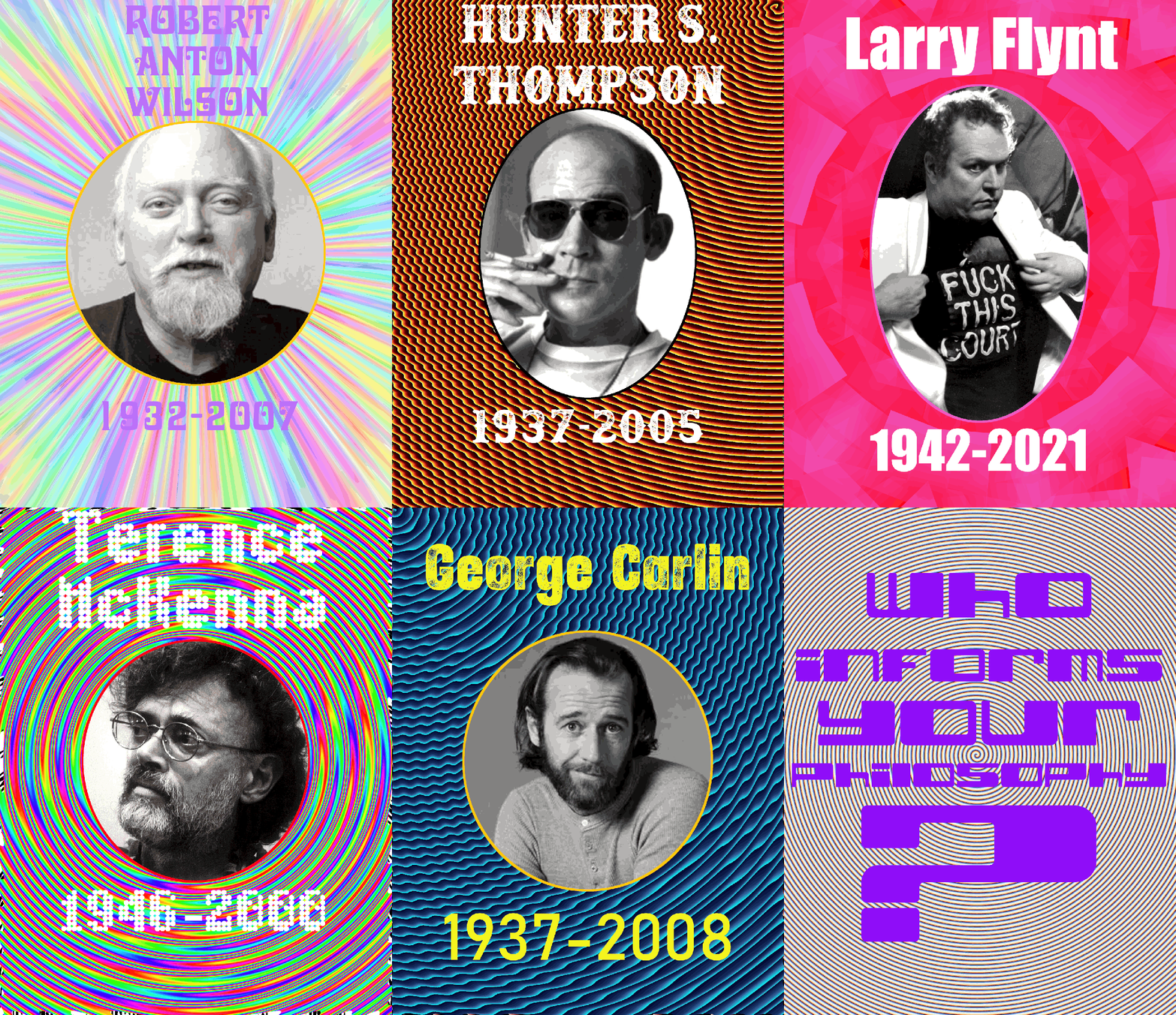
Philosophy. Who built yours?

Bernard Stiegler was, until his premature death, probably the most important philosopher of technology of the present. His work on technology has shown us that, far from being exclusively a danger to human existence, it is a pharmakon – a poison as well as a cure – and that, as long as we approach technology as a means to ‘critical intensification,’ it could assist us in promoting the causes of enlightenment and freedom.
It is no exaggeration to say that making believable information and credible analysis available to citizens at present is probably indispensable for resisting the behemoth of lies and betrayal confronting us. This has never been more necessary than it is today, given that we face what is probably the greatest crisis in the history of humanity, with nothing less than our freedom, let alone our lives, at stake.
To be able to secure this freedom against the inhuman forces threatening to shackle it today, one could do no better than to take heed of what Stiegler argues in States of Shock: Stupidity and Knowledge in the 21st Century (2015). Considering what he writes here it is hard to believe that it was not written today (p. 15):
The impression that humanity has fallen under the domination of unreason or madness [déraison] overwhelms our spirit, confronted as we are with systemic collapses, major technological accidents, medical or pharmaceutical scandals, shocking revelations, the unleashing of the drives, and acts of madness of every kind and in every social milieu – not to mention the extreme misery and poverty that now afflict citizens and neighbours both near and far.
While these words are certainly as applicable to our current situation as it was almost 10 years ago, Stiegler was in fact engaged in an interpretive analysis of the role of banks and other institutions – aided and abetted by certain academics – in the establishment of what he terms a ‘literally suicidal financial system’ (p. 1). (Anyone who doubts this can merely view the award-winning documentary film of 2010, Inside Job, by Charles Ferguson, which Stiegler also mentions on p.1.) He explains further as follows (p. 2):
Western universities are in the grip of a deep malaise, and a number of them have found themselves, through some of their faculty, giving consent to – and sometimes considerably compromised by – the implementation of a financial system that, with the establishment of hyper-consumerist, drive-based and ‘addictogenic’ society, leads to economic and political ruin on a global scale. If this has occurred, it is because their goals, their organizations and their means have been put entirely at the service of the destruction of sovereignty. That is, they have been placed in the service of the destruction of sovereignty as conceived by the philosophers of what we call the Enlightenment…
In short, Stiegler was writing about the way in which the world was being prepared, across the board – including the highest levels of education – for what has become far more conspicuous since the advent of the so-called ‘pandemic’ in 2020, namely an all-out attempt to cause the collapse of civilisation as we knew it, at all levels, with the thinly disguised goal in mind of installing a neo-fascist, technocratic, global regime which would exercise power through AI-controlled regimes of obedience. The latter would centre on ubiquitous facial recognition technology, digital identification, and CBDCs (which would replace money in the usual sense).
A 25-year science wager has come to an end. In 1998, neuroscientist Christof Koch bet philosopher David Chalmers that the mechanism by which the brain’s neurons produce consciousness would be discovered by 2023. Both scientists agreed publicly on 23 June, at the annual meeting of the Association for the Scientific Study of Consciousness (ASSC) in New York City, that it is still an ongoing quest — and declared Chalmers the winner.
What ultimately helped to settle the bet was a key study testing two leading hypotheses about the neural basis of consciousness, whose findings were unveiled at the conference.
“It was always a relatively good bet for me and a bold bet for Christof,” says Chalmers, who is now co-director of the Center for Mind, Brain and Consciousness at New York University. But he also says this isn’t the end of the story, and that an answer will come eventually: “There’s been a lot of progress in the field.”

Philosophers tend to be highly influenced by their environment, and can often be found rationalizing instead of critically examining the conventional views of the people around them. But if anything warrants philosophical scrutiny, surely it is our national taboos. As a philosopher of biology, one taboo is of particular interest to me: the taboo on considering the possibility that genes play a role in group differences in psychological traits. So I wrote a paper arguing that, while nothing can be definitively proved, there is strongly suggestive evidence that genes are involved in group differences, and we should stop suppressing and censoring research into this topic.
I submitted the paper to Philosophical Psychology—a respected journal that publishes work on the connection between philosophy and psychology, which at the time was co-edited by Mitchell Herschbach (a philosopher) and Cees van Leeuwen (a psychologist). To my pleasant surprise, I received two positive referee reports along with a request for revisions. After two rounds of review, the paper was accepted and published in the January 2020 issue of the journal.
The paper was accompanied by an Editors’ Note written by van Leeuwen and Herschbach, saying:
The decision to publish an article in Philosophical Psychology is based on criteria of philosophical and scientific merit, rather than ideological conformity… In sum, Cofnas’ paper certainly adopts provocative positions on a host of issues related to race, genetics, and IQ. However, none of these positions are to be excluded from the current scientific and philosophical debates as long as they are backed up with logical argumentation and empirical evidence, and they deserve to be disputed rather than disparaged.
Needless to say, heterodoxy about politically sensitive issues is not always well received in academia, so it was gratifying to see the editors of an important journal taking a stand for free inquiry. “2020 is gearing up to be the best year ever,” I thought to myself.
It didn’t take long for the paper and Editors’ Note to come to the attention of the wokerati on Twitter. Macquarie University philosophy professor Mark Alfano deemed my paper “shit” and announced his plan to “ruin [my] reputation permanently and deservedly.” He started a petition on change.org demanding an “apology, retraction, or resignation (or some combination of these three)” from the journal editors. A number of philosophers—many of whom did not even read the paper—joined the campaign to get it retracted and/or smear me. University of South Carolina professor Justin Weinberg promoted Alfano’s petition on his widely read philosophy blog, Daily Nous. He also published a guest post that falsely and preposterously claimed that I defended “segregation” and “apartheid schemes.”
But the editors of Philosophical Psychology stood firm. Van Leeuwen and Herschbach wrote a statement on Facebook reiterating that the review process had been carried out properly, and declaring, “Efforts to silence unwelcome opinion… are doing a disservice to the community.”
 Hellbound and Down
You must be logged in to post a comment.