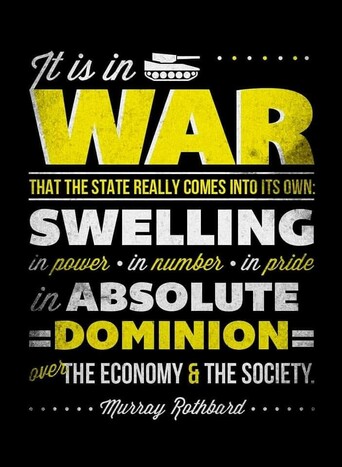
Murray Rothbard on war…

Ahost of foreign policy “experts” are now explicitly calling for “regime change” in Russia following Vladimir Putin invading Ukraine.
Reminiscent of the establishment’s failed calls for regime change in countries like Afghanistan and Iraq, whose military conflicts cost countless American lives and resources, the sentiment appears to be at odds with the majority of the country. Nearly three-quarters of Americans oppose playing a major role in the unfolding conflict.
Benjamin Wittes, a Senior Fellow in Governance Studies at the Washington, D.C.-based Brookings Institution, epitomized the establishment’s ultimate policy goal for Russia in a recent tweet: “Regime change: Russia.”
While the post drew significant criticism from other Twitter users, forcing Wittes to issue a Tweet for clarification of his stance, other mouthpieces for the establishment foreign policy think tank community championed Wittes’ proposal.
“This has to be the policy now,” tweeted Dr. Alina Polyakova, formerly the Founding Director for Global Democracy and Emerging Technology at the Brookings Institution, in response. Polyakova is now the President and CEO of the Center for European Policy Analysis (CEPA), which has hosted events featuring leaders from George Soros’s Open Society Foundations.
Richard Haass, President of the Council on Foreign Relations, noted how “now the conversation has shifted to include the possibility of desired regime change in Russia” in a February 27th Tweet.
There is one question today that is more important than any other question that could possibly be asked, and it’s this:
“Is what the US and its allies are trying to accomplish in Ukraine worth continually risking nuclear armageddon for?”
Russian state media have confirmed that Vladimir Putin’s orders to move the nation’s nuclear deterrent forces into “special combat duty mode” have been carried out, citing “aggressive statements from NATO related to the Russian military operation in Ukraine.”
“Russia’s ground, air and submarine-based nuclear deterrent forces have begun standby alert duty with reinforced personnel, Defence Minister Sergei Shoigu has informed President Putin,” Sputnik reports.
This comes days after Putin issued a thinly veiled threat of an immediate nuclear strike should western powers interfere in Russia’s invasion of Ukraine, saying, “Whoever tries to hinder us, and even more so, to create threats to our country, to our people, should know that Russia’s response will be immediate. And it will lead you to such consequences that you have never encountered in your history.”
Several Russian state-controlled or state-aligned websites appeared to have been hacked early Monday.
The websites for the major Russian state-owned news agency, TASS, the Russian nationally distributed newspaper, Kommersant, and the daily broadsheet newspaper, Izvestia, which was founded in St. Petersburg during the Russian Revolution and was one of principal media outlets in the Soviet Union, all displayed a message signed purportedly by the notorious hacking collective Anonymous.
“Dear citizens. we call on you to stop this madness,” the message began. “don’t send your sons and husbands to sure death. Putin is making us lie and puts us in danger. We have been isolated from the world, no one is buying our oil & gas. In a few year’s time we’ll be living like in North Korea. Why do we need this? For Putin to make it to history books? This is not our war, let’s stop it!”
Ohio Gov. Mike DeWine has issued an order for the state to stop buying and selling vodka made by a Russian-owned distillery after the country invaded Ukraine earlier this week.
DeWine announced on Twitter that he directed the Ohio Department of Commerce to stop both the buying and selling of vodka made by Russian Standard, the only overseas, Russian-owned vodka distillery selling the spirit in Ohio.
Russian Standard vodka is sold under the brand names Green Mark Vodka and Russian Standard Vodka.
In a statement from DeWine’s office, the Ohio Division of Liquor Control estimates there are approximately 6,400 bottles of vodka made by Russian Standard currently on sale in the state’s 487 liquor stores.
The state said other brands of vodka, even those with Russian names, are bought by the state from distilleries outside of Russia.




 Hellbound and Down
You must be logged in to post a comment.