Pearl Harbor and the Engineers of War

What gets me are the lies. Iraq’s “weapons of mass destruction” – Iran’s (nonexistent) nuclear weapons program – the Vietnamese “attack” in the Gulf of Tonkin – Germans bayoneting Belgium babies – the sinking of the USS Maine: over the long and bloody history of US imperialism, these are just a few of the fabrications US policymakers have seized on to justify Washington’s aggression. It’s quite a record, isn’t it? Not only that, but there’s been little if any acknowledgment by the American political elites that they’ve ever lied about anything: it’s all been thrown down the Memory Hole, along with whatever sense of shame these people ever had.

Indeed, if there is an award for sheer shamelessness then surely it must go to the court historians who preserve the myth of Pearl Harbor, insisting that the Japanese launched a “sneak attack” on the US fleet. The official version of the narrative is that the Americans, dewy-eyed innocents all, were simply minding their own business, not bothering anybody and certainly not aggressing against the predatory Japanese, who were fighting harmless “agrarian reformers” led by Mao Tse-Tung in China. Suddenly, totally without provocation, and out of the clear blue the Japs – to use the term routinely employed by the Roosevelt administration and its media minions at the time – crossed thousands of miles of Pacific Ocean to commit murder and mayhem for no good reason other than their own inherent evil.

What’s amazing is that even though this nonsense has been thoroughly and repeatedly debunked over the years by historians concerned with discovering the truth – as opposed to getting tenure at some Ivy League university – the Big Lie is still not only believed by the hoi polloi but also stubbornly upheld by the “intellectuals.” As to whether they actually believe it or not, that’s largely irrelevant as far as they’re concerned. As Arthur Schlesinger, Jr., the archetypal pointy-headed liberal intellectual – and idolator of FDR – put it: “If he [the President] was going to induce the people to move at all, he had no choice but to trick them.”

What do “the people” know? Only what our elites deign to tell them – and this was especially true in the run up to World War II. We didn’t have the Internet back then, nor did we have a group of people dedicated to defending truth-tellers against the government and its journalistic camarilla – the liberal-leftie ACLU wasn’t interested in defending “isolationists” against their hero FDR. Nor did they challenge the internment of Japanese-Americans. If a Snowden type had dared to come out and debunk the government’s lies the ACLU would’ve been in the front row of the hanging party.

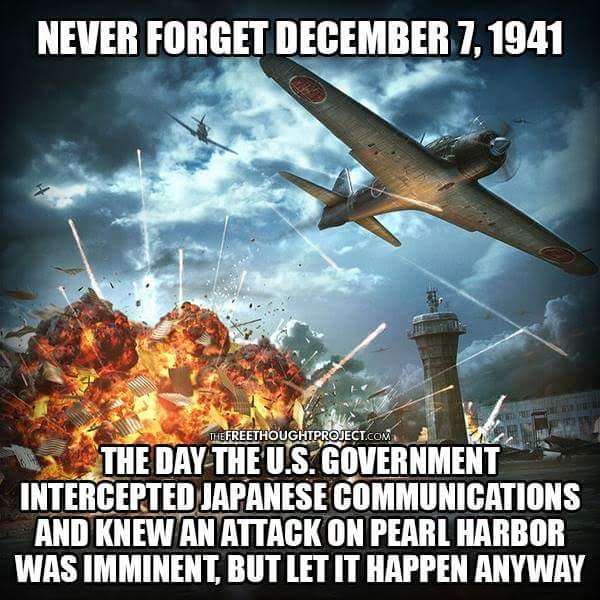
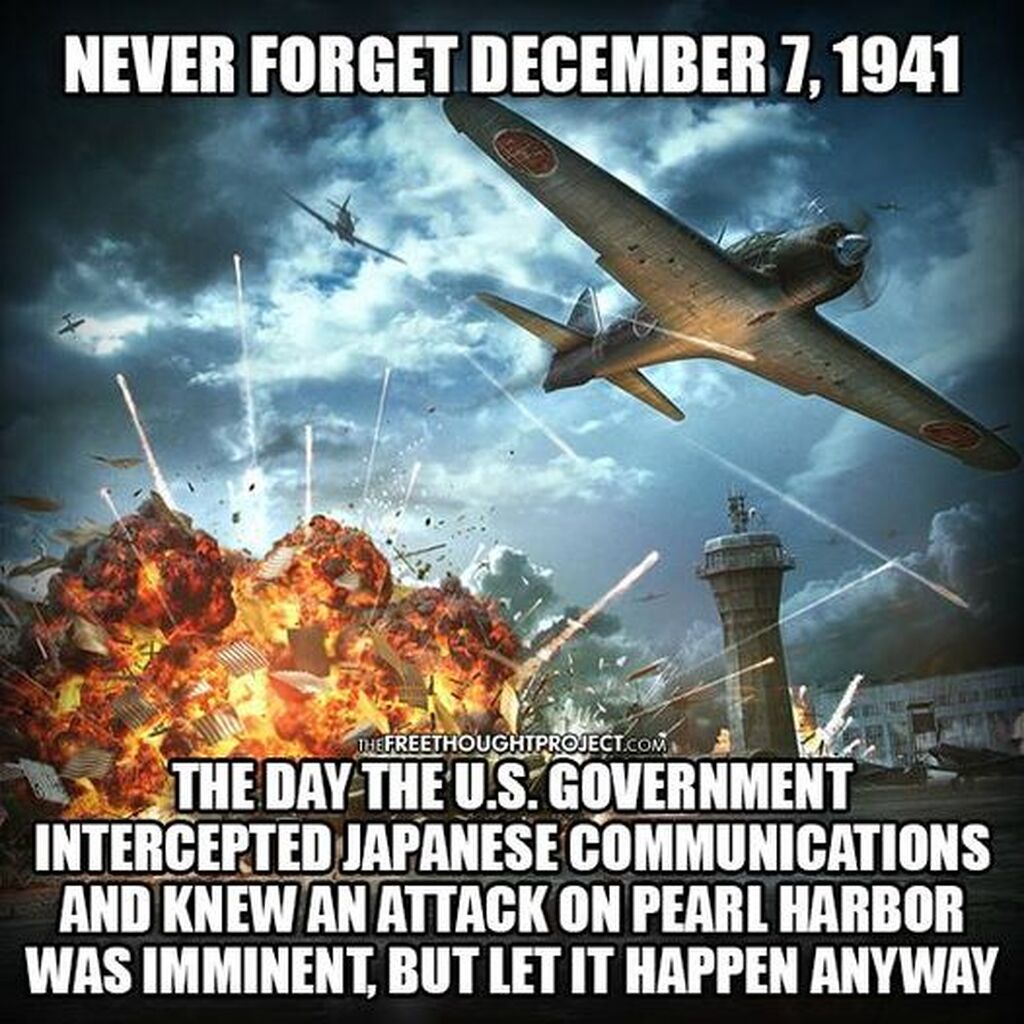
So we didn’t learn the truth about Pearl Harbor until many years later. The facts are these: the Americans had broken the Japanese diplomatic and military codes and knew all about Tokyo’s war plans. As the Japanese made their way across the Pacific the Americans tracked their every move: they knew the timing and the tactics of the Japanese attack, and yet President Franklin Roosevelt did nothing – he let the fleet sit there, a sitting duck.

Then there is the story of Takeo Yoshikawa, the 27-year-old spy sent by the Japanese to scout out Pearl Harbor. He was discovered almost immediately after he arrived in Hawaii: he was, after all, very suspicious to begin with. The Japanese never sent youngsters abroad on diplomatic missions, and yet here was Yoshikawa – going under the name Morimura – being assigned as an attaché at the Japanese consulate in Honolulu. So they followed him around and intercepted every one of his messages to Tokyo: they knew exactly what he was there for and what he was up to.

Previous efforts by the Japanese government to reach an agreement with Washington had failed due to American intransigence. When Japan’s Prince Konoye offered to travel to Washington on a secret mission to prevent the conflict, FDR refused – and leaked the news to the pro-British pro-war Herald Tribune. Konoye’s government fell shortly afterward due in part to the leak. With the pro-war faction in Tokyo in charge, FDR’s longstanding efforts to get us into the war were finally bearing fruit.

All this is known: indeed, pro-Roosevelt historians make a major point of telling us how necessary it was for FDR to lie us into war – for our own good, and the good of the world, of course. After all, what do we plebeians know about running the world. Best to leave such weighty matters to our betters.

Nothing has really changed since Pearl Harbor: our officials are still lying, our “historians” are covering up the lies, and the whole rotten edifice is sitting on a foundation of lies, past and present.

Keep reading

80 Years After Pearl Harbor, We Now Know the Govt Knew the Attack Was Coming

On the morning of December 7, 1941, Japanese planes, launched from aircraft carriers, attacked the American fleet at Pearl Harbor in Hawaii, sinking or heavily damaging 18 ships (including eight battleships), destroying 188 planes, and leaving over 2,000 servicemen killed.

The next day, President Franklin D. Roosevelt denounced this “day of infamy” before Congress, from whom he secured an avid declaration of war.

Up until then, however, Americans had overwhelmingly opposed involvement in World War II. They had been thoroughly disillusioned by the First World War:

  • although they had been told they would be fighting for “democracy” in that previous war, taxpayers learned from the postwar Graham Committee of Congress that they’d been defrauded out of some $6 billion in armaments that were never manufactured or delivered1;
  • atrocity tales about German soldiers (such as cutting the hands off thousands of Belgian children) had turned out to be fabrications;
  • the sinking of the Lusitania – the central provocation that ultimately led to the U.S. declaration of war – had been committed by Germany not to kill women and children (as propaganda claimed), but to prevent tens of tons of war munitions from reaching the European front. (Click here for a debunking of the Lusitania myth.)

When the Maine sank, the proactive Assistant Secretary of the Navy had been Teddy Roosevelt. After the 1898 Spanish-American War he became governor of New York, and by 1901 was President of the United States. When the Lusitania sank, the Assistant Secretary of the Navy was his distant cousin Franklin D. Roosevelt – who likewise went on to become governor of New York and then President.

Just as coincident: during the Lusitania affair, the head of the British Admiralty was yet another cousin of Franklin D. – Winston Churchill. And in a chilling déjà vu, as Pearl Harbor approached, these two men were now heads of their respective states.

Keep reading

Biden Erased Decades of Historic Crimes in His Speech to Congress

Following 9/11, the Bush administration, in conjunction with Congress, expedited the passage of the Patriot Act, a wide-sweeping national security law that infringed on the civil liberties of every American in the name of fighting terror. The Fourth Amendment became a relic of the past as the government’s power to surveil and spy on its own citizens reached its peak. Individuals who shared names with persons of interest or suspected terrorists, including U.S. citizens, landed on government no-fly lists, restricting their right to freely move about the country for dubious reasons and with no due process or recourse. And even worse, many had their right to due process eviscerated when they were detained by the newly-created Department of Homeland Security and found themselves at Guantanamo Bay without even being charged with a crime.

Yet this is not the first time that American citizens, or even permanent residents for that matter, had their rights infringed upon by the government.

Keep reading