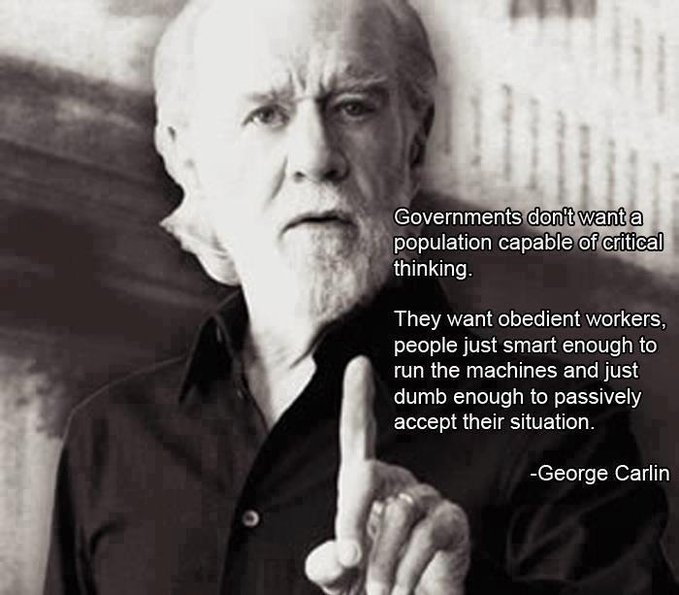
George Carlin on critical thinkers…


“And the word “courage” should be reserved to characterize the man or woman who leaves the infantile sanctuary of the mass mind.”— Sam Keen, Fire in the Belly
In the privacy of our minds many of us disagree with the ideologies, political agendas, and government mandates of our day, yet in public we comply. We do what we are told, say what is politically correct, and justify our hypocrisy by telling ourselves that we are powerless to change society, and so we might as well blend in with the crowd. In this video, we explain why publicly conforming to what we privately disagree with makes us complicit in tyranny, and why each of us has far more power to influence society than we have been led to believe.
In the 1950s, the social psychologist Solomon Asch conducted an experiment which demonstrated the degree to which individuals will reject what they think is true in order to conform to the majority. In the experiment, Asch showed a test subject two cards. On the first card was a single line, and on the second card were three lines, A, B, and C, with only line C being the same length as the line on the first card. Asch instructed the test subject to state which line on the second card was the same length as the line on the first card. However, before the test subject gave an answer, they witnessed 7 confederates – or individuals who were in on the experiment – state that line B was the same length as the line on the first card. Rather than state the obvious truth, the test subjects gave the same wrong answer as the group 37% of the time, and of the 123 test subjects who took part in this experiment, two thirds went along with the group at least once. Asch’s experiment confirms what philosophers have been reiterating for thousands of years: for most human beings conforming to what others say and do – no matter how objectively false or absurd – takes precedence over adapting to reality and discovering the truth.

Twenty twenty-three is the year when counterculture officially went spook. Of course, it started there, too, so it would be more accurate to say that in 2023 counterculture closed the circle.
From 1953 to 1973, the CIA ran MKUltra, the illegal program designed to chart the potential of psychedelic drugs for mind control. Among the notable graduates of the program were the Beat writers Allen Ginsburg and Ken Kesey, environmental terrorist Ted Kaczinski, and the architect of the murder of the twentieth century, Charles Manson. All counterculture heroes on this list were first introduced to LSD by the spy agency, and all but Kaczinski then passed that experience to their disciples, forging the hippie ideology and aesthetic.
Now the CIA plans on recruiting at the South by Southwest festival, or SXSW, the punk rock/alternative yearly flagship event in Texas. On their webpage, the CIA announced that it will be holding a tech-dedicated panel called “Spies Supercharged”:
In a world of ubiquitous surveillance, artificial intelligence, sophisticated disinformation campaigns, and data streams that double in size every two years, how will intelligence agencies respond to the opportunities and challenges presented by emerging technologies and the ever-changing digital ecosystems we will live within? Join CIA Leaders in Technology and Digital Innovation on this wide-ranging discussion about the future of intelligence.
Adding that participants can
Talk with CIA officers about exciting career opportunities [and] learn about industry partnerships […]
Shortly after the panel was announced on social media, one punk rocker immediately inquired about potential financial benefits. The account tweeted:
please use your platform and make your voice be heard to demand SXSW pays performers more than just a wristband [sic].
To be sure, plenty of snarky comments were hurled at the spy agency. Still, it’s interesting that the CIA is interested in recruiting among the characters who a few years ago would be considered security risks and also that the promoters are allowing the spooks to set up a booth.
It used to be that proud degenerates, like the now disgraced Biden Administration’s gender fluid nuclear waste appointee Sam Brinton, would not be allowed anywhere near state secrets. Now it took a formal felony charge to revoke the accused serial thief’s security clearance. Brinton, who sometimes spotted a red Mohawk and purple lipstick, probably had a full-blown punk stage in college. So there is that precedent.
In decades past, an eccentric appearance was taken as a sign of rebellion. In the seventies, punk rockers lived to provoke traditional mores and challenge all authority. An art movement grounded solely in rousing emotions was expected either to wither away or emerge as a hegemonic force at the expense of shedding its core principles. It’s hard to say which option would constitute success.
In that subculture, preserving rebellious authenticity was always an uphill struggle. Some of the indicators and signals were quickly discarded—sure, wearing swastikas would antagonize a great many passers-by but tended to attract the wrong people to your shows.
In the nineties, facial piercings went hipster, and tattoos became mainstream. A sanitized version of punk aesthetic invaded suburban malls, prompting subcultural figures to guard bona fides of the scene with a more subtle dress code and, in particular, far Left politics.
In the meantime, the nation grew increasingly polarized, and the Left’s Long March through the institutions continued apace. To stand out, musicians with countercultural pretensions always opted to channel the most radical ideological assumptions into every aspect of their private lives. As a result, insufferably woke musicians cancel bandmates. That isn’t lost on the former Sex Pistol Johnny Rotten who surmised:
I never thought I’d live to see the day when the right wing would become the cool ones giving the middle finger to the establishment, and the left wing becoming the sniveling self-righteous twatty ones going around shaming everyone.
Although a handful of conservatives who happened to know who Rotten is were delighted to hear it, the musician’s opinions hardly won him any new friends in his own circles.
During the COVID lockdowns, punk rockers proved themselves to be obedient little subjects, deferring to institutional authority, supporting every repressive measure from masking, lockdowns, and compulsory injections to championing social engineering schemes.
Henry Rollins is a great example of the newfound obedience. In an interview with Eugene Weekly the former frontman of Black Flag explained:
I believe in scientists. When Fauci speaks, I listen. I think he’s looking out for me.
Likewise, a Satanic Temple gathering scheduled for April 2023 in Boston will require masking and proof of a mRNA jab. The insistence on theatrics, long after the government bureaucracies found it unnecessary, suggests a certain fixation on power—Satanists are going to institute repressive measures just because they can.

The world is a confusing place. People do things that don’t make any sense, think things that aren’t supported by facts, endure things they do not need to endure, and viciously attack those who try to bring these things to their attention.
If you’ve ever wondered why, you’ve come to the right place.
Any casual reader of the alternate media landscape will eventually come up with a reference to Stanley Milgram, or Philip Zimbardo, the “Asch Experiment” or maybe all three.
“Cognitive Dissonance”, “Diffusion of Responsibility”, and “learned helplessness” are phrases that regularly do the rounds, but where do they come from and what they mean?
Well, here are the important psycho-social experiments that teach us about the way people think, but more than that they actually explain how our modern world works, and just how we got into this mess.


 Hellbound and Down
You must be logged in to post a comment.