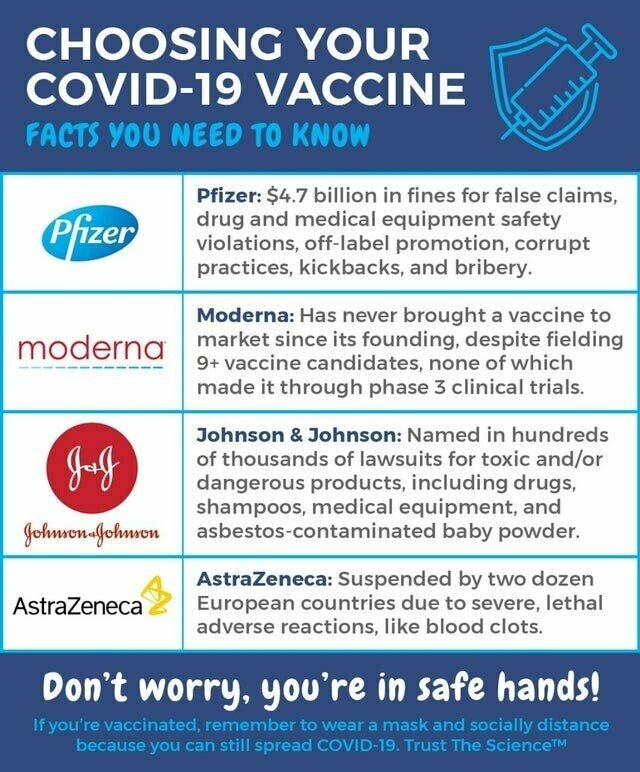
Moderna vaccinations halted in Japan’s Okinawa after ‘black substances’ found in vial, days after other batch of jab was suspended

Okinawa prefecture has halted Moderna vaccinations after unknown materials were found in a vial of the drug. The move comes after Japan pulled 1.6 million Moderna doses from a different batch over contamination concerns.

Black substances were discovered in syringes and a vial, while unidentified pink substances were spotted in a different syringe with a Moderna vaccine dose, according to Japan’s public broadcaster, NHK. 

Okinawa’s government said in a statement on Sunday that it was suspending the use of Moderna vaccines after “foreign substances were spotted in some of them.”

Takeda Pharmaceutical, Japan’s domestic distributor of the Moderna shot, is expected to probe whether the suspected contamination occurred during production and will consult with the health ministry on the matter, NHK reported. 

Keep reading

Japan suspends 1.6 million Moderna doses over contamination fears

Japan has suspended the use of about 1.63 million doses of the Moderna vaccine due to contamination.

The health ministry said “foreign materials” were found in some doses of a batch of roughly 560,000 vials.

Takeda Pharmaceutical, which sells and distributes the vaccine in Japan, said Moderna had put three batches on hold “out of an abundance of caution”.

It said an issue at a manufacturing contract site in Spain was the likely cause, but did not elaborate.

“To date, no safety or efficacy issues have been identified,” Moderna said, adding that it would work with regulators and Takeda to investigate the matter further.

There are no details of what the “foreign objects” are, but Takeda described it as particulate matter, after which it said conducted an emergency examination.

Keep reading

Moderna Wants to Transform the Body Into a Vaccine-Making Machine

Almost every antiviral vaccine ever sold works in a similar way: A dead or weakened virus, or a piece of one, is introduced into a healthy person. The weakened virus stimulates the immune system to generate antibodies, protecting the person when the real pathogen threatens to infect them.

Over the decades, this tried-and-true approach has vanquished polio, eradicated smallpox, and reined in chicken pox, measles, and mumps. But vaccine production has never been simple or fast. Many flu vaccines are still grown in chicken eggs. Newer approaches draw on genetic engineering to eliminate the need for whole viruses, but their viral proteins are still grown inside live cells.

The coronavirus vaccines from Moderna Inc., in Cambridge, Mass., and its German rival BioNTech SE propose to immunize people in a radically different way: by harnessing human cells to become miniature vaccine factories in their own right. Instead of virus proteins, the vaccines contain genetic instructions that prompt the body to produce them. Those instructions are carried via messenger RNA, or mRNA.

Moderna’s mRNA-1273 consists of a strand of mRNA that tells the body to produce the spike protein the coronavirus uses to latch onto human cells. The strand is like one side of a zipper; the “teeth” are a sequence of chemical letters that cells read to produce the 1,273 amino acids that make up the spike protein. If the vaccine works as intended, the body will start producing the proteins soon after injection, prompting the immune system to react and build up protective antibodies against them.

The great advantages of mRNA vaccines are speed and flexibility. No finicky live cells or hard-to-handle viruses are needed, and the basic chemistry is straightforward. Moderna’s vaccine reached Phase I human trials on March 16, only 63 days after the company began developing it. And at 6:43 a.m. on July 27, the first volunteer in Moderna’s 30,000-person, final-stage efficacy trial in the U.S. received an injection. Less than 12 hours later, BioNTech and its partner, Pfizer Inc., said they, too, were beginning a late-stage trial, a study that will be conducted in the U.S., Brazil, and several other countries. They took advantage of mRNA’s rapid-response capability to create four slightly different vaccines, which they compared in initial trials before selecting the best one for large-scale testing.

Keep reading

Heart inflammation cases in young men higher than expected after mRNA vaccines -U.S. CDC

Preliminary findings from two vaccine safety monitoring systems suggest a higher-than-expected number of cases of heart inflammation after the second dose of mRNA COVID-19 vaccines in young men, the U.S. Centers for Disease Control and Prevention (CDC) said on Thursday.

More than half of the myocarditis or pericarditis cases reported to the U.S. Vaccine Adverse Event Reporting System after patients had received either the Pfizer/BioNTech or Moderna vaccines were in people between the ages of 12 and 24, the CDC said. Those age groups accounted for less that 9% of the doses administered.

“We clearly have an imbalance there,” Dr. Tom Shimabukuro, deputy director of the CDC’s Immunization Safety Office, said in a presentation here to an advisory committee to the U.S. Food and Drug Administration that is meeting on Thursday.

He said that the Vaccine Safety Datalink (VSD) – another safety monitoring system – showed an increased incidence of the heart inflammation in 16 to 39 year olds after their second dose of the shots when compared to the rate observed after their first dose.

Keep reading

According To ALARMING New Report: Pfizer And Moderna COVID Vaccines Could Easily Trigger Alzheimer’s, ALS, And Other Neurological Degenerative Diseases

As we already reported a few days ago, over 60% of the new COVID cases involve people who have already been vaccinated.

And now, an alarming new report in Microbiology and Infectious Disease reveals the mRNA vaccines could easily trigger Alzheimer’s disease, ALS, and other neurological and cognitive degenerative diseases.

From the report of J. Bart Classen, MD:

Development of new vaccine technology has been plagued with problems in the past. The current RNA based SARS- CoV-2 vaccines were approved in the US using an emergency order without extensive long term safety testing.

Dr. Classen and his colleagues discovered that the vaccine increases the likelihood of these hideous diseases by opening a pathway into human DNA, which is exactly what this gene-therapy drug is intended to do:

The results indicate that the vaccine RNA has specific sequences that may induce TDP-43 and FUS to fold into their pathologic prion confirmations. In the current analysis a total of sixteen UG tandem repeats (ΨGΨG) were identified and additional UG (ΨG) rich sequences were identified.

Two GGΨA sequences were found. Potential G Quadruplex sequences are possibly present but a more sophisticated computer program is needed to verify these. Furthermore, the spike protein, created by the translation of the vaccine RNA, binds angiotensin converting enzyme 2 (ACE2), a zinc containing enzyme.

More about that issue with zinc:

This interaction has the potential to increase intracellular zinc. Zinc ions have been shown to cause the transformation of TDP-43 to its pathologic prion configuration. The folding of TDP-43 and FUS into their pathologic prion confirmations is known to cause ALS, front temporal lobar degeneration, Alzheimer’s disease and other neurological degenerative diseases.

Dr. Classen’s ALARMING conclusion:

The enclosed finding as well as additional potential risks leads the author to believe that regulatory approval of the RNA based vaccines for SARS-CoV-2 was premature and that the vaccine may cause much more harm than benefit.

Click HERE if you want to read the full report of J. Bart Classen, MD.

Keep reading

Immunologist: Pfizer, Moderna Vaccines Could Cause Long-Term Chronic Illness

Back in 1999, leading U.S. Food and Drug Administration (FDA) official Dr. Peter Patriarca contended that modern advances in vaccine technology were rapidly “outpacing researchers’ ability to predict potential vaccine-related adverse events.” Patriarca mused that this could lead to “a situation of unforeseen and unpredictable vaccine outcomes.”

In a new research article published in Microbiology & Infectious Diseases, veteran immunologist J. Bart Classen expresses similar concerns and writes that “RNA-based COVID vaccines have the potential to cause more disease than the epidemic of COVID-19.”

For decades, Classen has published papers exploring how vaccination can give rise to chronic conditions such as Type 1 and Type 2 diabetes — not right away, but three or four years down the road.

In this latest paper, Classen warns that the RNA-based vaccine technology could create “new potential mechanisms” of vaccine adverse events that may take years to come to light.

Classen’s study establishes the potential for the messenger RNA (mRNA) vaccines developed by Pfizer and Moderna to activate human proteins to take on “pathologic configurations” — configurations associated with chronic degenerative neurological diseases.

Although his specific interest is in prion diseases (conditions associated with misfolded versions of normal proteins), Classen also outlines a handful of other mechanisms whereby RNA-based vaccines could give rise to “multiple other potential fatal adverse events.”

Keep reading

CDC: Over 500 Deaths Now Following MRNA Experimental Injections

The CDC has done another data dump into the Vaccine Adverse Event Reporting System (VAERS), a U.S. Government funded database that tracks injuries and deaths caused by vaccines.

The data goes through January 29, 2021, with 11,249 recorded adverse events, including 501 deaths following injections of the experimental COVID mRNA shots by Pfizer and Moderna.

Keep reading

California halts injections of Moderna Covid vaccine batch due to ‘higher-than-usual number of adverse events’

California health officials are asking vaccine providers to stop administering a batch of Moderna’s Covid-19 jab, after an unusually high number of adverse reactions were linked to the drug.

Doses from Moderna Lot 041L20A are suspected of causing a “higher-than-usual number of adverse events” and should be shelved until a proper investigation can be conducted, the California Department of Public Health said on Sunday. 

State epidemiologist Dr. Erica S. Pan said in a statement that “fewer than 10 individuals” suffered “a possible severe allergic reaction” and required medical attention over the past 24 hours after being injected with the specific batch of vaccine. All of the incidents appear to have occurred at a single community clinic that was administering the lot. The site reportedly closed for several hours after the string of adverse reactions occurred, before switching to a different batch of the drug.

Keep reading