
Grab one for yourself, HERE!
Tag: magick
Physicists Change the Nature of Matter With Light in Breakthrough That Blurs the Line Between Science and Magic
When physicists at the University of Konstanz shone a flash of light on a simple iron crystal, they weren’t expecting to watch the rules of matter change before their eyes. Yet that seems to be what happened.
In an experiment that reads like science fiction, the team discovered a way to use light—not heat or exotic materials—to alter a substance’s magnetic properties, effectively turning one material into another in a fraction of a trillionth of a second.
The results, published in Science Advances, show that the effect doesn’t require supercooling or specialized alloys: it happens at room temperature. The light responsible doesn’t melt, burn, or deform the crystal. Instead, it simply changes the way its atoms behave. This process opens a door to new physics that merges the quantum and the macroscopic. With this, light itself can rewrite the physical identity of matter.
The researchers describe their discovery as a way to “change the frequencies and properties of the material in a non-thermal way.” In other words, they have shown that light alone, “not temperature,” can alter a material’s magnetic behavior, offering a new route to control magnetism without heat.
“Every solid has its own set of frequencies: electronic transitions, lattice vibrations, magnetic excitations,” lead author and physicist at the University of Konstanz, Dr. Davide Bossini, said in a statement. “Every material resonates in its own way. It changes the nature of the material, the ‘magnetic DNA of the material,’ so to speak, its ‘fingerprint.’ It has practically become a different material with new properties for the time being.”
Researchers used laser pulses to excite pairs of “magnons”—quantum waves that represent collective spin oscillations in a magnetic material. These magnons act like tiny disturbances or waves in a sea of electron spins. By controlling them, researchers found they could change the material’s magnetic “fingerprint.”
“The result was a huge surprise for us,” Dr. Bossini said. “No theory has ever predicted it.”
In essence, when light strikes the hematite crystal, it excites pairs of magnons to vibrate in sync. Those vibrations cascade through the lattice, coupling with other magnetic modes—types of oscillations in the arrangement of atomic spins—and reshaping the entire magnetic spectrum.
That transformation lasts only as long as the excited states persist—mere trillionths of a second—but it’s long enough to prove that light can temporarily redefine the intrinsic behavior of matter itself.
To achieve the effect, researchers used haematite, a naturally occurring iron ore once used in medieval compasses. “Haematite is widespread. Centuries ago, it was already used for compasses in seafaring,” Dr. Bossini said.
Using ultrafast laser pulses, each less than a millionth of a billionth of a second, the researchers could excite high-momentum magnons—quantized packets of spin waves that carry magnetic energy—within the hematite, a type of iron oxide. When these tiny magnetic waves coupled with lower-energy modes (slower, less energetic oscillations), the material’s resonance pattern shifted. This wasn’t a thermal effect from heating; it was purely quantum mechanical.
In their paper, the researchers verified this by changing the laser’s pulse rate and intensity. Even when the overall heat input varied by a factor of four, the results were identical. The magnetic states had changed, but not because of temperature. “The effects are not caused by laser excitation. The cause is light, not temperature,” Dr. Bossini confirmed.
In traditional physics, to alter a material’s state—for example, turning metal into a magnet—you’d need to heat, cool, or chemically modify it. However, here, the transformation is instantaneous and reversible.
Once the light stops, the material returns to its normal state. But for those fleeting moments, its magnetic behavior, and potentially its quantum properties, become something entirely new.
The experiment demonstrates a fundamental ability to control quantum phenomena at room temperature, something that has long eluded researchers. Normally, the delicate interactions behind quantum behavior collapse at everyday temperatures. However, by exciting magnon pairs, researchers achieved effects previously observable only near absolute zero.
These findings could have big implications for quantum technology. In quantum tech, information is stored and processed using magnetic spins and waveforms, not electric charges. This technique offers a way to modulate those spins without heat or energy loss. Heat and energy loss are major hurdles for developing fast and efficient quantum devices.
This ability to control magnetism with light could one day enable faster data storage and transmission at terahertz rates—without the thermal slowdowns that limit current electronic systems.
Recommended reading…

Get it HERE.
“In his short 37 years, John Whiteside “Jack” Parsons embodied at least several different roles in one tormented but glorious life.
By day, Parsons’ unorthodox genius created a solid rocket fuel that helped the Allies win World War II and NASA send spacecraft to the moon. Co-founder of Jet Propulsion Laboratory and the Aerojet Corporation, a lunar crater was named after Parsons.
By night, Parsons called himself The Antichrist when he performed Aleister Crowley’s Thelemic rituals to create a new sort of human being that would finally destroy Christianity.
In a Pasadena mansion, the dark, handsome Parsons hosted soirees for the emerging literature of science fiction, visited by writers such as Robert Heinlein, Ray Bradbury, and none other than L. Ron Hubbard, who later founded the Church of Scientology. With Hubbard playing his “Scribe,” Parsons enacted dark “Babalon” rituals to help foment a new occult age. Jack Parsons died suddenly in a huge, mysterious explosion that even today cannot be definitively explained. Was it murder? Suicide? Or just an accident?
Feral House’s paperback edition adds new photographs and an Afterword about Parsons’ “Black Pilgrimage.” One of the inspirations for hit television series, “Strange Angels.””
Recommended reading…

Get it HERE.
“This eclectic collection presents a series of articles outlining Robert Anton Wilson’s unique perspective on the notorious scoundrel and mystic, Aleister Crowley – the Man, the Mage and his life’s work. The centerpiece, “Do What Thou Wilt,” recently liberated from the archival depths of Harvard University, is published here for the first time ever. In this, until recently unknown manuscript, Wilson examines and contrasts the pragmatic and theoretical revelations of Crowley’s system, Thelema, with various other contemporaneous scientific research into expanded consciousness. Lion of Light is fleshed out with an introduction and foreword by Lon Milo Duquette and Richard Kaczynski respectively, along with four additional pieces by seasoned explorers that shed light on the relationship of these two Masters, Wilson and Crowley.
~~~~
“Do what thou wilt shall be the whole of the Law.
Like many of my generation, I was steeped to magical maturity in a technicolor broth stirred by the Holy Trinity of Alan Watts, Timothy Leary, and Robert Anton Wilson. But when the subject is Aleister Crowley, I cannot possibly imagine a more informed, brilliant and insightful commentator than Robert Anton Wilson.
Love is the law, love under will.” – Lon Milo DuQuette, author of The Magick of Aleister Crowley
“Two of the twentieth century’s most provocative thinkers – Robert Anton Wilson and Aleister Crowley – meet in this career-spanning collection of Wilson’s essays on magick and Thelema. RAW and AC go together like peanut butter and shrooms.” – Richard Kaczynski, author of Perdurabo and The Weiser Concise Guide to Aleister Crowley”
Of memes and magick
Deep in the labyrinthine tags of TikTok, a group of teenage occultists promise they have the power to help you change your life. ‘Manifesting’ influencers – as they’ve come to be known – promise their legions of viewers that, with the right amount of focus, positive thinking and desire, the universe will bend to their will. ‘Most of these people [who manifest] end up doing what they say they’re going to do and being who they say they’re going to become,’ insists one speaker on the mindsetvibrations account (600,000 followers). Another influencer, Lila the Manifestess (70,000 followers) offers a special manifestation (incantation?) for getting your partner to text you back. (‘Manifest a text every time.’) Manifest With Gabby tells her 130,000-odd followers in pursuit of ‘abundance’ about ‘5 things I stopped doing when learning how to manifest’ – among them, saying ‘I can’t afford.’
It’s not just TikTok. Throughout the wider wellness and spirituality subcultures of social media, ‘manifesting’ – the art, science and magic of attracting positive energy into your life through internal focus and meditation, and harnessing that energy to achieve material results – is part and parcel of a well-regulated spiritual and personal life. It’s as ubiquitous as yoga or meditation might have been a decade ago. TikTok influencers and wellness gurus regularly encourage their followers to focus, Law of Attraction-style, on their desired life goals, in order to bring them about in reality. (‘These Celebrities Predicted Their Futures Through Manifesting’, crows one 2022 Glamour magazine article.)
It’s possible, of course, to read ‘manifesting’ as yet another vaguely spiritual wellness trend, up there with sage cleansing or lighting votive candles with Ruth Bader Ginsburg’s face on them. But to do so would be to ignore the increasingly visible intersection of occult and magical practices and internet subcultures. As our technology has grown ever more powerful, our control over nature seemingly ever more absolute, the discursive subculture of the internet has gotten, well, ever more weird.
Sometimes it seems like the whole internet is full of would-be magicians. ‘WitchTok’ and other Left-occult phenomena – largely framed around reclaiming ancient matriarchal or Indigenous practices in resistance to patriarchy – have popularised the esoteric among young, largely progressive members of Gen Z. The ‘meme magicians’ and ‘Kek-worshippers’ – troll-occultists of the 2016-era alt-Right – have given way to a generation of neotraditionalists: drawn to reactionary-coded esoteric figures like the Italian fascist-mage Julius Evola. Even the firmly sceptical, such as the Rationalists – Silicon Valley-based members of tech-adjacent subcultures like the Effective Altruism community – have gone, well, a little woo. In an article for The New Atlantis, I chronicled the ‘postrationalist’ turn of those eager to blend their Bayesian theories with psychedelics and ‘shadow work’ (a spiritualised examination of the darkest corners of our unconscious minds). As organised religion continues to decline in Western nations, interest in the spooky and the spiritual has only increased. Today, witches might be one of the fastest-growing religious groups in the United States.
Magic, of course, means a host of things to a plethora of people. The early 20th-century anthropologist Edward Evans-Pritchard used ‘magic’ to describe the animistic religious sentiments of the Azande people, whom he deemed primitive. There is folk magic, popular in a variety of cultures past and present: local remedies for ailments, horseshoes on doors, love charms. There is fantasy magic, the spellcasting and levitation and transmogrification we find in children’s novels like Harry Potter. And there is magic-as-illusion, the work of the showman who pulls rabbits out of hats. But magic, as I mean it here, and as it has been understood within the history of the Western esoteric tradition, means something related to, yet distinct from, all of these. It refers to a series of attempts to understand, and harness, the workings of the otherwise unknowable universe for our personal desired ends, outside of the safely hierarchical confines of traditional organised religion. This magic comes in different forms: historically, natural magic, linked with the manipulation of objects and bodies in nature, was often considered more theologically acceptable than necromancy, or the calling on demons. But, at its core, magic describes the process of manipulating the universe through uncommon knowledge, accessible to the learned or lucky few.
The canny reader may note that magic as I’ve defined it sounds an awful lot like technology, given a somewhat spiritualised sheen. This is no coincidence. The story of modernity and, in particular, the story of the quixotic founders of our early internet (equal parts hacker swagger and utopian hippy counterculture) is inextricable from the story of the development and proliferation of the Western esoteric tradition and its transformation from, essentially, a niche cult of court scientists and civil servants into one of the most influential yet least recognised forces acting upon contemporary life.
Magic and Mystical Warfare in World War II
All throughout the history of war enemies have constantly tried to one-up each other. From fist, to stick, to stone, to spear, to guns and nuclear weapons, there has always been constant one-upmanship. In the old days, people often would turn to magic and dark paranormal forces to try and change the tide of conflict, but far from mere ancient superstitions and lore, this has persisted well into the modern day. During the brutal trial by fire that was World War II there were certainly those who sought to harness supernatural powers to their own ends, and both friend and enemy alike absolutely turned to magic to try to gain an upper hand.
When talking about using magic and World War II it is inevitable that we start with the Nazis. The Nazis have always made great villains and for good reason. Their twisted philosophies, seemingly all-encompassing presence during World War II, their ruthlessness, and their numerous secret projects have all sort of wreathed them with this ominous air of evil and inscrutable mystique. Throw in stories of unleashing top secret super weapons, occult powers, secret underground lairs, and quests for powerful ancient artifacts and you have the perfect recipe for a mysterious villainous organization. Yet the movie portrayal of Nazis is not always as completely so far removed from reality as one might think. Indeed, the Nazis were deep into research, expeditions, and experiments that are just as fantastic and at times downright absurd as any fiction involving them, and they were often involved in the dark world of the weird and the occult to a degree many might not be aware of. Truth is indeed sometimes stranger than fiction, and man’s propensity for evil knows few boundaries. It is a potent combination that makes the reality of the Nazis something at once stranger and far more terrifying than any movie depiction of them.
Somebody needs to…
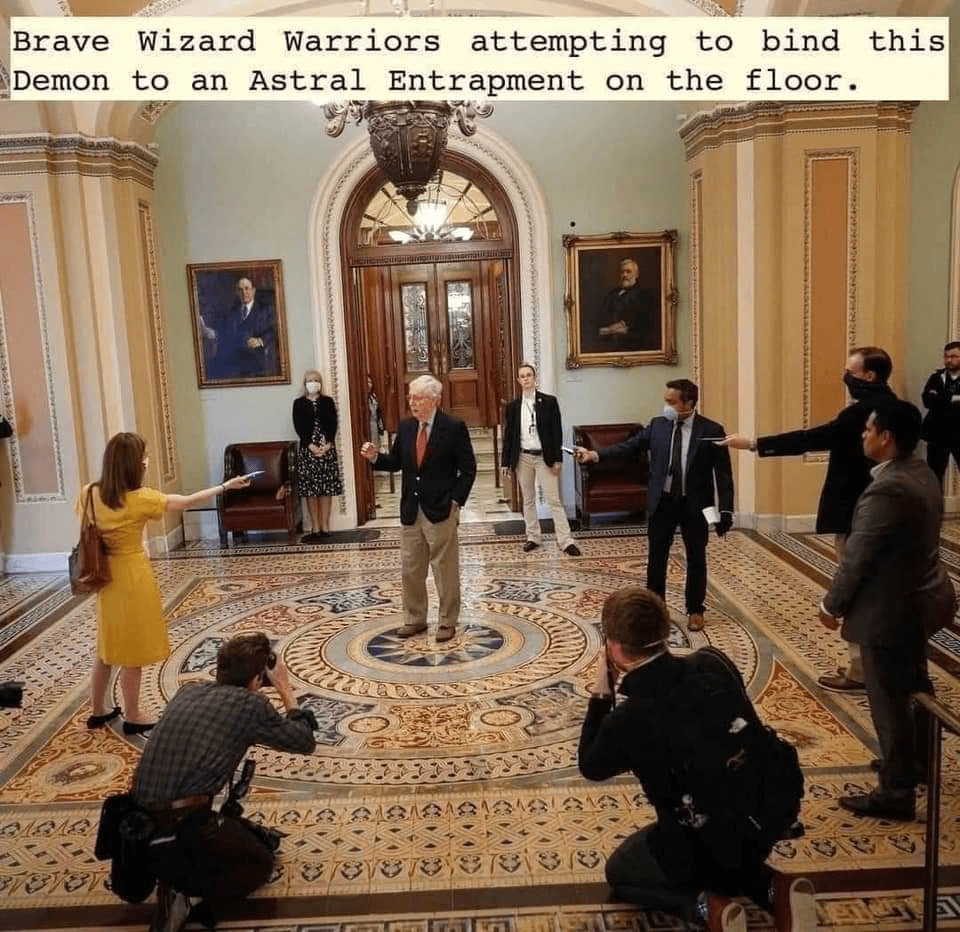
It’s magic(k)!

 Hellbound and Down
You must be logged in to post a comment.