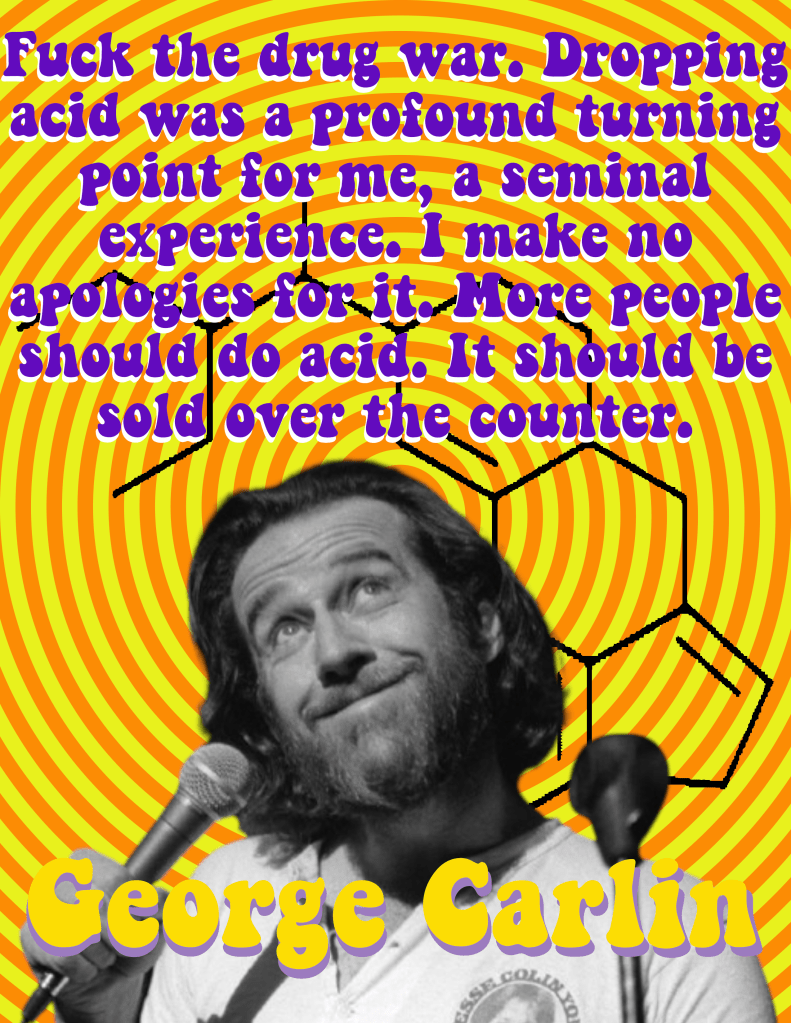
George Carlin on LSD…

Seth Ferranti was driving his Ford pickup on a southeastern Nebraska stretch of the interstate in November 2024 when law enforcement pulled him over, claiming that he had wobbled onto the hard shoulder.
As the Seward County sheriff’s deputies questioned Ferranti, a filmmaker who had spent 21 years in prison for distributing LSD, they allegedly smelled cannabis. Declaring this probable cause for a search, they searched the vehicle and discovered more than 400 pounds of marijuana.
But were those the actual reasons for the stop and search? When Ferranti went on trial, his attorneys presented a license plate reader report produced by the security communications company Motorola Solutions. It revealed Ferranti had been consistently monitored prior to his arrest, including by the local sheriff on the day he was apprehended. (Neither the sheriff’s office nor Motorola responded to Reason‘s requests for comment.)
Ferranti’s legal team argued that it was unconstitutional to surveil somebody based on his previous crimes. The argument did not carry the day: Last month their client was sentenced to up to two and a half years for possession of cannabis with intent to distribute. But the case still raises substantial moral and constitutional questions about both the scale of these public-private surveillance partnerships and the ways they’re being used.
Ferranti had long been a celebrity in the drug-reform world, going back to that LSD arrest in the early ’90s. After that first bust, he jumped bail, went on the lam, landed on the U.S. Marshals’ 15 Most Wanted Fugitives list, and even staged his own drowning to evade the authorities. After he started serving his sentence in 1993, he became a prolific prison journalist, writing the “I’m Busted” column for Vice. The New Jersey native always insisted that his crimes were nonviolent and that the drugs he sold, LSD and cannabis, had medicinal or therapeutic benefits.
After Ferranti came out of prison, his 2017 documentary White Boy—the true story of a teenage FBI informant who became a major cocaine trafficker—was a success on Netflix. He produced a number of further films, including 2023’s Secret History of the LSD Trade. And apparently, the government kept watching him.
It’s been watching a lot of people—and Motorola isn’t the only company helping it. Flock Safety was founded in 2017, and within five years it had tens of thousands of cameras operational. As the American Civil Liberties Union (ACLU) has warned, Flock’s AI-assisted automated license plate recognition (ALPR) system has been undergoing an “insidious expansion” beyond its supposed purposes of identifying vehicles of interest, such as stolen cars and hit-and-run suspects. Immigration and Customs Enforcement has used it to locate illegal migrants, and law enforcement in Texas used it to investigate a self-administered abortion, foreshadowing its potential use as a predictive policing tool for all Americans. Lee Schmidt, a veteran in Virginia, recently learned that the system logged him more than 500 times in four months.
“I don’t know whether law enforcement officers are using [ALPRs] to do predictive policing,” says Joshua Windham of the Institute of Justice, a public interest law firm that is campaigning to stop the warrantless use of license plate reader cameras. “We know that [Customs and Border Patrol] is using ALPRs generally to stop cars with what they deem ‘suspicious’ travel patterns.”
After reviewing the document cataloguing the Ferranti’s vehicle monitoring, Windham adds: “The records are consistent with an officer either looking up a car in his system to see where else that car was captured by ALPRs, or that car showing up as a ‘hot list’ alert in the Motorola system. But it’s hard to tell, from the records alone, whether the stop was a ‘predictive policing’ stop.”
Ferranti is convinced it was. “There were no warrants, investigations, informants, state police, DEA, or FBI involvement, just Seward County Sheriff’s office [and an] AI-assisted license plate tracking service to perpetuate their outdated War on Drugs mission,” he said in an Instagram post published by his family following his sentencing. “Traveling the highways as a person with a record is now considered [suspicious] activity by the AI.”
At Dr. David Feifel’s Kadima Neuropsychiatry Institute clinic in La Jolla, patients come in with depression, anxiety, PTSD, OCD and eating disorders.
But what sets this office apart is how these diagnoses are treated.
“I just felt that I wanted to create a center that focused on these advanced treatments that have expertise in these treatments and that also would be involved in developing the next generation of treatments,” Dr. Feifel said.
He opened his clinic in 2017 and is excited for this new era in psychedelic research.
“We’re picking up where we left off 30-40 years ago, and they are just looking very, very promising,” Dr. Feifel said.
One of the fastest-growing conditions his clinic sees is generalized anxiety disorder, or GAD.
“We see it especially growing among the youth and young females especially,” Dr. Feifel said.
One of those patients is Lucas Hoffman, who’s battled GAD for years, trying treatment after treatment for several years, with no major benefits.
As part of Dr. Feifel’s clinic, Hoffman joined a clinical trial for a new investigational drug called MM-120, a pharmaceutically optimized version of LSD.
“I came in that morning, I was a little late for the dosing session because I was dragging at home,” Hoffman said. “I was pretty, pretty nervous,”
In a controlled environment, patients receive a single monitored dose.
“I really personally, and this cannot represent the expectation for any of you on the trial, I really did, feel a sense of freedom,” Hoffman said. “I felt a breakthrough of some of the anxiety that was holding on so tightly to me.”
Early results are encouraging.
Taking a high dose of LSD, coupled with assisted therapy, led to “greater reductions in depression” among patients compared to those who received a low dose of the psychedelic, according to a new study.
Researchers at the University of Basel in Switzerland investigated the therapeutic potential of LSD for people with moderate-to-severe major depressive disorder, and they found the substance showed “promise” as a “novel approach” to treating the condition.
Notably, the study—published this month in the journal Med—indicated that “high-dose-LSD-assisted therapy reduced depressive symptoms more than low-dose therapy” and that the improvements lasted for up to 12 weeks after the treatment.
The randomized, double-blind trial involved administering doses of 100μg and 200μg of LSD for one cohort and two doses of 25μg of the psychedelic for the other. Symptoms of depression were measured at multiple intervals, starting with the baseline and followed up with examinations after two weeks, six weeks and 12 weeks.
After assessing the 61 patients post-administration, the researchers concluded that the “findings of this exploratory study support further investigation of LSD-assisted therapy in depression in a larger phase 3 trial.”
“The present trial’s strengths include a clinically representative sample with respect to the duration of illness, common comorbid conditions, and various pretreatments,” the study authors said. “Other strengths include the comparison with a low-dose group and a relatively long follow-up period of 12 weeks after the last administration.”
“LSD could be used safely within the framework of this study,” they said, adding that compared to previous trials involving psilocybin, “LSD has a longer duration of action.”
“This prolonged effect makes clinical application more resource intensive. It remains to be resolved whether this extended duration offers clinical advantages,” the study text says. “Furthermore, it is yet to be determined if there are other relevant differences among hallucinogenic drugs in terms of therapeutic potential.”
Robert F. Kennedy Jr., the head of the U.S. Department of Health and Human Services (HHS), says he had a “wonderful experience” with LSD at 15 years old, which he took because he thought he’d be able to see dinosaurs, as portrayed in a comic book he was a fan of.
Unfortunately, he said that LSD trip led him to later take methamphetamine and, ultimately, go through a decade-long battle with heroin addiction.
At the 2025 Rx and Illicit Drug Summit in Nashville on Thursday, Kennedy spoke candidly about his own journey with certain drugs, offering a window into the HHS secretary’s perspective on substance use as he assumes a critical health and drug policy role in the Trump administration.
Kennedy said he was straight-edge up until he was 15, when he went to a party that became a “melee” and met a person who offered him LSD as they hitchhiked home.
“I would never have taken it,” he said. But in his town, there was a store kids flocked to every week for comic books—and in one of his favorite series, Turok: Son of Stone, the characters took “some kind of hallucinogen” like mescaline and they saw dinosaurs.
Kennedy said he “had a deep interest in paleontology” at the time, and the person who gave him the LSD said it was possible he could see dinosaurs, too.
In November 1956, three people gathered in a converted Connecticut barn to take LSD, a powerful psychedelic drug that was legal at the time.
The children had just been put to bed upstairs. In the converted barn’s main room, Elizabethan ballads drifted through smoke-thick air as someone scattered chrysanthemum petals across a sheepskin rug. The flowers seemed to reanimate in the candlelight, blooming and dying with each flicker. Two of the participants lay hand-in-hand in ecstatic communion, while a third sat rigid and apart, his detachment crumbling into barely contained fury.
By midnight, everything would shatter.
One participant spiraled into visions of nuclear war. Another transformed into a 10-foot colossus of feminine power. And in the space between these extremes, a marriage began its quiet collapse.
The aftershocks would reverberate through three generations of Britain’s most celebrated intellectual family, the Huxleys, leaving wounds that simmered in private letters for more than sixty years.
It’s fitting that this story should be told on Bicycle Day, the annual commemoration of April 19, 1943, when Swiss chemist Albert Hofmann first rode his bike home under the effects of LSD — and ushered in the modern psychedelic era. Nearly 14 years after that inaugural ride, the drug had drifted from the lab into the lives of artists, seekers and intellectual elites like the Huxleys.
The trip’s architect was Dr. Humphry Osmond, the psychiatrist who had first guided Aldous Huxley — the author of “Brave New World” and “The Doors of Perception” — in experiments with mescaline. and coined the term “psychedelic.” His subjects that evening were Aldous’ only son, Matthew Huxley; Matthew’s wife, Ellen; and Francis Huxley, Matthew’s cousin and the son of biologist Julian Huxley.

Get yours HERE!
People who have used so-called “classic psychedelics” such as psilocybin or LSD are less likely to report having frequent bad headaches, a new study concludes.
The results, authors wrote this month in the Journal of Pharmacology, “add to the literature suggesting classic psychedelics as a possible future prophylactic treatment option for primary headache disorders.”
Researchers gathered data from 11,419 records collected from 1999 to 2000 as part of the British Child Development Study 1958, which follows a cohort of people born over the course of a single week in March 1958.
Specifically, they looked at responses to three questions: “Do you often have bad headaches?” “Have you ever tried LSD, also known as acid or trips?” and “Have you ever tried magic mushrooms?”
The team’s analysis showed that “lifetime use of classic psychedelics was associated with 25% lower odds of having frequent bad headaches.”
There are, of course, limitations as to what conclusions can be drawn from the observational nature of the study.
“Although we have proposed a direction of association, we cannot draw any causal inferences about the association between lifetime use of classic psychedelics and frequent bad headaches,” they wrote. “It is possible that the negative association found is a result of people suffering from frequent bad headaches abstaining from the use of classic psychedelics.”
Data from the same survey, for example, showed that low alcohol use was associated with higher likelihood of frequent bad headaches. In that case, authors interpreted the finding by saying it “may be explained by individuals experiencing frequent bad headaches choosing to abstain from alcohol,” noting that alcohol is understood to be a trigger for headaches.
Overall, 16 percent of people in the survey reported frequent bad headaches. Of those, 71 percent were female and 29 percent were male. Lifetime use of classic psychedelics, meanwhile, was reported by 6.5 percent of people with frequent bad headaches and 8.6 percent of those without.
Notably, when the research team divided reports by sex, they noticed a stronger association between psychedelics use and headaches among female respondents.
From the mid-1950s to the early 1960s, men in San Francisco who patronized prostitutes ran the risk of becoming unwitting participants in a clandestine CIA experiment. It was designed to test whether the combination of sex and the hallucinogenic drug LSD might influence the men to reveal information that the government wanted. What information, nobody is really sure.
The experiment, known as Operation Midnight Climax inside the CIA, was part of a larger research program code-named MKULTRA. The agency launched MKULTRA out of worries that the Soviet Union had developed a mind-control drug.
CIA officials had observed the vacant gaze and trance-like behavior of Hungarian cleric Cardinal József Mindszenty at a show trial in Budapest in 1949. They were convinced that his confession had been extracted with chemicals, according to a 1977 New York Times article and decided that the U.S. needed to have similar capabilities.

Get yours at the Merch Shop!
 Hellbound and Down
You must be logged in to post a comment.