Overdose deaths appear to rise amid coronavirus pandemic in U.S.

Davidson was part of a surge in overdose deaths that hit Kentucky this spring. May was its deadliest month for overdoses in at least five years. At the end of August, the state had seen almost as many overdose deaths as it had in all of 2019.

It is not alone. National data is incomplete, but available information suggests U.S. drug overdose deaths are on track to reach an all-time high. Addiction experts blame the pandemic, which has left people stressed and isolated, disrupted treatment and recovery programs, and contributed to an increasingly dangerous illicit drug supply.

Keep reading

In Heavily Locked Down San Francisco, 360% More People Died from Overdoses Than COVID-19

Stay home, save lives. This is the mantra many Californians have repeated and lived by for the last 10 months as their governor instituted some of the most draconian measures in the country. Watching their economy turn to shambles as thousands of businesses close their doors forever is making some folks grow weary of the COVID-19 lockdowns, and rightfully so.

Earlier this month, the city of San Francisco issued an order shutting down outside play for kids at playgrounds. Seriously. Even dating is banned unless it’s done masked, outside, and kiss free.

According to the order, residents can “meet with 1 other person who doesn’t live with you” to take a walk, “hang out at the park,” and play low-contact sports, such as golf, tennis, pickleball and bocce ball. However, couples cannot share equipment.

It’s utterly ridiculous.

Countless San Franciscan businesses have closed their doors forever and the city, whose population is nearly 900,000 has seen less than 200 coronavirus deaths since the beginning of the pandemic — 173 to be exact.

While folks aren’t dying from COVID-19 very often in the area, there is definitely a spike in deaths, and it is staggering. A record 621 people as of December 19 have died of drug overdoses in San Francisco. That is 360% more deaths than COVID-19.

Keep reading

Birx travels, family visits highlight pandemic safety perils

As COVID-19 cases skyrocketed before the Thanksgiving holiday weekend, Dr. Deborah Birx, coordinator of the White House coronavirus response, warned Americans to “be vigilant” and limit celebrations to “your immediate household.”

For many Americans that guidance has been difficult to abide, including for Birx herself.

The day after Thanksgiving, she traveled to one of her vacation properties on Fenwick Island in Delaware. She was accompanied by three generations of her family from two households. Birx, her husband Paige Reffe, a daughter, son-in-law and two young grandchildren were present.

Keep reading

Lockdowns Do Not Control the Coronavirus: The Evidence

The use of universal lockdowns in the event of the appearance of a new pathogen has no precedent. It has been a science experiment in real time, with most of the human population used as lab rats. The costs are legion. 

The question is whether lockdowns worked to control the virus in a way that is scientifically verifiable. Based on the following studies, the answer is no and for a variety of reasons: bad data, no correlations, no causal demonstration, anomalous exceptions, and so on. There is no relationship between lockdowns (or whatever else people want to call them to mask their true nature) and virus control. 

Perhaps this is a shocking revelation, given that universal social and economic controls are becoming the new orthodoxy. In a saner world, the burden of proof really should belong to the lockdowners, since it is they who overthrew 100 years of public-health wisdom and replaced it with an untested, top-down imposition on freedom and human rights. They never accepted that burden. They took it as axiomatic that a virus could be intimidated and frightened by credentials, edicts, speeches, and masked gendarmes. 

The pro-lockdown evidence is shockingly thin, and based largely on comparing real-world outcomes against dire computer-generated forecasts derived from empirically untested models, and then merely positing that stringencies and “nonpharmaceutical interventions” account for the difference between the fictionalized vs. the real outcome. The anti-lockdown studies, on the other hand, are evidence-based, robust, and thorough, grappling with the data we have (with all its flaws) and looking at the results in light of controls on the population. 

Keep reading

Anti-lockdown gym owner to ‘petty tyrant’ NJ governor: ‘The only way you’ll ever close these doors is when you close my casket’

“We have been open against unconstitutional shut down orders since May,” Smith wrote in a now-viral Instagram post over the weekend. “Not once have we flinched, and the petty tyrant of New Jersey governor Murphy has tried everything he could possibly think of to ruin us. Over seven months later we will open our doors every single day.”

He added: “No government official will ever tell me that I am not able to provide for my family. I do not answer to public servants – no matter what threats or punishments they impose. I am a free man. I do not ask for permission. I do not ask for forgiveness. You work for us. The only way you’ll ever close these doors is when you close my casket.”

The post comes with video in which Smith is seen holding up pieces of paper — which he presents to the camera and then discards one by one, “Subterranean Homesick Blues“-style — that send the same overall message.

“We have had our business license stripped,” the messages Smith holds aloft say. “We have had our doors locked and barricaded. We have been arrested and have over 60 citations.”

Keep reading

Pandemic Lockdown Battles Offer Glimpses of Political Conflicts to Come

Across the country, government officials are tightening and reimposing curfews, stay-at-home orders, mask mandates, and other restrictions as COVID-19 numbers climb. But with public patience over lockdowns wearing thin, many individuals and local authorities openly reject rules that drive people to poverty and despair. County sheriffs in CaliforniaNew YorkNorth DakotaOregon and elsewhere say they’ll have nothing to do with enforcement efforts and spar with governors who resent such independence.

It’s the rebellious spirit of the earlier sanctuary city and Second Amendment sanctuary movements, amplified by the pressures of the pandemic into an eruption of what some legal scholars call “punitive federalism.” Get used to it, because our politically polarized era offers fresh soil for such dictates and defiance.

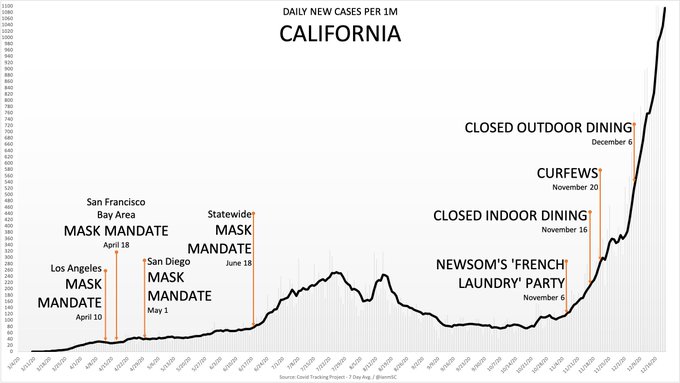
California’s revolt is especially widespread. “All told, over a third of Californians live in a county with a sheriff promising not to enforce the governor’s stay-at-home order,” Reason‘s Christian Britschgi pointed out this week. Ironically, when Gov. Gavin Newsom threatened to withhold funds from jurisdictions that ignore his dictates, Riverside County Sheriff Chad Bianco snapped back that the governor was behaving just like President Trump, who California’s elected officials have criticized for using money in an effort to extract compliance.

Keep reading

Taking the Piss: New York Briefly Bans Diners From Using Restaurant Bathrooms

New York City’s outdoor dining patrons who needed to relieve themselves were left out in the cold briefly by a state policy that forbade them from using a restaurant’s indoor bathroom.

On Thursday, the city, through the Office of the Counsel to the Mayor, issued a guidance FAQ to help restaurants understand Gov. Andrew Cuomo’s executive order shutting down indoor dining in the city this past Monday, as well as guidance from the State Liquor Authority (SLA) interpreting that order.

Among those FAQs was a question asking, “If my SLA-licensed establishment is offering outdoor dining, may I allow customers to use the bathroom inside?” The answer was an emphatic no. “No. Customers may not enter the inside of the establishment for any reason,” reads the document.

The same document also made clear that restaurant staff were not allowed to share meals together. Employees were barred from eating or drinking at bars, in dining rooms, or other areas of their workplace that are used by the public. (Better that they eat their shift meal in a crowded kitchen, I guess.)

This FAQ document and the underlying state guidance sparked fierce criticism from restaurant advocates.

Keep reading