How the Supreme Court Rewrote the Constitution Part VII: Concentration Camps and the End

This is the last installment in a series on the nadir, or low point, of the U.S. Supreme Court. This was the period from 1937 to 1944, when the court stopped protecting the Constitution’s limits on the federal government. Our Constitution has never fully recovered.

The firstsecondthirdfourthfifth and sixth installments related to how the justices initially tried to balance the demands of President Franklin D. Roosevelt’s New Deal with the Constitution’s rules. In 1937, however, Roosevelt began to replace sitting justices with New Deal enthusiasts who had no prior judicial credentials. The remodeled bench successively discarded limits on federal spending, federal property ownership, and federal economic regulation. In at least one case, it abandoned habeas corpus and the right to a trial by jury.

This final installment addresses the court’s role in what was, aside from slavery, the most egregious violation of civil rights in U.S. history. It adds some observations on how the court’s abysmal record from 1937 to 1944 continues to affect us today.
Keep reading

Biden Sends Migrant Kids To Former Japanese Internment Camp Site

The Los Angeles County Fairgrounds, one of the places Japanese Americans were held during World War II, will serve as an emergency shelter for unaccompanied children who have crossed the border into the United States, L.A. County has announced.

Hilda Solis, chair of the Los Angeles County Board of Supervisors, said Thursday the decision was made after discussions with the Biden White House.

The Biden administration has contacted communities throughout the nation to find space for undocumented children being sheltered in Border Patrol facilities. It even urged, unsuccessfully, that NASA employees go to the border to volunteer in the overcrowded camps.

Also known as the Pomona Fairplex, the mega-facility in the city of Pomona is the third in Southern California to serve in that capacity.

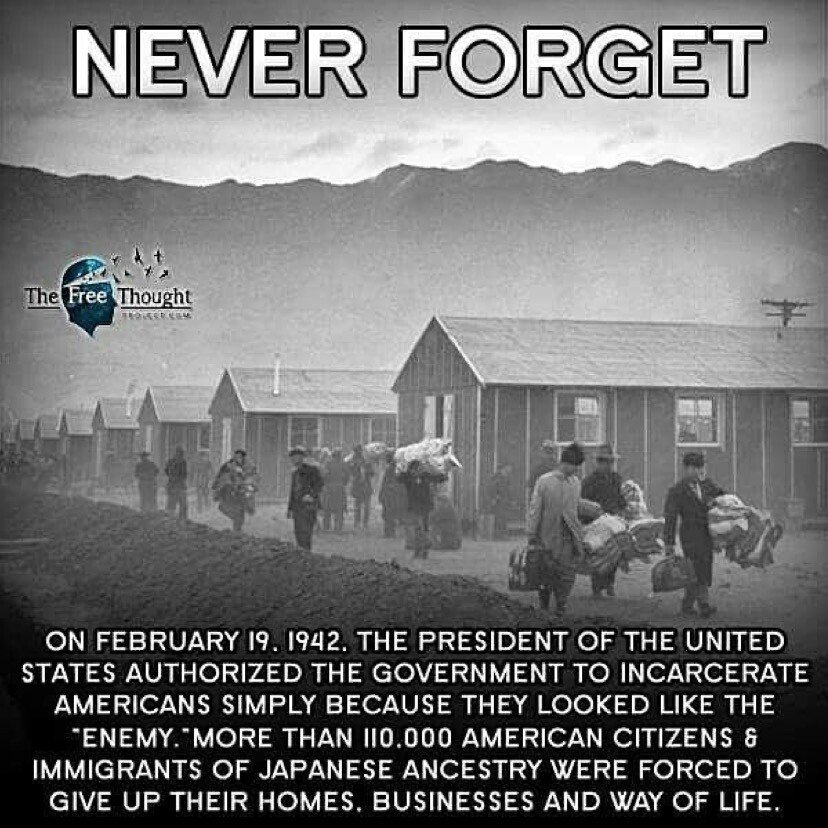
In 1942, months after the attack on Pearl Harbor, President Franklin Roosevelt authorized the detention of Japanese Americans, fearing they would be loyal to the emperor of Japan.

The Pomona location was selected as one of the camps. A California Historic Landmark plaque near Fairplex, at around 1099 West McKinley Avenue, Pomona, commemorates the event.

Opened in May 1942, the detention camp had 309 barracks, 8 mess halls, and 36 shower and latrine facilities. It reached a peak population of more than 5,000 before it closed later in the year. Most of the internees were transferred to another camp in Wyoming.

Keep reading