Stole something? IRS says stolen property and bribes must be reported as income

Did you steal a car in 2021? How about taking a bribe? If you did, the IRS says to make sure you report it on your taxes.  

Those provisions went viral Monday following a tweet alerting taxpayers to those somewhat surprising requirements to note the value of your ill gotten gains. 

“Tax szn is around the corner,” read the tweet from @litcapital. “Remember to report your income from illegal activities and stolen property to the IRS.”

The requirements can be found at IRS.gov amid other missives to report income earned from jobs in the gig economy and what to do about taxable alimony payments. 

“If you steal property, you must report its fair market value in your income in the year you steal it unless you return it to its rightful owner in the same year,” read the provision for stolen property.’

What if you’re dealing drugs or caught up in other crimes?

In that case, the IRS publication says jot your earnings on line 8z, Schedule 1 of your 1040 form, “or on schedule C … if from your self-employment activity.”

And don’t forget to report any bribes or kickbacks you took in the course of doing business.

The kickbacks also go on Schedule 1 or Schedule C, while the IRS says bribes should simply be included in your income. 

Keep reading

Biden Wants To Empower the IRS Despite Its Track Record of Trampling Rights and Undermining Privacy

President Joe Biden’s plan to beef up IRS enforcement and snoop on Americans’ bank accounts will require hiring more than 80,000 additional tax cops—expanding a federal bureaucracy with a long track record of flouting due process and undermining privacy.

As part of Biden’s “Build Back Better” plan, the IRS would get $80 billion in additional funding over the next 10 years. The bulk of those new funds, nearly $45 billion, would be directed toward enforcement actions with the goal of doubling the number of annual audits of small businesses. By comparison, the bill spends a relatively meager $1.93 billion on improving taxpayer services, including education and filing assistance.

In short, for every new dollar the IRS will spend helping Americans understand the endlessly complicated federal tax code, the agency will spend roughly $23 new dollars on enforcing those same rules.

Everyone should pay the taxes they owe, of course, but the IRS’ track record suggests that more enforcement will also mean more trampling of Americans’ due process rights.

“It’s a systematic practice at the IRS to violate due process and to abuse taxpayers,” says Isabelle Morales, a policy specialist for Americans for Tax Reform, a conservative nonprofit that opposes tax increases. Biden is proposing to boost funding “for an agency that needs reform,” Morales tells Reason, “and that will only lead to us fueling their bad practices.”

Keep reading

Joe Biden Wants To Have The IRS Harass Americans While Dodging It Himself

The White House fears that an impending Congressional Budget Office analysis will say Democrats’ spending bill would increase federal deficits. The dispute seems unsurprising, given the myriad budgetary gimmicks in the bill—but not for the reasons one might expect.

Ignore for a moment the fact that the bill contains ten years of tax increases to pay for a few years’ of spending that Democrats later hope to extend, meaning that independent budget analysts have pegged the bill’s true ten-year cost not at $1.75 trillion but nearer to $5 trillion. Ignore too the fact that front-loading the bill’s spending means it will almost certainly increase federal deficits in the short-term, exacerbating inflation at a time price increases are already at 30-year highs.

Instead, the proximate dispute with CBO concerns whether an increase in tax enforcement will yield as much revenue as Treasury claims. On that front, one of the biggest arguments against the Biden administration’s position comes via Joe Biden himself.

Dueling Tax Estimates

The New York Times reported Monday that “the White House has begun bracing lawmakers for a disappointing estimate” from CBO, and is “urging lawmakers to disregard the budget office assessment, saying it is being overly conservative in its calculations.” While administration officials say additional tax enforcement will generate $400 billion in new revenue, CBO Director Philip Swagel on Monday said he stood by the agency’s September estimate that enhanced enforcement authority will net roughly $120 billion.

The difference between the lower and higher revenue figures could determine whether the bill gets scored as a budget-saver or budget-buster. Treasury has therefore come out swinging at CBO, with Assistant Treasury Secretary Ben Harris calling the office’s methodology “patently absurd” in an interview with the Times.

Whither IRS Enforcement?

But given his own boss’ conduct, Mr. Harris doth protest too much on tax enforcement. After leaving the vice presidency in early 2017, Joe Biden and his wife Jill created two S-corporations, and characterized most of their book and speech earnings as profits from those corporations rather than taxable wages.

These maneuvers allowed the Bidens to dodge nearly $517,000 in payroll taxes. The Tax Policy Center called the Bidens’ actions “pretty aggressive.” And a recent Congressional Research Service report outlined several instances in which federal courts agreed with the IRS in requiring S-corporations to pay back taxes—all of which arguably applied to the Bidens.

Yet despite the Bidens’ public release of their returns, and coverage of the irregularities surrounding them, no news has yet emerged of an IRS audit. Why?

Keep reading

How Many Guns Does the IRS Have?

President Joe Biden and Democrats who support his multi-trillion dollar “Build Back Better” spending agenda want to empower the IRS with even more resources. 

According to the Heritage Foundation, the bill would increase the IRS budget by 70 percent. 

“House Democrats’ massive tax-and-spending package would reward the unpopular tax-collecting agency by increasing its current budget by more than 70%. Over the next 10 years, the bill would add $88 billion of new funding for the IRS, including $45 billion dedicated to enforcement, $27 billion for operations support, $5 billion for new business systems, $4 billion to administer green energy initiatives, and $4 billion to administer child tax credits,” Heritage analyzes. “Meanwhile, it dedicates less than $2 billion for taxpayer services.”

“Between the huge sums aimed directly at enforcement activities and operations support, expect a large majority of the $88 billion of new IRS funding to directly or indirectly support things like asset monitoring, audits, taxpayer investigations, and legal actions against taxpayers,” they continue. 

“On the issue of enforcement actives and operations support,” Americans for Tax Reform is reminding taxpayers the IRS already has substantial authority and power. This includes ownership of thousands of guns and agents who can be deployed to use them. 

Keep reading

Pelosi Doubles Down on IRS Looking Into Bank Transactions

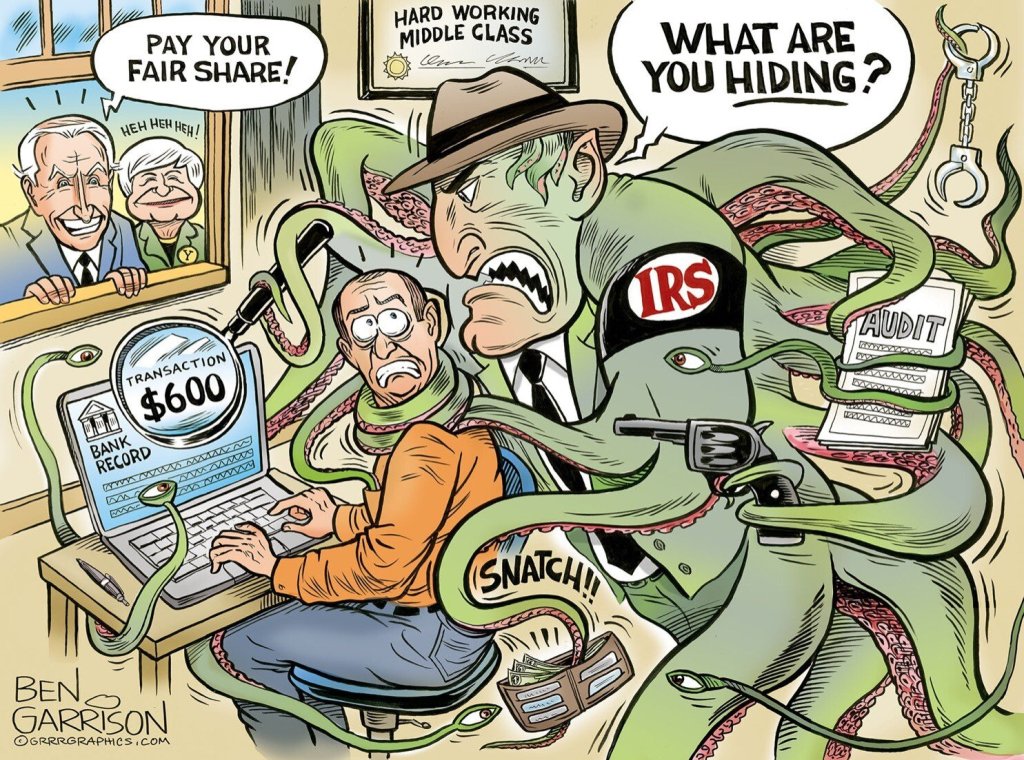
Speaker of the House Nancy Pelosi (D-Calif.) has doubled down on a provision in the Democrats’ multi-trillion-dollar reconciliation bill that would allow the Internal Revenue Service (IRS) to see information on all Americans’ bank transactions totaling $600 or more. Republicans and banks have raised the alarm about the provision, reporting that their constituents and clients are deeply concerned about the proposal.

Since the introduction of their reconciliation bill, Democrats have insisted that the bill will not add to the debt or the deficit, claiming that all new spending in the bill will be paid for.

Along with significantly increasing marginal tax rates to pay for the bill, Democrats proposed and wrote into the bill a section to allow the IRS to gather Americans’ private information from banks, including information on all transactions totaling more than $600.

Keep reading

Groups push back against Biden’s plan to grant IRS access to your bank account (and PayPal) transaction data

Banking industry officials and other financial services firms are bracing for a long fight over a bill that will require banks to share consumer account information with the Internal Revenue Service to boost federal tax revenue.

This notion originally gained traction this spring within the American Families Plan by the Biden administration. But bankers and even some consumer groups have slammed it as a compliance concern and a privacy issue. Financial institutions already provide the IRS with large quantities of data.

As part of the 3.5 trillion dollar budget reconciliation package proposed by the Biden administration, legislators are considering this invasive proposal as an income source to fund the massive budget.

The Biden administration argued that bank surveillance would prevent tax evasion, but many are obviously concerned that it’s a breach of the Fourth Amendment (which protects people from unreasonable searches and seizures by the government) and would also favor those who are embracing the move towards decentralized finance and cryptocurrencies, as well as those that use off-shore accounts.

The proposals would force banks to report every deposit and withdrawal related to a bank account and would also include centralized companies such as PayPal, Venmo, (owned by PayPal), CashApp, and cryptocurrency exchanges.

Keep reading

Biden proposal would give the IRS access to your bank account

Tax law and federal budgets are inherently boring things, so it comes as no surprise that language is often slipped into those bills that would otherwise cause outrage if proposed individually.  Like giving the IRS access to your personal and business bank account.

The Biden Administration’s 2022 budget proposal — which claims to advance “equity across government” — included a provision that generally slipped under the radar, but would impose onerous new reporting requirements on community banks and raises privacy questions.

The Independent Community Bankers Association reports that the proposal would require financial institutions to report information on customer bank accounts to the IRS.

Currently, banks are only required to report deposits of $10,000 or more, however, the proposal would require banks and other financial institutions to report to the IRS on the deposits and withdrawals of all business and personal accounts with a balance of more than $600. 

The Kansas Bankers Association objected strongly to the proposed requirement and said flatly that they stand in opposition.

“The new reporting requirements would raise questions about customers’ right to privacy, create unnecessary and expensive burdens for banks and raise the cost of tax preparation for small businesses,”  President & CEO Doug Wareham said in a statement. “While all banks would be affected, small community banks with limited internal resources will be especially burdened by this new requirement. The new requirements will require a massive and expensive compliance effort to track and report inflows and outflows on all bank products.”

ICBA — and 44 other community bank associations — have more or less gone to war over this issue sending out a  fact sheet and hearing statement, a Minority Bank Advisory Council letter to congressional leaders, a joint letter with 44 state community banking associations, and thousands of grassroots messages from community banks. 

Keep reading

Biden’s Disturbing Plans to Expand the IRS, Disclosure Rules Should Worry Conservatives

President Biden’s budget proposal calls for increasing funding for the IRS by $80 billion, much of which would go toward hiring nearly 87,000 new workers over the next 10 years. If Congress adopts Biden’s plan, the size of the IRS would double, with its workforce increasing by about 15 percent every year.

According to the Biden administration, the primary reason behind the expansion is to help the IRS chase down individuals and families who cheat on their taxes. Apparently, the tens of thousands of people who already work at the IRS aren’t enough to get the job done.

In addition to Biden’s plan to expand the size of the staff at the IRS, the White House and congressional Democrats have also proposed substantially increasing disclosure requirements for groups that spend money on political advertising, a policy proposal contained in the For the People Act, legislation that is separate from Biden’s budget.

Under the For the People Act, also commonly referred to as H.R. 1, many organizations that spend money during election cycles would be forced to reveal donors who have given at least $10,000.

Keep reading

The Secret IRS Files: Trove of Never-Before-Seen Records Reveal How the Wealthiest Avoid Income Tax

In 2007, Jeff Bezos, then a multibillionaire and now the world’s richest man, did not pay a penny in federal income taxes. He achieved the feat again in 2011. In 2018, Tesla founder Elon Musk, the second-richest person in the world, also paid no federal income taxes.

Michael Bloomberg managed to do the same in recent years. Billionaire investor Carl Icahn did it twice. George Soros paid no federal income tax three years in a row.

ProPublica has obtained a vast trove of Internal Revenue Service data on the tax returns of thousands of the nation’s wealthiest people, covering more than 15 years. The data provides an unprecedented look inside the financial lives of America’s titans, including Warren Buffett, Bill Gates, Rupert Murdoch and Mark Zuckerberg. It shows not just their income and taxes, but also their investments, stock trades, gambling winnings and even the results of audits.

Keep reading