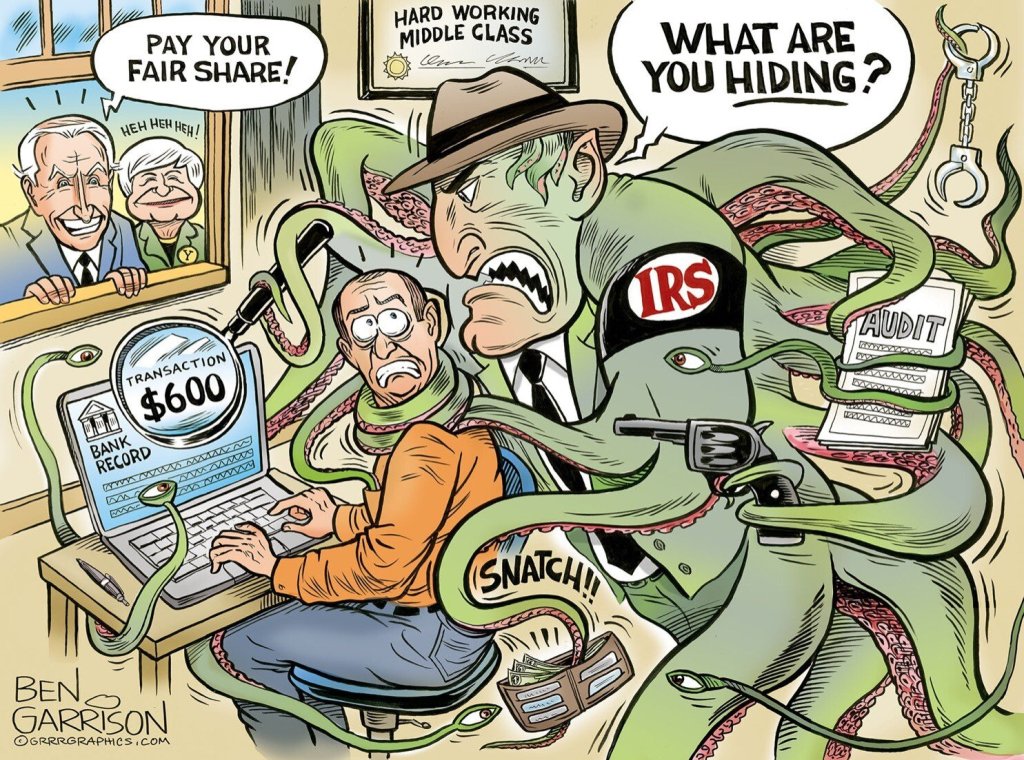
Groups push back against Biden’s plan to grant IRS access to your bank account (and PayPal) transaction data

Banking industry officials and other financial services firms are bracing for a long fight over a bill that will require banks to share consumer account information with the Internal Revenue Service to boost federal tax revenue.

This notion originally gained traction this spring within the American Families Plan by the Biden administration. But bankers and even some consumer groups have slammed it as a compliance concern and a privacy issue. Financial institutions already provide the IRS with large quantities of data.

As part of the 3.5 trillion dollar budget reconciliation package proposed by the Biden administration, legislators are considering this invasive proposal as an income source to fund the massive budget.

The Biden administration argued that bank surveillance would prevent tax evasion, but many are obviously concerned that it’s a breach of the Fourth Amendment (which protects people from unreasonable searches and seizures by the government) and would also favor those who are embracing the move towards decentralized finance and cryptocurrencies, as well as those that use off-shore accounts.

The proposals would force banks to report every deposit and withdrawal related to a bank account and would also include centralized companies such as PayPal, Venmo, (owned by PayPal), CashApp, and cryptocurrency exchanges.

Keep reading

Biden proposal would give the IRS access to your bank account

Tax law and federal budgets are inherently boring things, so it comes as no surprise that language is often slipped into those bills that would otherwise cause outrage if proposed individually.  Like giving the IRS access to your personal and business bank account.

The Biden Administration’s 2022 budget proposal — which claims to advance “equity across government” — included a provision that generally slipped under the radar, but would impose onerous new reporting requirements on community banks and raises privacy questions.

The Independent Community Bankers Association reports that the proposal would require financial institutions to report information on customer bank accounts to the IRS.

Currently, banks are only required to report deposits of $10,000 or more, however, the proposal would require banks and other financial institutions to report to the IRS on the deposits and withdrawals of all business and personal accounts with a balance of more than $600. 

The Kansas Bankers Association objected strongly to the proposed requirement and said flatly that they stand in opposition.

“The new reporting requirements would raise questions about customers’ right to privacy, create unnecessary and expensive burdens for banks and raise the cost of tax preparation for small businesses,”  President & CEO Doug Wareham said in a statement. “While all banks would be affected, small community banks with limited internal resources will be especially burdened by this new requirement. The new requirements will require a massive and expensive compliance effort to track and report inflows and outflows on all bank products.”

ICBA — and 44 other community bank associations — have more or less gone to war over this issue sending out a  fact sheet and hearing statement, a Minority Bank Advisory Council letter to congressional leaders, a joint letter with 44 state community banking associations, and thousands of grassroots messages from community banks. 

Keep reading

Biden’s Disturbing Plans to Expand the IRS, Disclosure Rules Should Worry Conservatives

President Biden’s budget proposal calls for increasing funding for the IRS by $80 billion, much of which would go toward hiring nearly 87,000 new workers over the next 10 years. If Congress adopts Biden’s plan, the size of the IRS would double, with its workforce increasing by about 15 percent every year.

According to the Biden administration, the primary reason behind the expansion is to help the IRS chase down individuals and families who cheat on their taxes. Apparently, the tens of thousands of people who already work at the IRS aren’t enough to get the job done.

In addition to Biden’s plan to expand the size of the staff at the IRS, the White House and congressional Democrats have also proposed substantially increasing disclosure requirements for groups that spend money on political advertising, a policy proposal contained in the For the People Act, legislation that is separate from Biden’s budget.

Under the For the People Act, also commonly referred to as H.R. 1, many organizations that spend money during election cycles would be forced to reveal donors who have given at least $10,000.

Keep reading

The Secret IRS Files: Trove of Never-Before-Seen Records Reveal How the Wealthiest Avoid Income Tax

In 2007, Jeff Bezos, then a multibillionaire and now the world’s richest man, did not pay a penny in federal income taxes. He achieved the feat again in 2011. In 2018, Tesla founder Elon Musk, the second-richest person in the world, also paid no federal income taxes.

Michael Bloomberg managed to do the same in recent years. Billionaire investor Carl Icahn did it twice. George Soros paid no federal income tax three years in a row.

ProPublica has obtained a vast trove of Internal Revenue Service data on the tax returns of thousands of the nation’s wealthiest people, covering more than 15 years. The data provides an unprecedented look inside the financial lives of America’s titans, including Warren Buffett, Bill Gates, Rupert Murdoch and Mark Zuckerberg. It shows not just their income and taxes, but also their investments, stock trades, gambling winnings and even the results of audits.

Keep reading

Judge orders IRS to reveal if it criminally investigated Clinton Foundation, citing records ‘gap’

AU.S. Tax Court judge has ordered the Internal Revenue Service to reveal if it criminally investigated the Clinton Foundation, directing the agency to cure a mysterious “gap” in its records in the case.

Most of the proceedings in the case involving the Clinton Foundation and the whistleblowers Lawrence W. Doyle and John F. Moynihan have been sealed, but U.S. Tax Court Judge David Gustafson authorized the release of an April 22 ruling to Just the News this week.

In it, Gustafson remanded the case back to the IRS Whistleblower Office (WO), saying the agency’s claim there was no criminal investigation against the Clinton Foundation “was not supported by the administrative record and thus constituted an abuse of discretion.”

“The WO must further investigate to determine whether CI [criminal investigative division] proceeded with an investigation based on petitioners’ information and collected proceeds,” the judge ruled. “… It seems clear we should remand the case to the WO so that it can explore this gap.”

Keep reading

IRS Plans a 50% Ramp-Up in Audits of Small Businesses Next Year

The Internal Revenue Service is planning to ramp up audits of smaller businesses and their investors by about 50% next year, following years of persistently low examination rates, an agency official said Tuesday.

The result could be a surge in audits of companies ranging from mom-and-pop retail stores and technology startups to investment funds that have historically faced only infrequent checks thanks to the time and effort required at the IRS.

“The IRS is focusing our efforts to increase compliance activity in this area of not only partnerships, but also investor returns related to pass-throughs,” De Lon Harris, the IRS deputy commissioner of examination for small businesses, said at an American Institute of Certified Public Accountants event. For 2021 “we are planning for 50% more than we had in the previous year.”

Keep reading