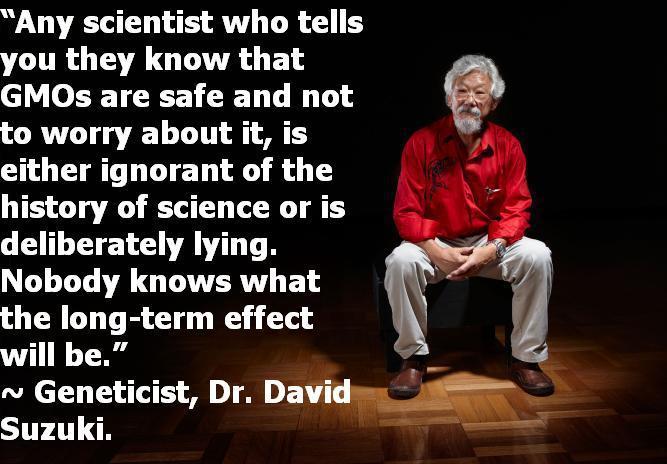
David Suzuki on GMOs…

“Biotechnology can be classified as the cloning of animals with identical genetic composition or genetic engineering (via recombinant DNA technology and gene editing) to produce genetically modified animals or microorganisms. Cloning helps to conserve species and breeds, particularly those with excellent biological and economical traits. Recombinant DNA technology combines genetic materials from multiple sources into single cells to generate proteins. (Journal of Animal Science and Biotechnology)
Genetically-modified organisms can be patented and owned. Monsanto owns the GMO seeds. Once DNA vaccines are used on humans — and it has never been done before — humans could possibly be “owned”. We could in theory be “patented”.
None of this has been discussed at length, and very little about this is known publicly.
No randomized placebo-controlled trials have been conducted. Vaccine manufacturers are exempt from these and many other safeguards.
In 2010, the Defense Advanced Research Projects Agency (DARPA) admitted that this type of technology can be used to “enhance and subvert” humans at a genetic level.
Hydrogel nanotechnology is injected beneath the skin. It can interface with cell phones and Artificial Intelligence to monitor basically everything within the body, including anxieties, emotions, ovulations, vitamins etc. etc.
Once implanted, the technology spreads throughout the body. Scientists do not know how this affects our DNA.
Recombinant RNA and DNA technology will, argues Dr. Madej, cause permanent and unknown genetic changes in a person’s body.
Will it create a new species and destroy an old one?
Approved by the Environment Protection Agency in May, the pilot project is designed to test if a genetically modified mosquito is a viable alternative to spraying insecticides to control the Aedes aegypti. It’s a species of mosquito that carries several deadly diseases, such as Zika, dengue, chikungunya and yellow fever.The mosquito, named OX5034, has been altered to produce female offspring that die in the larval stage, well before hatching and growing large enough to bite and spread disease. Only the female mosquito bites for blood, which she needs to mature her eggs. Males feed only on nectar, and are thus not a carrier for disease.The mosquito also won federal approval to be released into Harris County, Texas, beginning in 2021, according to Oxitec, the US-owned, British-based company that developed the genetically modified organism (GMO).The Environmental Protection Agency granted Oxitec’s request after years of investigating the impact of the genetically altered mosquito on human and environmental health.

For the first time, the innovative CRISPR gene editing method has been used on squid, marking a milestone in the scientific study of these creatures – and opening up many new areas of potential research.
CRISPR enables very precise, speedy, and low-cost DNA edits. Put simple, the ingenious molecular workings of the method are often described as something that allows us to ‘cut’ and ‘paste’ genes; in humans it promises to give us a way of tackling disease and killing superbugs at the genetic level.
In this case CRISPR-Cas9 genome editing was used on Doryteuthis pealeii (the longfin inshore squid) to disable a pigmentation gene, turning off the pigmentation usually found in the squid eye and inside specialised skin cells called chromatophores.
“This is a critical first step toward the ability to knock out – and knock in – genes in cephalopods to address a host of biological questions,” says marine biologist Joshua Rosenthal, from the Marine Biological Laboratory (MBL) at the University of Chicago.



 Hellbound and Down
You must be logged in to post a comment.