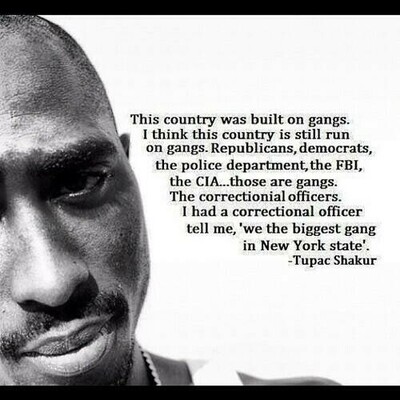
Tupac Shakur on gangs…

Recent documents from the Metropolitan Police Department in D.C. (MPD) and the Boston Police Department (BPD) show that Regional Intelligence Centers (RIC) are encouraging police officers to put children and adults in secret gang databases.
Last month an article in The Intercept showed that police gang databases are riddled with civil rights violations and errors. It revealed how police used civilian analysts to create flawed RIC (Fusion Center) gang member databases.
“A spreadsheet of the MPD database shared internally the next month included a supposed gang member who was less than 1 year old, as well as 2, 3, 5, and 6-year-olds. The 2,575 names in the spreadsheet also included children as young as 14.”
Cleveland Mayor Frank G. Jackson allegedly used his influence to protect his grandson — a reputed gang member — from being arrested in connection to a fatal shooting that still remains unsolved two years later, according to a report. The New York Post reported that Frank Q. Jackson, a suspected member of violent street gang No-Limit 700, was the prime suspect in the broad-daylight August 28, 2019 shooting of 30-year-old Antonio “Bisket” Parra.
Jackson, who is now being sued by the murdered man’s family, is accused of preventing the arrest of his grandson when cops went to the 74-year-old Democrat’s house the night of the shooting. According to documents, police intended to take his grandson into custody, but they stood down after a conversation the mayor had with Cleveland Police Chief Calvin Williams, according to the New Republic.
It’s unknown what took place during the encounter at the mayor’s house, since the elder Jackson apparently told the cops to turn off their body-worn cameras, in violation of department policy, a local TV station reported in September 2019.
The mayor, as part of the wrongful death lawsuit proceedings, claimed ignorance about why his grandson wasn’t arrested that night.
“I do not know,” Jackson said, according to the New Republic, “however, to the best of my recollection while outside my house … [police] spoke on the phone with Frank Q. Jackson’s lawyers.”
In addition to the circumstances surrounding cops backing away from arresting Frank Q., a local councilman claims the mayor — who has led the Ohio city since 2005 — has repeatedly provided cover for his grandson’s gang.
On March 29, just after 2:30 AM, Chicago’s ShotSpotter alert system detected eight or nine gunshots in the West Side, largely Latino, neighborhood of Little Village, where gangs like the Latin Kings and Two Six have made gunplay a regular part of life. Chicago police officer Eric Stillman and his partner sped toward the gunshots once they received the ShotSpotter alert, doubtless hoping to nab the perpetrators and spare the community additional carnage. When they arrived on the scene, almost immediately after those shots were fired, they happened upon two individuals. One of them—who we now know to be 13-year-old Adam Toledo—took off on foot and, at one point, pulled a gun with his right hand. Stillman gave chase, and the world saw what happened next—at least the part highlighted (and, in one case, deceptively edited) by media outlets, many of which elided the actual events of Toledo’s shooting.
The immediate cause of Toledo’s death was the bullet fired by Officer Stillman. But it’s worth examining how a 13-year-old boy ended up in a full sprint through a dark alley at 2:30 AM with a gun in his hand and a police officer on his tail.
Start a few minutes before the shooting. Though it hasn’t gotten much attention, a video compilation that the Chicago Police Department released includes footage that seems to show Toledo walking with a young man before one (or both) fired the eight or nine shots at a passing vehicle near the alley where the police encountered Toledo. Exactly who pulled the trigger remains unclear (the footage is grainy), though CNN reported last Friday, citing prosecutors, that both Toledo’s hand, and the gloves of the man he was with, tested positive for gunshot residue. According to police, that man is a 21-year-old named Ruben Roman, who was arrested at the scene for allegedly obstructing Officer Stillman as he gave chase.
Two rather insidious moves by law enforcement recently have gone relatively unreported in the mainstream. Because the implications for attacking free speech associated with them are extremely important, we feel compelled to bring them to our readers. It appears that criticizing or speaking out against law enforcement is putting targets on the backs of police critics.
The first worrisome move by anti-free speech law enforcement has to do with the statement “All Cops Are Bastards” or ACAB. This phrase dates back over a century to 1920s England and has been used by those critical of police ever since, becoming the popular abbreviation ACAB in 1940s by striking workers who clashed with the police.
ACAB banners, shirts, posters, graffiti, and signs are frequent staples at police brutality protests worldwide. While the Free Thought Project doesn’t believe in blanket statements that insult vast swaths of people, we stand by everyone’s right to make them — and so does the constitution.
However, that constitutional right to say ACAB is under attack and could soon land people on watch lists or even years in jail. During a police brutality protest in Arizona in October, law enforcement made multiple arrests, which is quite common. However, after the arrests, prosecutors made an insidious move to criminalize the speech used by the protesters as felonious.
The protesters were hit with felony street gang charges because they used the abbreviation ACAB.



You must be logged in to post a comment.