
False flags…

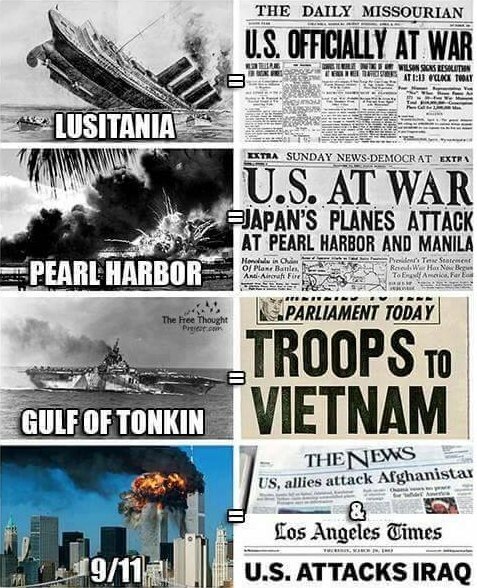
In August 1964, the USS Maddox destroyer was stationed in the Gulf of Tonkin off the coast of North Vietnam.
On August 2, it was attacked by North Vietnamese torpedo boats. And then, two days later, on August 4, the Johnson administration claimed that it had been attacked again. After the second attack, the U.S. Congress passed a resolution almost unanimously allowing the federal government to “take all necessary measures” to protect U.S. forces in Vietnam.
It was as close to a declaration of war that the Johnson administration would ever get. But it was based on a lie.
After decades of public skepticism and government secrecy, the truth finally came out: In the early 2000s, nearly 200 documents were declassified and released by the National Security Agency (NSA).
They showed that there was no attack on August 4. U.S. officials had distorted the truth about the Gulf of Tonkin incident for their own gains — and perhaps for Johnson’s own political prospects.


One dictionary definition of a conspiracy is, “an evil, unlawful, treacherous, or surreptitious plan formulated in secret by two or more persons; plot.”
Another definition reads, “an agreement by two or more persons to commit a crime, fraud, or other wrongful act.”
Some synonyms for conspiracy include plot, scheme, treason, connivance, and treachery.
Based on these definitions, it shouldn’t take much convincing to realize that conspiracies are taking place every day, in every part of the globe, by people of all walks of life. However, one of the greatest tools in the arsenal of those involved in a conspiracy is convincing people that it doesn’t exist (think Keyser Söze in the film The Usual Suspects).
The purpose of this article is to illustrate how major, even global conspiracies can exist without most people knowing. It will provide the ingredients typically included in every conspiratorial recipe to help people recognize them more easily both before and as they occur in real time.



You must be logged in to post a comment.