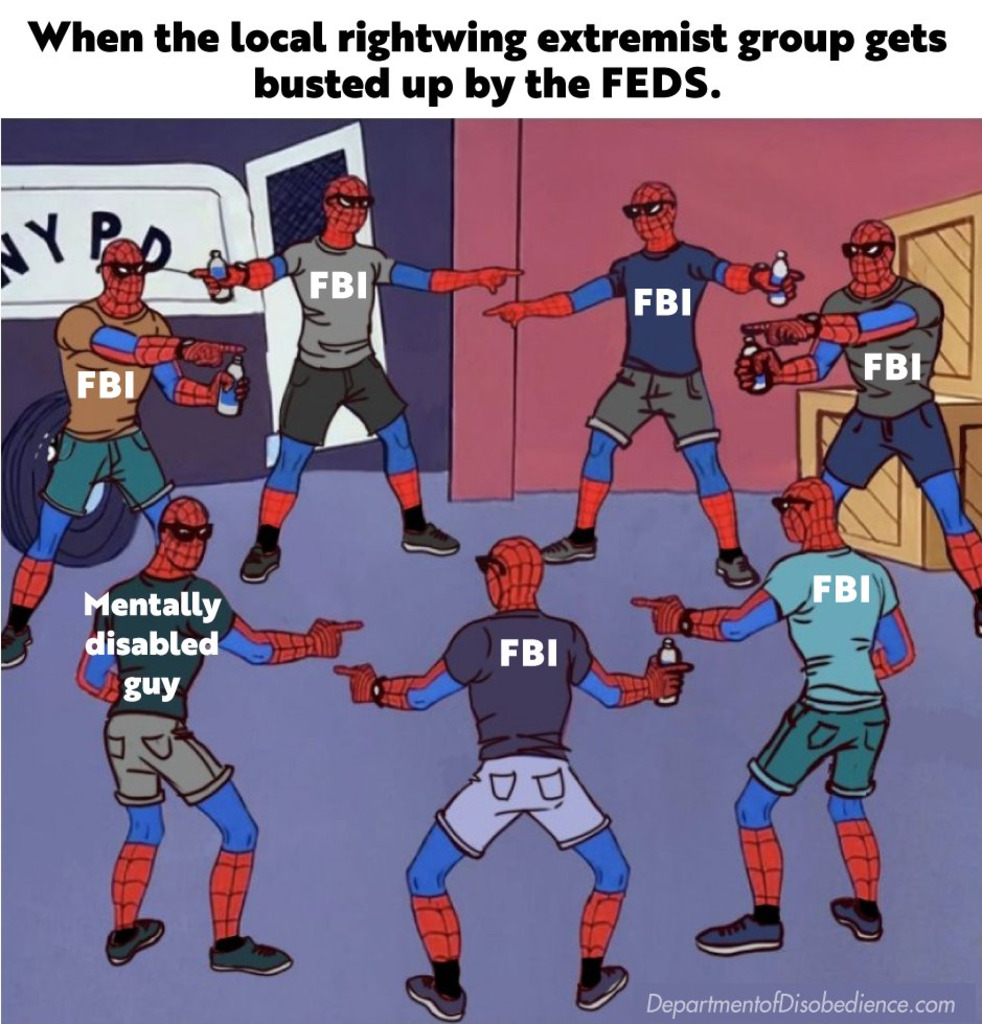
Meme Police: DHS Scanning Employees’ Social Media for ‘Conspiracy Theories,’ ‘Extremism’

The Department of Homeland Security (DHS) published a report recommending an increased focus on scanning the social media accounts of its employees in order to detect “extremism.”

Among the examples of “extremism” cited by DHS are: a belief that fraud occurred in the 2020 election, and objections to current coronavirus policies.

From the DHS report, obtained by Reclaim The Net:

A March 2021 unclassified threat assessment prepared by the Office of the Director of National Intelligence (ODNI), Department of Justice, and DHS, noted that domestic violent extremists “who are motivated by a range of ideologies and galvanized by recent political and societal events in the United States pose an elevated threat to the Homeland in 2021.” The assessment pointed to newer “sociopolitical developments such as narratives of fraud in the recent general election, the emboldening impact of the violent breach of the U.S. Capitol, conditions related to the COVID-19 pandemic, and conspiracy theories promoting violence” that “will almost certainly spur some [domestic violent extremists] [sic] to try to engage in violence this year.”

The report shows increased DHS concern with rooting out “extremists” within its own ranks, including through monitoring the social media accounts of employees.

Keep reading

Mayorkas Releases New Rules on Extremism – DHS Will Target Anyone Who Believes Election Was Stolen or Who Challenged Fauci’s Everchanging COVID Narrative

The new guidelines on extremist behavior include those who question the fraud in the 2020 election and anyone who question the regime’s talking points on COVID and its treatments including the mandates.

A March 2021 unclassified threat assessment prepared by the Office of the Director of National Intelligence (ODNI), Department of Justice, and DHS, noted that domestic violent extremists “who are motivated by a range of ideologies and galvanized by recent political and societal events in the United States pose an elevated threat to the Homeland in 2021.”3 The assessment pointed to newer “sociopolitical developments such as narratives of fraud in the recent general election, the emboldening impact of the violent breach of the U.S. Capitol, conditions related to the COVID-19 pandemic, and conspiracy theories promoting violence” that “will almost certainly spur some [domestic violent extremists] [sic] to try to engage in violence this year.”4

Over half of the US population question the results of the 2020 presidential election.

Another half of the public questions the ever-changing COVID talking points coming from the medical elites including Dr. Fauci who lied under oath about his funding of gain of function research in Chines labs.

If you mention this you may end up on their list.

Keep reading

DOD Issues New Policy on Extremism That Includes ‘Likes’

The Pentagon has updated its policy regarding extremism among military personnel.

The revised policy comes as the result of a Counter Extremist Activity Working Group established in the Spring by Defense Sec. Lloyd Austin.

Officials say the new policy does not seek to focus on any one ideology, thought, or political orientation, but to define more clearly what qualifies as prohibited extremist activity.

A report issued Dec. 20 provides a lengthy definition of “extremist activities” that range from advocating or engaging in political violence to knowingly displaying paraphernalia, words, or symbols in support of extremist activity.

This can include “liking” content on the internet, according to Pentagon press secretary John Kirby.

“The physical act of liking is, of course, advocating,” Kirby told reporters Monday. “And advocating for extremist groups—certainly groups that advocate violating the oath of the Constitution, overthrowing the government, terrorist activities. Liking is an advocation.”

According to the report, extremist activity can include posting, liking, sharing, re-tweeting, or otherwise distributing content—when such action is taken with the intent to promote or otherwise endorse extremist activities.

Keep reading

Facebook Now Sending Messages to Some Users Asking About Potentially ‘Extremist’ Friends

Some Facebook users have recently reported being sent warning messages from the social media giant relating to “extremists” or “extremist content.”

“Are you concerned that someone you know is becoming an extremist?” one message reads. “We care about preventing extremism on Facebook. Others in your situation have received confidential support.”

The message also provides a button to “Get Support,” which leads to another Facebook page about extremism.

Redstate editor Kira Davis, who said was sent a screenshot of the message from a friend, wrote: “Hey has anyone had this message pop up on their FB? My friend (who is not an ideologue but hosts lots of competing chatter) got this message twice. He’s very disturbed.”

Keep reading

New study further debunks “far-right” rabbit hole YouTube narrative

YouTube uses algorithms to suggest videos depending on what you watch. There have been many stories about how YouTube’s recommendation algorithms have “radicalized” people by populating their viewings with a specific subject, particularly when the subjects are “conspiracy theories.”

Yet, these accusations have been accused of being a “conspiracy theory” themselves as several studies have debunked such claims.

A new study published Monday further suggests that video recommendations on YouTube do not radicalize people.

The study focused on whether the alleged radicalization is anecdotal or represented an undeniable trend. The results of the study do not rule out the existence of radicalization through social media. However, it does strongly suggest that this radicalization is not at all common.

Keep reading

United Nations Greenlights Big Tech Mega-Database To Censor Americans Deemed ‘Extremists’

A Big Tech-led group is using its influence and power to broaden its shared censorship database to curb “extremist content” and collect video and images deemed white supremacist, according to Reuters. The expansion comes after the group “took on renewed urgency” after the Jan. 6 Capitol riot, which Democrats and tech giants continue to use as an excuse to justify suppression.

Facebook, Microsoft, Twitter, and YouTube, tech oligarchs trigger-happy to deplatform political dissidents, founded the Global Internet Forum to Counter Terrorism in 2017 in what they labeled “a new collective effort to prevent the spread of terrorist and violent extremist content online.” Initially, the organization claimed to focus its efforts on rounding up content from terrorist organizations such as the Islamic State and the Taliban as designated by the United Nations, but now the monopolies running GIFCT are using their oligarch power to crack down on dissidents of their elitist agenda.

Just five years after its founding, GIFCT is expanding its database to include “white supremacist” content as determined by the United Nation’s Tech Against Terrorism project and intelligence groups such as Five Eyes. According to Reuters, the database will include “attacker manifestos — often shared by sympathizers after white supremacist violence” as well as links and material from Proud Boys, Three Percenters, and other “neo-Nazi” groups that are identified and then censored or removed by social media platforms.

Keep reading

Police To Target Americans For Their Ideological Beliefs And Behaviors

Much has been written about President Joe Biden’s new Domestic Terror law, but nothing I have seen until now shows just how horrifying it is.

To say that the White House uses the Department of Homeland Security (DHS) like political puppets to push their own agenda would be an understatement. The New Yorker chronicled four DHS secretaries who were forced to resign by October 2019, and a fifth who resigned this January.

So when I heard about DHS counterterrorism chief John Cohen having a hard time containing his enthusiasm over Biden’s new domestic terrorism law in a GW Program on Extremism webinar I knew it couldn’t be good.

Ricardo Vazquez Garcia, from Homeland Security Today describes what happened.

Keep reading