Bangladeshi Islamists March in Protest at ‘Western’ Laws Guaranteeing Freedom, Equal Rights for Women

Thousands of angry Islamist men marched Saturday across the streets of the Bangladeshi capital, Dhaka, to protest against proposals guaranteeing equal rights for women in the Muslim-majority country.

“Men and women can never be equal: the Koran outlines specific codes of life for both genders,” protester Mohammad Shihab Uddin, 53, told AFP. He is leader of a women’s madrassa, a religious school.

“There is no way we can go beyond that.”

AP reports leaders of the Hefazat-e-Islam group said the proposed legal reforms – ensuring a range of freedoms for women – are contradictory to Sharia law and an affront to Islam.

More than 20,000 followers of the group rallied near the Dhaka University, some carrying banners and placards reading “Say no to Western laws on our women, rise up Bangladesh.”

Keep reading

Statist Egalitarianism and Patriotism

In his 1963 essay, “The Negro Revolution,” Murray Rothbard observes that by the 1930s and 1940s, American intellectuals had embraced two principles:

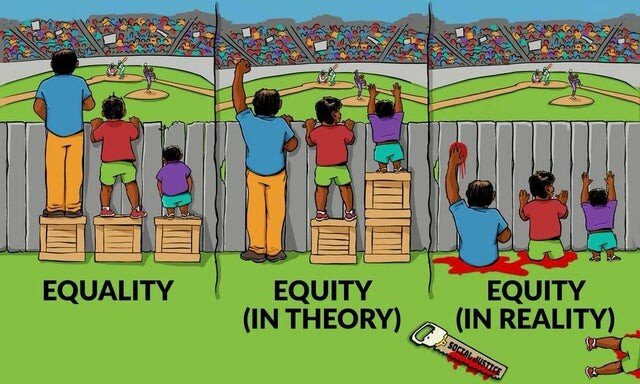
(1) all races and ethnic groups are intellectually and morally equal or identical, and (2) that therefore no one should be allowed to treat anyone else as if they were not equal, i.e., that the State should be used to compel absolute equality of treatment among the races.

As Rothbard points out, the first principle is incorrect, and the second principle is a non sequitur. Even if all human beings were intellectually and morally equal, which they are not, it would not follow that the state should be used to compel equal treatment. Yet these principles have been harnessed for decades to justify federal enforcement of equality. The promotion of equality has, in turn, been depicted as the hallmark of patriotism, with the idea being promoted that equality is an American ideal. Writing in the New York Times in 2013, the economist Joseph Stiglitz depicts equal opportunity as America’s “national myth,” an essential component of America’s “creed.” He decried inequality as a threat to the American dream and an affront to the ideal of America as a land of opportunity:

Without substantial policy changes, our self-image, and the image we project to the world, will diminish – and so will our economic standing and stability. Inequality of outcomes and inequality of opportunity reinforce each other – and contribute to economic weakness, as Alan B. Krueger, a Princeton economist and the chairman of the White House Council of Economic Advisers, has emphasized. We have an economic, and not only moral, interest in saving the American dream.

Upholding the principle of equality is thus depicted as a component of patriotism. The idea that the state has an important role to play in enforcing equality is then said to follow. While state enforcement of equality in its modern form is rooted primarily in the civil rights regime, the antecedents of statist egalitarianism can be traced back to the Reconstruction era, when the federal government set out to “reconstruct” the South.

One of their stated priorities was to ensure that Southerners had “genuinely” accepted their defeat in the war, and to this end, they gave credence to propaganda that any Southern resistance to equal rights for black citizens should be construed as an attempt to reinstate slavery under a different guise. At first glance, it seems bizarre that the government would link attitudes towards racial equality to the outcome of the war, and this notion was indeed regarded with bewilderment and outrage in the South. First, the aim of the war, as they saw it, was to defend their independence. Further, their defeat was decisive – what more could be required by way of “accepting” the outcome, after the surrender of all Confederate armies and the soldiers’ return to their homes and to civilian life? The Confederate generals, in disbanding their armies, had emphasized to their men not only that the war was ended, but that they must do all they could to keep the peace and obey the law:

In his farewell address to his men at Gainesville, Alabama, on May 9, [Lt. General Nathan Bedford] Forrest stated: “I do not think it proper or necessary at this time to refer to causes which have reduced us to this extremity; nor is it now a matter of material consequence to us how such results were brought about. That we are beaten is a self-evident fact, and any further resistance on our part would justly be regarded as the very height of folly and rashness.”

He ended his address by advising his men to “Obey the laws, preserve your honor, and the Government to which you have surrendered can afford to be, and will be, magnanimous.”

Keep reading

Why Equality Is Bad

Many people oppose the free market because it leads to inequality of wealth and income. It is unfair, they say, that some people have vastly more money than others. Some defenders of the free market respond that these inequalities, while undesirable in themselves, make the poor better off than they would be otherwise, and so should be accepted. Another argument made by defenders of the free market is that restricting inequality would interfere liberty, so that, although inequality is bad, we have to put up with it.

While it is true that inequality makes the poor better off and that restricting inequality interferes with liberty, these are not the best arguments that defenders of the free market should use. They accept that inequality is bad, but we should reject this assumption. There is nothing bad about inequality.

People are unequal in every dimension of their being, including weight, height, muscle build, intelligence, and so on. This just the way the world is. Why should we try to change it? People who attempt this have a grudge against the world. They are not satisfied with the way God created it.

And of course they can’t succeed. As the great Murray Rothbard points out, absolute equality is impossible. No two places on earth, for example, offer precisely the same view.

If we shouldn’t defend the free market by arguing that it decreases equality, what should we do? Fortunately, there are many better arguments available. I’m going to list a number of them, but if you want more details, you should read Murray Rothbard’s Power and Market and Ludwig von Mises’s Human Action.

One of the best of these arguments is that the free market makes possible mutually beneficial gains from trade. If I have something that you want and you have something I want, we can make an exchange, so we are both better off. But what if our exchange makes someone else worse off? This question is a version of the “externalities” or “market failure” argument. The claim is that some of our activities, including trade, impose costs on others. If so, this indicates a failure to define property rights. Once we do so, the so-called “problem” dissolves.

Keep reading

The “Equality of Opportunity” Fallacy

Many people argue in this way: The 1964 Civil Rights Act was fine. No one should be discriminated against because of his race or sex. Because blacks and women have suffered such discrimination in the past, it may be that programs like affirmative action are justified, at least temporarily. However, the purpose of these programs should be to promote equality of opportunity. Everybody deserves an equal chance to live a good life or, at any rate, a fair chance.

The problem that has arisen since the passage of the 1964 act, it is further alleged, is that “equality of outcomes or results” has come to replace “equality of opportunity.” This is a socialistic measure that is incompatible with the free market. In short—equality of opportunity, good; equality of results, bad. People who say this differ in the extent to which government intervention is needed to bring about equality of opportunity, with “conservatives” favoring much less intervention than “liberals.” Libertarians, from this perspective, would be those who think that little or no such intervention is needed.Clear, JamesBest Price: $5.25Buy New $9.26(as of 10:30 UTC – Details)

In a column published by the Hoover Institution, David Davenport gives a good statement of this position:

One end of the spectrum is traditional equality of opportunity as envisioned and embraced by the founders. In this view, men and women are created equal and therefore have equal rights, especially political and legal rights. From that starting point, people are free to make their own choices on how, as the Declaration of Independence put it, to pursue happiness. Guaranteeing individual rights, so that people are free to choose, is the primary role of government in this traditional view of equality of opportunity. Paring back the role of government regulation in people’s lives, reducing taxes, and promoting individual freedom was President Reagan’s path back toward this more traditional view and many conservatives still advocate this today.

From a Rothbardian standpoint, it must be said that this way of looking at things is entirely mistaken. People in a libertarian society own themselves and their legitimately acquired property, no more and no less. Everyone has these rights, and in this sense, it is permissible to say that people have equal rights, but to avoid confusion, it is better to say that everyone has the same rights. These rights emphatically do not include the “rights” to equal opportunity or equal results. They emphatically include the right to discriminate against others on grounds of race or sex.

Keep reading

Senate panel votes to make women register for draft

The Senate Armed Services Committee has approved language in its annual defense policy bill that would require women to register for the draft.

The National Defense Authorization Act (NDAA) approved by the committee behind closed doors Wednesday “amends the Military Selective Service Act to require the registration of women for Selective Service,” according to a summary released Thursday.

The United States has not instituted a draft since the Vietnam War, and Pentagon officials have repeatedly said they intend to keep the force all-volunteer.

But men ages 18 through 25 still have to register with what’s officially known as the Selective Service System or  face consequences such as losing access to federal financial aid for college.

Keep reading