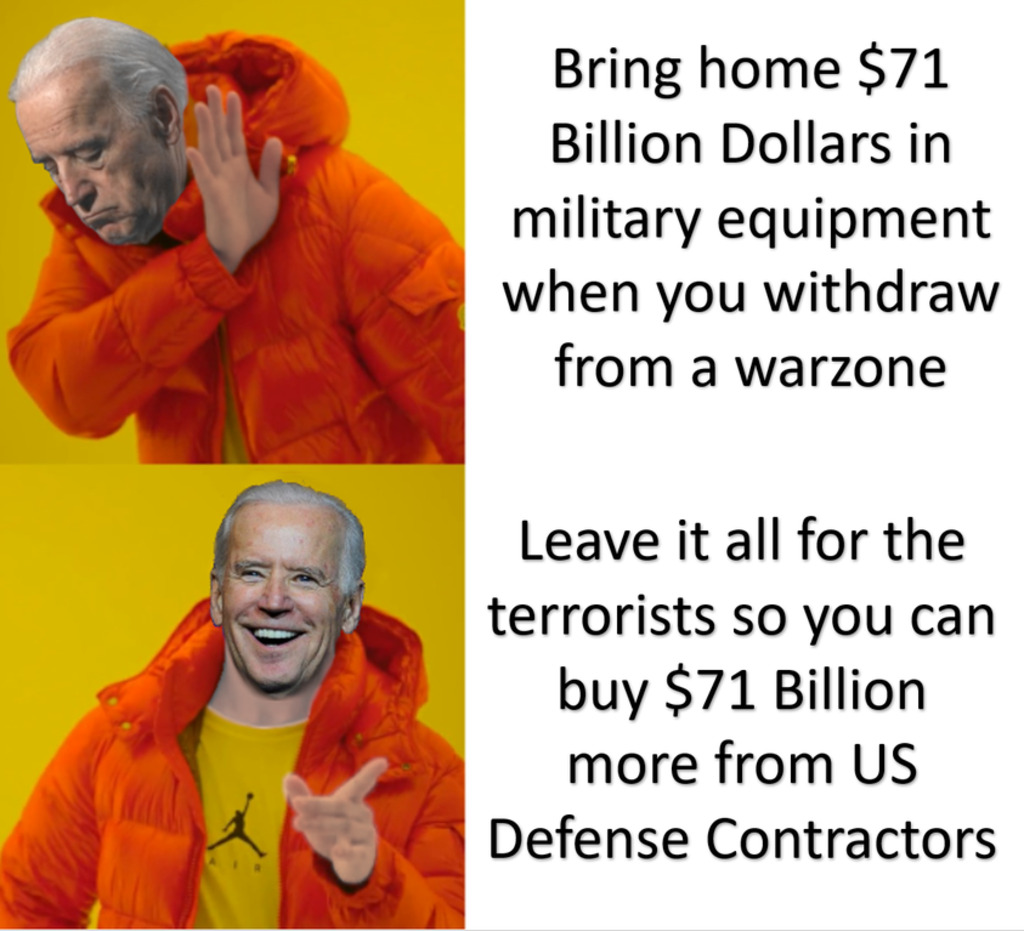
Tax dollars well spent…

Israel unveiled a new remote-controlled killer robot Monday at a major weapons fair in the U.K. that human rights advocates are criticizing as an event to sell “death machines” and tools of abuse.
Developed by Israel Aerospace Industries (IAI), the Rex MK II is a four-wheeled vehicle mounted with two machine guns to carry out remote attacks. According to a press statement from the state-owned company announcing the release, the robot has already been sold to global customers.
The weapon was unveiled Monday at Defence & Security Equipment International (DSEI) in London, an event that occurs every two years and is one of the world’s biggest arms fairs. The weapons expo has faced sustained condemnation from anti-war campaigners who say it’s a venue “where those who profit from war, repression, and injustice do business.”
IAI describes the robot as an unmanned land vehicle that can carry a load of 1.3 tons and execute operations including intelligence gathering using “electro-optical sensors and radar.” It can also be used to launch attacks with “remotely controlled weapons systems including a 7.62mm machine gun” and “a cal 0.50 heavy machine gun,” the company says, and serve “as a multi-mission multi-purpose platform to support additional missions based on troops needs.”
“I spent most of my time being a high-class muscle-man for Big Business, for Wall Street and for the Bankers. In short, I was a racketeer, a gangster for capitalism.” – Major General Smedley Darlington Butler (1881-1940) in his book “War is a Racket” (1935).
The ending of the 20-year-war in Afghanistan, the longest ever engagement in a single conflict by the United States armed forces, has been variously described as a “catastrophe”, a “disaster” and a “debacle”. Yet this national failure from which parallels have been drawn with the Vietnam War has not had the same ring of misfortune for some.
Indeed, long before the recent scenes of calamity and collapse in Kabul brought home with resounding finality the futility of a supposed nation-building exercise, the profit-motive for the initial US invasion and the preservation of an enduring occupation was an open secret to anyone who bothered to embark on the slightest inquiry.
The gravy train of American defence spending was in full effect, facilitated by the tentacles of what US President Dwight D. Eisenhower prophesied would become the Military Industrial Complex. For the last two decades have witnessed what has been described as a “wealth transfer from US taxpayers to military contractors”. But the war, apart from confirming Afghanistan’s reputation as the “Graveyard of Empires”, also validates the phrase coined by US Major General Smedley Butler that war is a racket.
The blame game currently being played out in the United States media by the political class risks obscuring one fundamental issue: the centrality of money and the profit motive in the waging of America’s two-decade-long war in Afghanistan.
The invasion of that country had been planned well in advance of the attacks of September 11th, 2001, the event which provided the impetus for mounting a military response including the country’s occupation. The United States has long coveted gaining access to the mineral and oil rich Caspian region and Central Asia, and the coming to power of the fundamentalist Islamic Taliban movement was not seen at the time by US policy makers as an impenetrable obstacle.
As the French writers Jean-Charles Briscard and Guillaume Dasquie wrote in their book Forbidden Truth: U.S.-Taliban Secret Oil Diplomacy and the Failed Hunt for Bin Laden, which was published in 2002, the American government had been prepared to accept Taliban rule on condition that they agreed to the construction of an oil pipeline across Central Asia.
Since U.S. military actions in Afghanistan were authorized in September 2001, the stocks of the top five defense companies have risen in value by an average of nearly 900%, strongly outperforming the S&P 500 index.
Among those who have benefitted from investments in the stocks are nearly four dozen members of Congress, the people who approve funding for the contracts that make up the bulk of the companies’ revenues.
At least 47 members of Congress and their spouses hold between $2 million and $6.7 million worth of stock in companies that are among the top 100 defense contractors, a Sludge analysis of financial disclosures found.
The war in Afghanistan has caused an estimated up to 174,000 direct war deaths, according to the Costs of War Project, with economic costs reaching over $2.26 trillion there and in Pakistan. The total cost of post-9/11 wars including Iraq and other operations has surpassed $6.4 trillion through last year.
At least 11 U.S. senators hold up to $1.7 million in defense industry stocks and at least 36 U.S. representatives hold a maximum value of over $5 million. Congress only reports its investments in broad ranges, so it’s not possible to know exactly how much their stocks are worth. Members of Congress have at least 108 investments in 16 major defense contractors, including all of the top 10 companies by defense revenue.
The Taliban’s stunning takeover of Afghanistan in the aftermath of a bungling US departure has led many to conclude the war in Afghanistan ended in failure. But it is unlikely to be a view shared by many in the US military.
For them, the twenty-year-long conflict has been a massive success.
When discussing the politics of war, a central premise is often put forward: Cui bono? Who benefits? John Boyd, a former Air Force fighter pilot famously expounded on a theory where there was no contradiction between the military’s stated mission and disregard for combat success:
“People say the Pentagon does not have a strategy,” he said. “They are wrong. The Pentagon does have a strategy. It is ‘Don’t interrupt the money flow, add to it.’”
And add to it they did.

Raytheon, the nation’s second-largest defense contractor, has launched a critical race theory program that encourages white employees to confront their “privilege,” reject the principle of “equality,” and “defund the police.”
WOW!
A defense contractor wants to defund the police, is racist against white people, demands inequality, and rejects this country’s values.
Under the guise of anti-racism, they are pushing racism. White people are singled out and have to sign a pledge to check their biases? Not black people? It centers on the quite evil intersectionality and divides people according to race, religion, sex, gender, and so on.
For the second time in the five months since he was inaugurated, President Joe Biden on Sunday ordered a U.S. bombing raid on Syria, and for the first time, he also bombed Iraq. The rationale offered was the same as Biden’s first air attack in February: the U.S., in the words of Pentagon spokesman John Kirby, “conducted defensive precision airstrikes against facilities used by Iran-backed militia groups in the Iraq-Syria border region.” He added that “the United States acted pursuant to its right of self-defense.”
Embedded in this formulaic Pentagon statement is so much propaganda and so many euphemisms that, by itself, it reveals the fraudulent nature of what was done. To begin with, how can U.S. airstrikes carried out in Iraq and Syria be “defensive” in nature? How can they be an act of “self-defense”? Nobody suggests that the targets of the bombing campaign have the intent or the capability to strike the U.S. “homeland” itself. Neither Syria nor Iraq is a U.S. colony or American property, nor does the U.S. have any legal right to be fighting wars in either country, rendering the claim that its airstrikes were “defensive” and an “act of self-defense” to be inherently deceitful.

Marines scored a direct hit in a first-ever live-fire test in which they launched a Navy missile from the back of an unmanned tactical vehicle to strike a surface target at sea.
The Marine Corps has combined two existing technologies to produce a deadly new way to hit targets offshore. Coined NMESIS, the Navy Marine Expeditionary Ship Interdiction System can launch naval strike missiles from the back of a modified Joint Light Tactical Vehicle, or JLTV, to destroy targets on land or at sea.
Raytheon Missiles and Defense, which makes the naval strike missile, announced Wednesday that the Marine Corps used NMESIS to hit a target in the water from Point Mugu Sea Range in California. The missile can take out targets from more than 100 nautical miles away.
 Hellbound and Down
You must be logged in to post a comment.