Patel aims to protect civil liberties, reform the FBI to prevent serial weaponized spying

Director Kash Patel says his team is working on implementing new civil liberties protections at the FBI and touted his effort to refocus the bureau after confirmation that the investigative agency collected expansive phone data on Republican senators, House members, staff, and White House officials. 

He said his team has, or is currently working on, implementing new civil liberties protections at the FBI and touted his effort to refocus the bureau on its core mission. 

“We’ve ended that regime,” Patel told Just the News in a wide-ranging interview with the Just the News, No Noise TV show which aired on Wednesday. 

30 million lines of telephone data

Earlier this month, Just the News reported that the FBI collected call data on Republican senators and one House member as part of Special Counsel Jack Smith’s investigation into the January 6 Capitol riot. 

Just the News also reported on Tuesday that congressional investigators had collected 30 million lines of phone data mapping contacts between conservatives and the Trump White House in the name of investigating the Jan. 6 Capitol breach. The data was later offered to the bureau on the eve of the 2024 election. 

Patel: “It is law enforcement first”

“We’ve already implemented changes. We’ve already informed Congress we won’t be grabbing their cell phone records or their staff or cell phone records for just a sense of weaponization,” Patel said. 

He told Just the News a big part of preventing these abuses in the future is refocusing the agency on its core mission, to enforce the law and investigate crimes. 

“So the good news about this FBI, it is mission focused,” Patel said. “It is law enforcement first, and it doesn’t matter if you’re red or blue or in between, or where you live, we are going to come in and root out not just criminality, but corruption in every single town in this country.”

Internal documents unearthed by Patel’s FBI and turned over to Congress showed that Special Counsel Smith obtained the phone records from eight senators and one House member in President Trump’s orbit. 

Keep reading

Ross Ulbricht: Implications for the Future of Freedom in America

In 2011, Ross Ulbricht founded the website Silk Road.

It was a cleverly designed online marketplace that leveraged decentralized technologies like Tor and Bitcoin to establish an anonymous and completely free market without government interference.

Much to the chagrin of politicians like Chuck Schumer, the Silk Road operated openly and successfully for about two and a half years.

Eventually, the government managed to identify Ross, arrest him, and shut down the Silk Road.

What’s your perspective on the concept of the Silk Road and the government’s response to it?

Keep reading

Rule by Decree: The Emergency State’s Plot to Override the Constitution

We have become a nation in a permanent state of emergency.

Power-hungry and lawless, the government has weaponized one national crisis after another in order to expand its powers and justify all manner of government tyranny in the so-called name of national security.

COVID-19, for example, served as the driving force behind what Supreme Court Justice Neil Gorsuch characterized as “the greatest intrusions on civil liberties in the peacetime history of this country.”

In a statement attached to the Supreme Court’s ruling in Arizona v. Mayorkas, a case that challenged whether the government could continue to use it pandemic powers even after declaring the public health emergency over, Gorsuch provided a catalog of the many ways in which the government used COVID-19 to massively overreach its authority and suppress civil liberties:

Executive officials across the country issued emergency decrees on a breathtaking scale. Governors and local leaders imposed lockdown orders forcing people to remain in their homes. They shuttered businesses and schools, public and private. They closed churches even as they allowed casinos and other favored businesses to carry on. They threatened violators not just with civil penalties but with criminal sanctions too. They surveilled church parking lots, recorded license plates, and issued notices warning that attendance at even outdoor services satisfying all state social-distancing and hygiene requirements could amount to criminal conduct. They divided cities and neighborhoods into color-coded zones, forced individuals to fight for their freedoms in court on emergency timetables, and then changed their color-coded schemes when defeat in court seemed imminent.

“Federal executive officials entered the act too.  Not just with emergency immigration decrees. They deployed a public-health agency to regulate landlord-tenant relations nationwide. They used a workplace-safety agency to issue a vaccination mandate for most working Americans.  They threatened to fire noncompliant employees, and warned that service members who refused to vaccinate might face dishonorable discharge and confinement.  Along the way, it seems federal officials may have pressured social-media companies to suppress information about pandemic policies with which they disagreed.

“While executive officials issued new emergency decrees at a furious pace, state legislatures and Congress—the bodies normally responsible for adopting our laws—too often fell silent.  Courts bound to protect our liberties addressed a few—but hardly all—of the intrusions upon them. In some cases, like this one, courts even allowed themselves to be used to perpetuate emergency public-health decrees for collateral purposes, itself a form of emergency-lawmaking-by-litigation.”

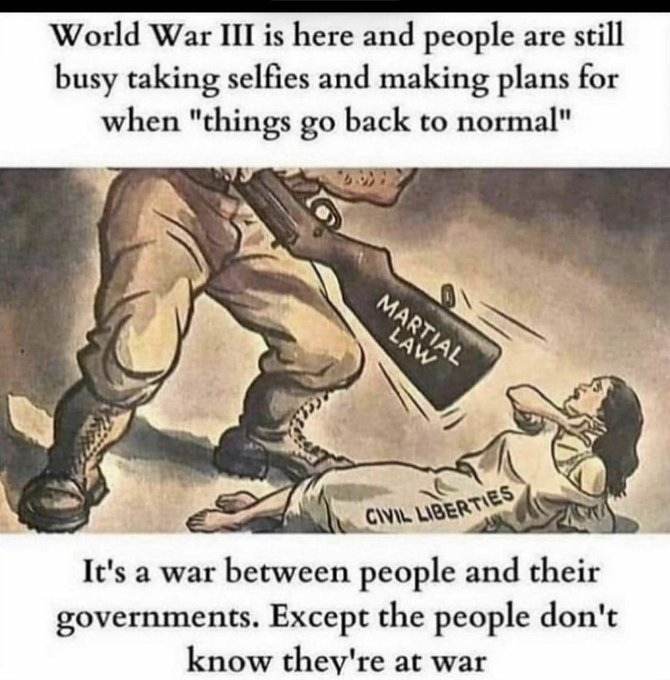
Yet while the government’s (federal and state) handling of the COVID-19 pandemic delivered a knockout blow to our civil liberties, empowering the police state to flex its powers by way of a bevy of lockdowns, mandates, restrictions, contact tracing programs, heightened surveillance, censorship, overcriminalization, etc., it was merely one crisis in a long series of crises that the government has shamelessly exploited in order to justify its power grabs and acclimate the citizenry to a state of martial law disguised as emergency powers.

Keep reading

WHO Group Co-Chair Calls For “Prioritizing Actions That May Restrict Individual Liberties”

During a meeting last week, a co-chair of a World Health Organization (WHO) working group that’s focused on international law amendments that would increase the WHO’s powers, took the power grab a step further by urging members to prioritize “actions that may restrict individual liberties.”

The co-chair of the WHO’s working group on amendments to the International Health Regulations (2005), Dr. Abdullah Assiri, made the comments during a strategic roundtable at the seventy-sixth World World Health Assembly (an annual meeting of the WHO’s decision-making body).

During the strategic roundtable, WHO members discussed the international pandemic treaty and amendments to the International Health Regulations — two instruments that will collectively expand the WHO’s powers to target “misinformation,” increase its surveillance powers, and push global vaccine passports.

Assiri provided an update on the WHO’s progress with the IHR amendments before suggesting that individual liberties should be curtailed by this unelected health agency.

Keep reading

COVID emergency orders are among `greatest intrusions on civil liberties,′ Justice Gorsuch says

The Supreme Court got rid of a pandemic-related immigration case with a single sentence.

Justice Neil Gorsuch had a lot more to say, leveling harsh criticism of how governments, from small towns to the nation’s capital, responded to the gravest public health threat in a century.

The justice, a 55-year-old conservative who was President Donald Trump’s first Supreme Court nominee, called emergency measures taken during the COVID-19 crisis that killed more than 1 million Americans perhaps “the greatest intrusions on civil liberties in the peacetime history of this country.”

He pointed to orders closing schools, restricting church services, mandating vaccines and prohibiting evictions. His broadside was aimed at local, state and federal officials — even his colleagues.

“Executive officials across the country issued emergency decrees on a breathtaking scale,” Gorsuch wrote in an eight-page statement Thursday that accompanied an expected Supreme Court order formally dismissing a case involving the use of the Title 42 policy to prevent asylum seekers from entering the United States.

The policy was ended last week with the expiration of the public health emergency first declared more than three years ago because of the coronavirus pandemic.

From the start of his Supreme Court tenure in 2017, Gorsuch, a Colorado native who loves to ski and bicycle, has been more willing than most justices to part company with his colleagues, both left and right.

Keep reading

The Power of Silence: How and Why You Should Never Talk to Police

The issue of police abuse and violence towards people for victimless crimes is one that cannot be ignored. The police state is growing, and with it, so is the amount of aggression and force used against citizens who have not committed any actual harm to others.

It is concerning that many police officers seem to prioritize their own interests over the safety and well-being of citizens. As a result, there have been numerous cases of police brutality and misconduct, including unnecessary use of force and even fatalities. This has further eroded trust between law enforcement and the communities they are supposed to serve.

Furthermore, the police have a financial incentive to make arrests and generate revenue for the state, often at the expense of the rights and dignity of individuals. Many officers engage in tactics such as fishing for information and coercing confessions from individuals who may not fully understand their rights or who feel intimidated by the authority of law enforcement.

It is important to hold law enforcement accountable for their actions and to demand reform that prioritizes the protection and rights of all citizens. This can include advocating for increased transparency and accountability, as well as pushing for changes in policing tactics and training that prioritize de-escalation and community engagement.

These issues are why it is so important to always assert your 5th Amendment right to remain silent during police interactions, especially given the fact that many police officers are not very good at their jobs and need the help and participation of citizens to do their job effectively. This is particularly evident in the fact that roughly 90% of all arrests are self-incriminated. If the police can legally charge you with information they have gathered without your help, then let them try, but most of the time they require your help to incriminate yourself. By simply not talking, you have a 90% less chance of going to jail. By invoking your right to remain silent, you can protect yourself from self-incrimination and others around you who might be with you; talking can also incriminate other people like passengers and even your friends.

Ultimately, the role of law enforcement should be to serve and protect communities. Unfortunately, that is not the reality, especially when considering that the U.S. Supreme Court has ruled that police have no specific obligation to protect individuals, as demonstrated in its 1989 decision in DeShaney v. Winnebago County Department of Social Services ruling. Instead, they often act as an oppressive force that intimidates and abuses citizens, particularly in cases involving victimless actions. By holding police accountable for their actions and advocating for reform, we can work towards creating a more just and equitable society for all.

Keep reading

Canada’s finance minister created a blacklist of trucking companies that participated in the protest for civil liberties

Canada’s Finance Minister Chrystia Freeland’s office distributed a blacklist of 201 trucking companies that participated in the Freedom Convoy Protest in February.

“Please find attached an excel sheet detailing which companies whose trucks are participating in Ottawa convoy demonstrations,” an unidentified employee at Freeland’s office wrote in an email, according to Blacklock’s Reporter.

“A total of 45 companies whose trucks are in Ottawa have accessed the Canada Emergency Wage Subsidy out of a total of 201 companies whose trucks are publicly known as being in Ottawa. Three of the companies with trucks in Ottawa are US-based companies.”

The blacklist was sent the same day that the government invoked the Emergencies Act, February 14. The Emergencies Act allowed the government to order financial institutions to freeze the accounts of businesses and individuals involved in the protest without a court order.

“In doing so, [the financial institutions] will be protected against civil liability for actions taken in good faith,” Freeland said at a press conference on February 14. She added that the government would freeze the accounts of trucking companies if their trucks are found to be taking part in the protest.

Blacklock’s Reporter also obtained internal documents showing that Freeland proposed that people who had their accounts frozen should first report to the police before their accounts are unfrozen.

Keep reading