
Betcha didn’t know that…

A retired Air Force official in charge of one of its most famous UFO research efforts said before his death last year that the effort may have been scuttled not because it was fruitless, but just the opposite.
In a clip from the new documentary “The Phenomenon,” Lt. Col. Robert Friend pointed to the sudden closure of Project Blue Book in 1969.
“Which would suggest what?” he asked before answering his own question: “That they knew what it was.”
James Fox, the film’s director added: “Or didn’t know what it was.”
But Friend, who led Project Blue Book from 1958-1963, persisted.
“Also the other way,” Friend replied with a telling grin. “That they did know what it was.”

Donald Trump did not deny media reporting that the US Department of Defense has set up a task force to examine “unidentified alien phenomena” after the Air Force released a video earlier this year showing pilots flying by what many people have speculated was a UFO.
“Can you explain why the Department of Defense has set up a UFO task force?” Fox News host Maria Bartiromo asked Mr Trump in an interview on Sunday.
“Are there UFOs?” she asked.
“Well, I’m going to have to check on that. I mean, I’ve heard that. I heard that two days ago. So I’ll check on that. I’ll take a good, strong look at that,” Mr Trump said.
He then quickly segued into a boast about US military might, which some people on Twitter took to be the president threatening aliens with human weaponry.
“I will tell you this, we now have created a military the likes of which we’ve never had before, in terms of equipment. The equipment that we have, the weapons that we have, and hopefully — hope to god we never have to use them,” Mr Trump said.
A secret dossier that details one of Britain’s most famous UFO sightings is to be kept secret for another 50 years.
It apparently contains incredible colour photos taken in 1990 that allegedly show a 100ft craft hovering over Calvine in the Scottish Highlands.
Two hikers were walking in the area when suddenly they say they saw a diamond shaped aircraft over the landscape before speeding off into the distance.
The two hikers took pictures of the craft and immediately contacted journalists from the Scottish Daily Record Newspaper.
After viewing their photos, the journalists chose to share both pictures and negatives with the Ministry of Defence.
A 30-year rule meant the file was meant to be declassified in January next year, but the Ministry of Defence has now blocked its release for another 50 years, until 2072.
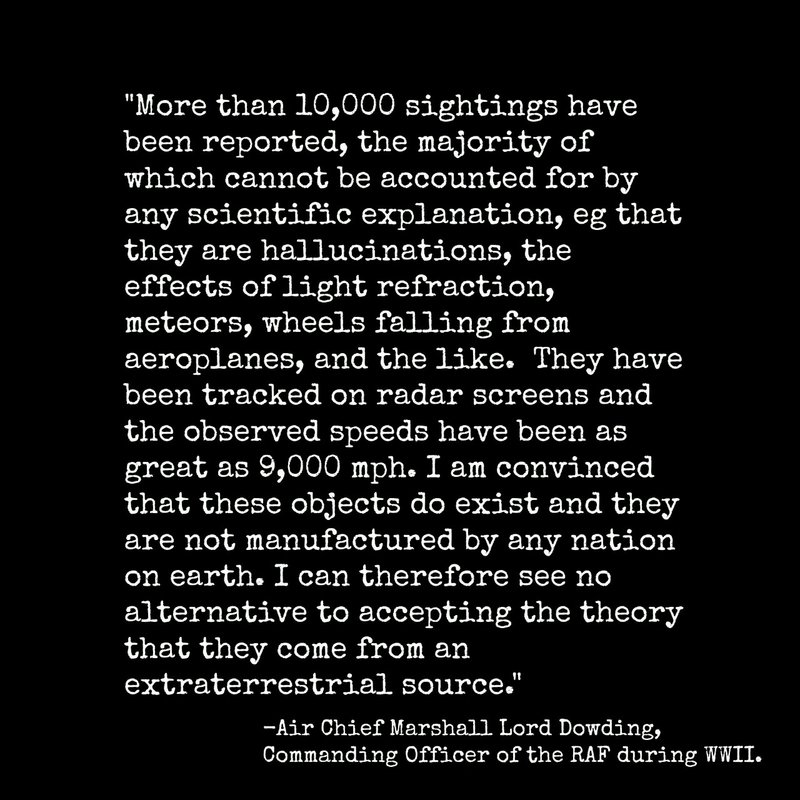

The existence of UFOs may seem like the exclusive domain of science fiction, but as Representative John Moss of California laid the groundwork for legislation that eventually became the Freedom of Information Act (FOIA) in 1966, he didn’t discriminate in his pursuit to open as much government information as possible to the public.
During the 1950s and 1960s, as the House held hearings and debated the scope of Moss’s legislation, the Special Government Information Subcommittee and the Foreign Operations and Government Subcommittee (FOGI) of the Committee on Government Operations, both of which were chaired by Moss, addressed a deceptively simple problem. Every year the federal government produced vast amounts of information. But of that mountain of data, the subcommittee needed to know what the government could (or should) release, as well as what federal officials should (or had) to restrict.
A sample page from Project Blue Book depicting an alleged UFO sighting.The subcommittees fielded thousands of requests from the public, newspapers, and other Members of Congress on every imaginable topic, from Amelia Earhart to ballistic missiles to frozen foods. Of the organizations that contacted the FOGI Subcommittee, two stand out: Flying Saucers International and the National Investigations Committee on Aerial Phenomena. Surprising? Yes, but consider this: In the decade before FOIA became law, the United States and the Soviet Union spent an immense amount of money developing programs to send defense technology and eventually people into outer space. By mid-century, whatever existed beyond Earth’s atmosphere actually seemed within reach, and the idea—the very possibility—that “unidentified flying objects” were zooming around the galaxy captured the public imagination. Many people who believed in UFOs were also convinced the Air Force knew about them too, and that the military had kept their existence secret. Anxious Americans considered this a major problem: What if the Russians somehow got access to extraterrestrial technology and used it against the United States? And didn’t defense personnel need confirmation that UFOs existed and the training to distinguish them from planes and missiles so that accidental war with the Soviet Union might be prevented?
Protocol for UFOs? That’s exactly what Defense Minister Taro Kono ordered the Self-Defense Forces to follow Monday as he issued standing orders for dealing with unidentified aerial objects that could pose a threat to Japan’s security.
In a statement, Kono asked SDF members to record and photograph any such objects that they encounter or that enter Japanese airspace and to take steps for the “necessary analysis” of the sightings, including information provided separately by the public.
While the Defense Ministry says there have been no known cases of the SDF encountering UFOs, the latest move comes after the U.S. Defense Department established a special Unidentified Aerial Phenomena Task Force last month in order “to improve its understanding of, and gain insight into, the nature and origins” of the objects and other phenomena.
The Pentagon also released videos in April that were taken in 2004 and 2015, including one that showed an elliptical flying object that demonstrated unseen levels of speed and maneuverability.
Kono said after the videos’ release that he does not believe in UFOs.
 Hellbound and Down
You must be logged in to post a comment.