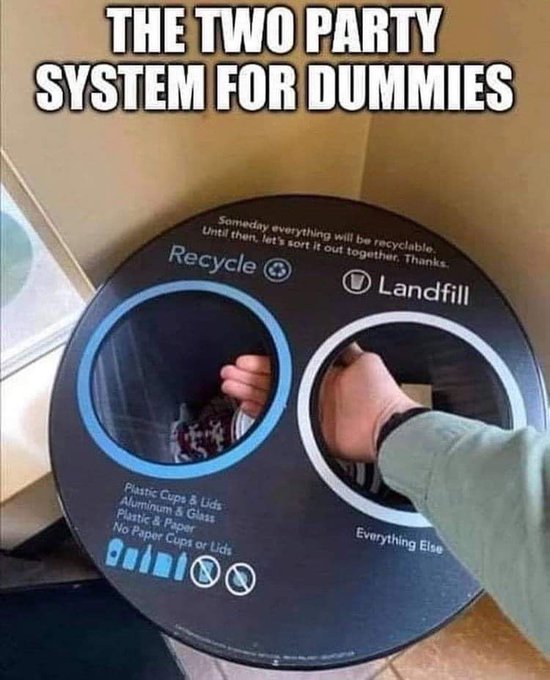
Recycling Eco-Myths Is The Existential Threat

By promising a relatively simple solution to an alleged problem, it has enabled the left to control behavior through a made-up morality that stigmatized dissent – Only bad people refuse to recycle.

Like most progressive interventions – from welfare policies that destroyed families while increasing dependency, to drug use reforms that have filled city streets with desperate addicts – recycling plans that sound good on paper (and plastic) have continuously collided with reality so that even liberal outlets such as the New York Times (“Your Recycling Gets Recycled, Right? Maybe, or Maybe Not”), NPR (“Recycling plastic is practically impossible — and the problem is getting worse”) and the Atlantic magazine (“Plastic Recycling Doesn’t Work and Will Never Work”) have finally admitted its failures.

The same dynamic is now at work regrading a far more significant green fantasy: the left’s push to decarbonize the U.S. and other Western industrial economies during the next few decades and attain an eco-purity calculus known as Net Zero. While brandishing the moral cudgel with full force – President Biden describes climate change as “an existential crisis,” i.e., every person and puppy will die if we don’t submit to his agenda – the left also suggests the transition will be easy-peasy: Just build some windmills, install some solar panels, and swap out your car, stove, and lightbulbs for cleaner and cheaper alternatives.

Though much of the cheerleading media downplays this fact, it is already clear that Biden’s enormously expensive, massively disruptive goal is a pipe dream. In a recent series of articles, my colleagues at RealClearInvestigations have reported on several of the seemingly intractable problems that the administration and its eco-allies are trying to wish away.

The dishonesty begins with the engine of the green economy – the vast array of wind and solar farms that must be constructed to replace the coal and gas facilities that power our economy. James Varney reported for RCI that the Department of Energy’s official line is that the installations required to meet Biden’s goal of “100% clean electricity” by 2035 will require “less than one-half of one percent of the contiguous U.S. land area” – or roughly 15,000 of the lower 48’s roughly 3 million square miles. However, Varney noted, “the government report that furnished those estimates also notes that the wind farm footprint alone could require an expanse nine times as large: 134,000 square miles. That is equivalent to the land mass of Ohio, Indiana, and Kentucky combined – plus all of New England.

Echoing the 19th century adage that figures don’t lie, but liars figure, the discrepancy mostly involves estimates of what can be built around the windmills. Each turbine’s footprint is relatively small, but they have to be spaced far apart. The DOE’s smaller number is based on the fanciful assumption that all the surrounding land can be used for agriculture and other purposes, while the larger figure assumes none of it will. The truth probably is somewhere in between. That the government is trumpeting the impossibly small number – while ignoring the additional land needed to build transmission lines which will carry the current to end users – is telling and troubling.

Keep reading

They Promised “Advanced Recycling” for Plastics and Delivered Toxic Waste

HEAD SOUTH ON state Highway 96, past a stretch of soybean crops and tobacco fields, and you’ll arrive in Zebulon, North Carolina, population 8,665. There, on a quiet stretch of Industrial Drive, sits a nondescript commercial building. It’s easy to miss; the name on the front door is barely legible. But atop that humble three-acre lot lies a leading solution to the global plastic pollution crisis — well, according to the plastic industry.

The facility is home to the 24-hours-a-day, 7-days-a-week operations of Braven Environmental, a company that says it can recycle nearly 90 percent of plastic waste through a form of chemical recycling called pyrolysis. Traditional recycling is able to process only about 8.7 percent of America’s plastic waste; pyrolysis uses high temperatures and low-oxygen conditions to break down the remaining plastics, like films and Styrofoam, ideally turning them into feedstock oil for new plastic production.

The American Chemistry Council, the country’s leading petrochemical industry trade group, claims that chemical recycling will create a “circular economy” for the bulk of the world’s plastic, diverting it from oceans and landfills. Plastic giants have gone so far as to dub the process “advanced recycling,” but environmentalists say this is a misnomer because the majority of the plastic processed at such facilities is not recycled at all. In fact, researchers have found that the process uses more energy and has a worse overall environmental impact than virgin plastic production. Numerous companies have tried and failed to prove that chemical recycling is commercially viable.

Despite these challenges, lawmakers nationwide are now embracing the technology, thanks to a massive lobbying push from the ACC and other petrochemical groups. As of September, 24 states have passed industry-backed bills that reclassify chemical recycling as manufacturing. The change effectively deregulates the process, since manufacturing facilities tend to face less stringent guidelines than waste incinerators.

As one of only seven commercial facilities currently operating in the United States, Braven Environmental is at the vanguard of the growing chemical recycling boom. An Intercept investigation, however, found numerous issues at its Zebulon facility.

Keep reading

Recycle THIS! Greenpeace admits plastic should just be thrown away

The green agenda across America has taken a huge hit, with a report confirming that Greenpeace is admitting that recycling plastic as “largely failed.”

The City-Journal cited the environmental organization’s recent report that was headlined, warningly, “Plastic Recycling Is A Dead-End Street – Year After Year, Plastic Recycling Declines Even as Plastic Waste Increases.”

The Greenpeace article found: “Mechanical and chemical recycling of plastic waste has largely failed and will always fail because plastic waste is: (1) extremely difficult to collect, (2) virtually impossible to sort for recycling, (3) environmentally harmful to reprocess, (4) often made of and contaminated by toxic materials, and (5) not economical to recycle.”

“This has been obvious for decades to anyone who crunched the numbers, but the fantasy of recycling plastic proved irresistible to generations of environmentalists and politicians. They preached it to children, mandated it for adults, and bludgeoned municipalities and virtue-signaling corporations into wasting vast sums—probably hundreds of billions of dollars worldwide—on an enterprise that has been harmful to the environment as well as to humanity,” the City-Journal reported.

Keep reading

Wind Turbine Blades Can’t Be Recycled, So They’re Piling Up in Landfills

A wind turbine’s blades can be longer than a Boeing 747 wing, so at the end of their lifespan they can’t just be hauled away. First, you need to saw through the lissome fiberglass using a diamond-encrusted industrial saw to create three pieces small enough to be strapped to a tractor-trailer.

The municipal landfill in Casper, Wyoming, is the final resting place of 870 blades whose days making renewable energy have come to end. The severed fragments look like bleached whale bones nestled against one another.

“That’s the end of it for this winter,” said waste technician Michael Bratvold, watching a bulldozer bury them forever in sand. “We’ll get the rest when the weather breaks this spring.”

Tens of thousands of aging blades are coming down from steel towers around the world and most have nowhere to go but landfills. In the U.S. alone, about 8,000 will be removed in each of the next four years. Europe, which has been dealing with the problem longer, has about 3,800 coming down annually through at least 2022, according to BloombergNEF. It’s going to get worse: Most were built more than a decade ago, when installations were less than a fifth of what they are now.

Keep reading